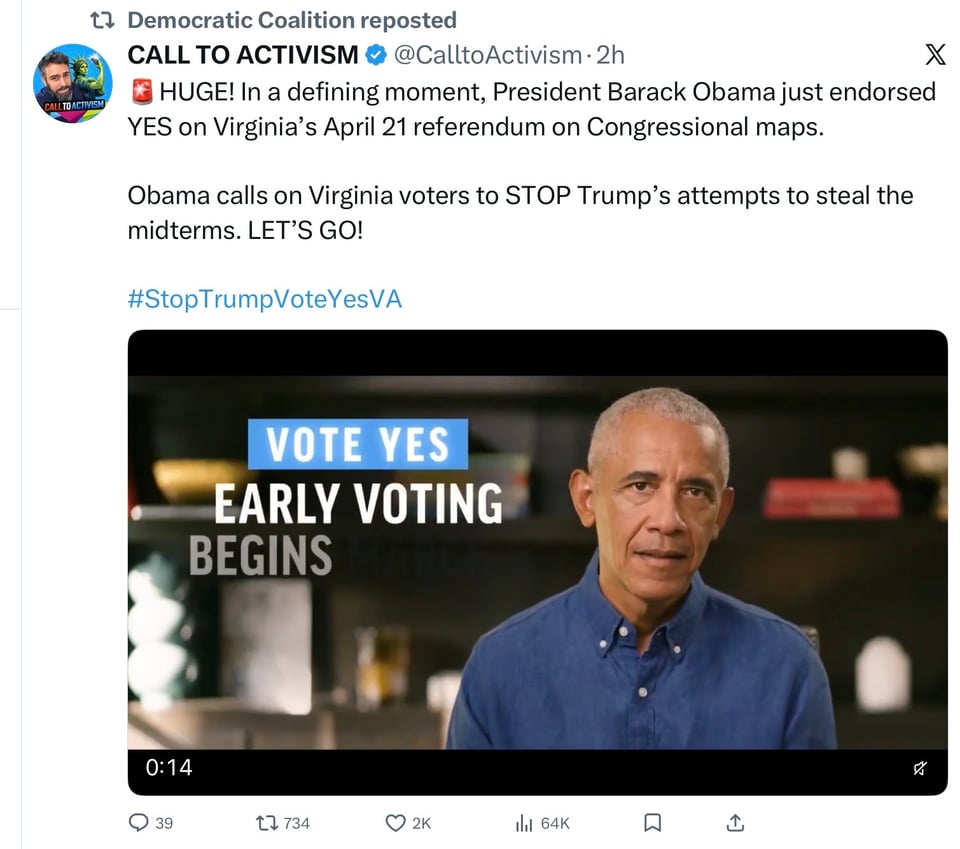
Thursday, April 9, 2026. Annette’s Roundup for Democracy.
Another bad Election Day for dangerous TACO and his cult.
Warnings for the G.O.P.: 3 Takeaways From the Elections in Georgia and Wisconsin.
A Republican won Marjorie Taylor Greene’s seat, but Democrats shifted the district 25 points to the left since the 2024 presidential race. Conservative candidates lost in Wisconsin, too.
On Tuesday night, voters in a conservative and rural corner of Georgia sent a Republican, Clay Fuller, to Congress to replace Marjorie Taylor Greene. But they did so with decidedly less enthusiasm than they showed two years ago: All 10 of the district’s counties shifted by double digits toward the Democratic candidate compared with the 2024 presidential election.
And in Wisconsin, voters again handed a liberal Supreme Court candidate, Chris Taylor, a commanding victory over a conservative rival, cementing a five-to-two liberal majority on the state’s high court. Judge Taylor’s victory came by an even wider margin than the 2023 and 2025 liberal triumphs in Wisconsin Supreme Court elections that drew national attention and served as magnets for political donors.
Georgia’s special election had the largest shift toward Democrats, about 25 points, of any congressional contest since President Trump took office at the beginning of 2025. It came a year after Wisconsin’s last state Supreme Court race brought the first Democratic rebuke of Mr. Trump’s second term.
Here are three takeaways from the Tuesday night results:
A Big Shift in Georgia
Mr. Fuller won comfortably in a special election that was never much in doubt. But Republicans elsewhere will take note that a district where Mr. Trump took 68 percent of the vote in 2024 swung 25 points away from Mr. Fuller on Tuesday.
The shift is a potential harbinger for Republicans in this year’s midterm elections. Nearly two dozen House Republicans won their 2024 races by 10 points or less. The Senate map includes seats in Alaska, Iowa, Ohio and Texas that could be in play if the Democratic advantage proves to be durable through November. Georgia Democrats also saw the outcome as a boost for Senator Jon Ossoff, who is seeking re-election this fall.
Turnout, of course, is expected to be higher in November than in any special election. Torrents of money will materialize that was not present in a Georgia special election Republicans were certain to win. But Mr. Trump tried to help Mr. Fuller. He offered a full endorsement and traveled to the district for a rally in February.
Shawn Harris, the Democrat who lost to Mr. Fuller, declared victory anyway.
“If Democrats, independents and Republicans can do this in a ruby-red district, the Democrats can win anywhere,” Mr. Harris said Tuesday night after his defeat. “Nobody ever thought that we would ever be this close.” (New York Times, to read the full article, click the blue link above ☝️.)
As Politico said in evaluating Tuesday’s Election Returns,
“Democrats just had one of their best election nights since President Donald Trump returned to the White House.”
One more time.
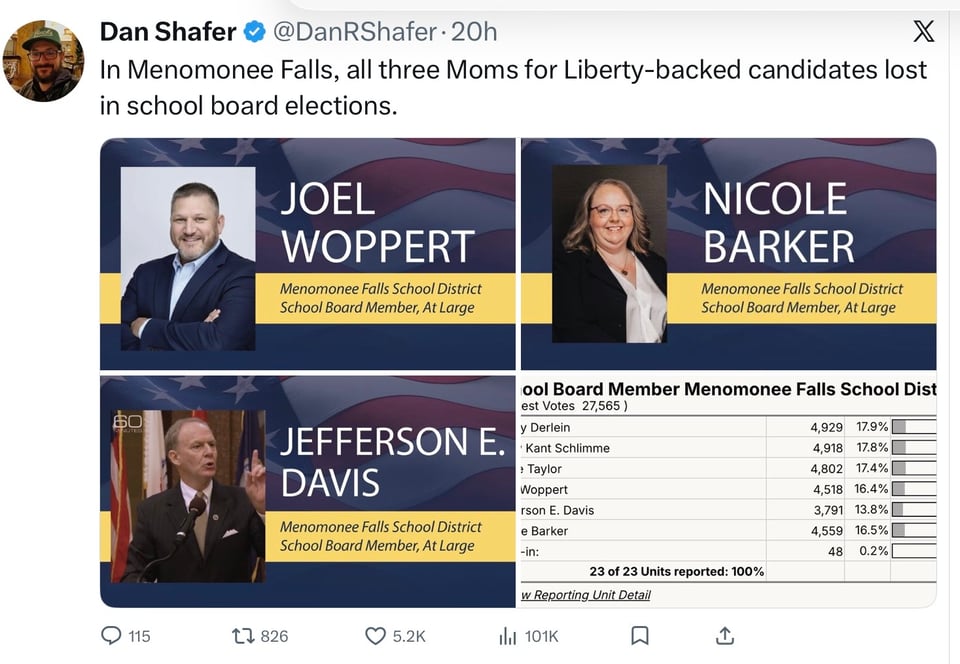
Good things happened in Wisconsin.
If you donated to Chris Taylor, you made this happen.
Wisconsin's liberal Supreme Court majority.
Trump may be a hero to Netanyahu, but that brings him very small applause.
Even as They Praise Iran Cease-Fire, World Leaders Are Whipsawed by Trump.
Across Europe and the globe, the war has damaged economies, roiled politics and underscored a lack of options in dealing with President Trump’s whims.
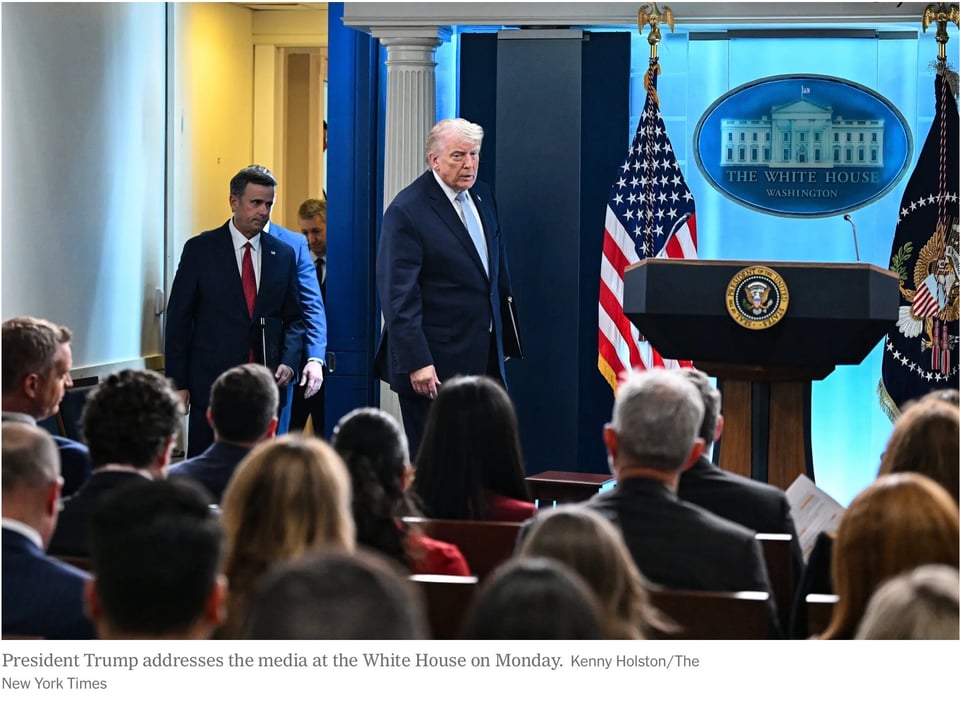
World leaders expressed relief on Wednesday that the United States, Israel and Iran had agreed to a temporary cease-fire, with President Trump backing off his apocalyptic threat to escalate a war that had already set off a cascading series of global crises.
But the relief was tempered by the profound powerlessness that most countries have felt over the last six weeks as they watched Mr. Trump wage a war that has rattled their economies, their energy supplies, their domestic politics and their relationships with the world’s pre-eminent superpower.
Even if the two-week cease-fire becomes permanent, those leaders, particularly in Europe, will be left to repair the cracks this war has caused in the global economy and security environment.
They will also be left searching for better ways to navigate the new world order that Mr. Trump has brought to bear in his second term in the White House, in which the president whipsaws friends and foes alike. Other countries have found few ways to buffer themselves, even as they express alarm at Mr. Trump’s actions.
“Is the world a better place today than yesterday? Undoubtedly,” the Danish foreign minister, Lars Lokke Rasmussen, wrote on the social media platform X. “Than 40 days ago? More than doubtful.”
Pedro Sánchez, the prime minister of Spain, an outspoken opponent of the Iran war, lauded cease-fires as “good news, especially if they lead to a just and durable peace.” But he added a harsh condemnation of Mr. Trump’s military campaign.
“The momentary relief cannot make us forget the chaos, the destruction, and the lives lost,” he wrote. “The government of Spain will not applaud those who set the world on fire just because they show up with a bucket. What is needed now: diplomacy, international law and PEACE.”
Beyond Europe, the cease-fire drew praise from countries including Oman, Japan, Malaysia and Australia.
(New York Times, to read the full article, click the blue link above ☝️.)
One more thing. Or two.
It’s not just NATO and us Trump has alienated.
Is Trump Losing Support Among Young MAGA Voters Over Iran War?
When Carson Carpenter saw that a U.S. strike had killed Iran's supreme leader Ayatollah Ali Khamenei, he did not see it as a show of force. Instead, the 20-year-old Trump supporter saw the start of a conflict with no clear end and a hefty price tag.
“When [President Donald Trump] says that this operation is going to end up like Venezuela, because he compared the two during the address, is just a fallacy. It's just not going to happen,” Carpenter said, referring to the swift U.S.-backed intervention earlier this year that helped removed President Maduro without a prolonged war.
For Carpenter and many other young conservatives, the Iran war has exposed a growing rift within the coalition that helped return Trump to the White House in 2024. A younger generation drawn to Trump’s promises to avoid foreign wars is now confronting a widening conflict with uncertain aims—and questioning what “America First” is meant to deliver.
“It's going to be a long-term struggle if we continue to drag out this conflict, and we don't know what the end goal is,” he said.
Carpenter, of Prescott, Ariz., and the co-founder of Off The Record USA, a media company that oversees young conservative content creators, opposes the Iran war, arguing that it evokes the legacy of post 9/11 conflicts, which cost more than 7,000 American lives, hundreds of thousands of Iraqi and Afghan lives, and trillions of dollars.
Similar sentiments are emerging among Gen Z Republicans across the country. James Cox, 20-year-old college student from American University in Washington D.C., and the Chief of Staff of D.C. College Republicans, estimated that about half of his peers would disagree with how Trump has handled the conflict.
“It's quite the spectrum of different beliefs, and I think it's captured the party, the, you have, of course, the non-interventionists, the isolationists who are against this conflict, and then you've got the folks again who are unsure and the folks who are in support of it,” Cox said. “Among young Republicans and college Republicans, it is a defining issue.”
The unease comes as the Trump administration struggles to clearly define its miltiary objectives amid mounting casualties and declining public support. On Wednesday, Secretary of Defense Pete Hegseth called Trump “a president of peace,” a day after Trump threatened to wipe out Iran’s civilization. The U.S. and Iran have agreed to a two-week ceasefire, but concerns remain over how long the pause in hostilities will hold.
Decline in support among young voters
The latest Economist/YouGov poll shows only 28% of Americans strongly or somewhat approve of Trump's handling of the Iran conflict, a five-point drop from the same survey question two weeks ago. Among people aged from 18 to 29, 63% of them oppose the war.
This shift carries political risk for the Republican party who compaigned on the promise of "America First." Alex Tarascio, Principal and Pollster at Cygnal, explains that Republicans relied heavily on young men’s votes to win the 2024 election given the narrow margin of Trump’s victory. As Tarascio points out, men between 18 and 49 favored Trump over Harris by 1 point, compared to a 10-point margin for Biden in 2020.
That same voting bloc that helped Trump last time around is showing far less interest in voting in the midterms. A CNN/SSRS poll showed that just 33% of Republican and Republican-leaning voters younger than 45 say they’re extremely motivated to vote, compared to a majority of older Republicans. Tarascio added that young male voters historically have a low participation rate in the midterm elections, and he expects the same this year, unless the rising cost of living impacts turnout.
People don't pick inflation in the economy as their top priority because they feel like the economy's going well. They usually pick it and it goes up because they feel like things are going poorly,” Tarascio said.
In an effort to reassure the public, Trump last week delivered his first address to the nation since military operations began, insisting that the campaign was “nearing its completion.”
But to Carpenter, the speech signaled the potential for a prolonged conflict: “He said Vietnam lasted 19 years, Iraq, eight years. He listed out every war in modern times that America has been in, and prepped the American public of a longer standing conflict.”
Not all young Trump voters are opposed to the war however. Keiran Laffey, a 20-year-old college student in Washington, D.C., told TIME he believes the intervention is justified from a humanitarian and strategic point of view, and will eventually be a net positive for America, citing Iran’s crackdown against anti-government protesters and its nuclear program.
“They're enriching uranium inside mountains,” he said. “They've killed 40,000 people, they burn the American flag for sport. And if we can really cut that off and deter what they've been doing, I think it does mean America first.”
Laffey, who voted for Trump in 2024, said he remembered Trump arguing in a debate in 2016 that George W. Bush should be impeached for leading the country into the Iraq War under false pretenses.
“He stood out. I remember the debate stage. He was really the only one to directly say that, and that's why he got a lot of support,” Laffey said, adding that having Tulsi Gabbard, a strong advocate against military interventions in foreign countries like Syria, in Trump’s 2024 campaign was a huge part of his coalition.
Still, even within his own organization—the College Republicans at George Washington University—Laffey said debate over the war, now in its second month, is intensifying.
“I am more patient, I don't want to come to a conclusion,” he said. “Let's see what happens in the next three weeks. I expect this conflict to come to a close.”
What MAGA now means for young Trump voters
Beneath the debate over Iran lies a more fundamental tension: whether MAGA as a political movement is rooted in a political philosophy that ultimately benefits the American people, or simply a coalition that follows Trump wherever he leads.
“There was a movement, but now there's no motion when it comes to where it's going to go for the future [elections],” Carpenter said. He now identifies himself as an “America First” rather than a MAGA supporter.
“I don’t think the Republican party has necessarily even embraced the MAGA movement to the extent that President Trump was aiming for, because he [Trump] wanted it to be more of an ideology instead of a political party,” he explained.
Others see it differently. Laffey, who still identifies himself as a MAGA supporter, insisted the movement was never about a singular issue like isolationism.
“Right now, I think MAGA still stands for the same core idea,” he said. “It’s about common sense leadership. It’s about strength when we need it, like being willing to take decisive action against threats like the IRGC, but also knowing the limits.”
Where that limit ends is being tested as Trump ramps up military actions against Iran.
Cox meanwhile said when it comes to MAGA, it’s a “fool’s errand” to box Trump in a specific set of policies. What the MAGA movement is really about, he said, is power.
“I look at energy as what Hamilton spoke of in the Federalist Papers: a strong, active executive, one that's able to wield the powers of the executive branch of government, not, as a pen, just signing off on documents, but actually more of like a sword or a hammer enforcing and willing, so that the interest of the United States making people bend to the interests of the United States, whatever they may be, foreign and domestic policy wise.”
The phrase “America First,” which dates to the early 20th century and was later revived by Trump, has traditionally been associated with prioritizing domestic concerns and avoiding foreign entanglements. For a generation that grew up on Trump's promises to end foreign wars, the reality of a widening military presence across the Middle East and Latin America, along with a record-breaking Pentagon budget request, is proving harder to square with the movement's founding promise.
“When I see our politicians advocating for other countries, some people are very pro-Israel, some people are against bombing Iran,” says Stryder Bigler, 21-year-old student at Arizona State University who co-founded Off the Record USA. “All of these people focused on all these conflicts, when we have conflicts that are killing people here in our own country.”
Bigler argued that domestic issues such as homelessness, mental health crisis and birthrate decline should take greater precedence, warning that it could otherwise spell trouble for the administration in the midterms.
The phrase “America First,” which dates to the early 20th century and was later revived by Trump, has traditionally been associated with prioritizing domestic concerns and avoiding foreign entanglements. For a generation that grew up on Trump's promises to end foreign wars, the reality of a widening military presence across the Middle East and Latin America, along with a record-breaking Pentagon budget request, is proving harder to square with the movement's founding promise.
“When I see our politicians advocating for other countries, some people are very pro-Israel, some people are against bombing Iran,” says Stryder Bigler, 21-year-old student at Arizona State University who co-founded Off the Record USA. “All of these people focused on all these conflicts, when we have conflicts that are killing people here in our own country.”
Bigler argued that domestic issues such as homelessness, mental health crisis and birthrate decline should take greater precedence, warning that it could otherwise spell trouble for the administration in the midterms.
A shifting view on the Israel
The debate over Iran is unfolding alongside a broader shift in attitudes toward Israel among younger Americans, amplified by criticism from high-profile commentators with large followings among young conservatives.
In the first week of the conflict, Secretary of State Marco Rubio sparked backlash among supporters after he claimed that a key reason behind the U.S. conducting strikes in Iran was because of an Israeli preemptive attack. “We knew that there was going to be an Israeli action, we knew that that would precipitate an attack against American forces, and we knew that if we didn’t preemptively go after them before they launched those attacks, we would suffer higher casualties,” he said. He later clarified the comment and said the decision to strike came from Trump, not Israel. The White House has repeatedly denied claims that Israel pushed the U.S. into the war.
The clarification has done little to stem that narrative among some corners of the right. Right-wing podcaster Nick Fuentes, who has more than 1.3 million followers on X, has been highly critical of the war and suggested its ultimate aim is for Israel to "expand its borders." Tucker Carlson, once a strong supporter of the MAGA movement who retains a signficant online following and has had several meetings with Trump at the White House this year, meanwhile said in an interview with the Economist that the U.S. “put Israel’s interests before ours.”
Polling shows how much of a pronounced shift in attitudes there has been among younger voters towards Israel, one of America’s closest allies. A recent NBC News poll found that almost two-thirds of Americans aged 18—34 had a negative view of Israel, a significant increase from 37% three years ago. According to Tarascio, the latest survey showed that among young Republicans, Israel is “about as well liked to Saudi Arabia by young Republicans.”
That's just so, so different from every other older cohort, even Democrats," Tarascio explained.
On his college campus in Washington, D.C., Laffey said visible support for Israel has declined significantly. “Do I think it's our responsibility to back Israel at whatever they do? Of course not. 100% no. This war clearly is in Israel's interest,” Laffey argued.
For Carpenter, the divide reflects what he sees as a generational difference within conservatism.
“You're just seeing a lot of hypocrisy with a lot of these older conservatives compared to the younger conservatives,” Carpenter said. “We remember what 2022 was like. We had high gas prices. We had the threat of military intervention in a European war [in Ukraine], the largest conflict since World War II. And we're not falling for the same trap.” (Time)
The Strait of Hormuz used to be free and open to boat traffic. Trump ended that.
Oil industry pleads its Hormuz case with White House
Oil executives are citing international treaties, sanction laws and high payments in opposing Iran's plan to charge ships passing through the Strait of Hormuz.

Liberia-flagged tanker Shenlong Suezmax, carrying crude oil from Saudi Arabia, is seen at the Mumbai Port in Mumbai, India, on March 12, 2026. | Rafiq Maqbool/AP.
President Donald Trump’s Iran peace plan is getting pushback from one key constituency: the oil industry.
Oil company executives are reaching out to the White House, Secretary of State Marco Rubio and Vice President J.D. Vance to protest allowing Iran to charge tolls through the strategic Strait of Hormuz as a condition of peace talks, said one industry consultant granted anonymity to discuss relations with the administration.
“Hell yes,” this person said when asked if executives were contacting the White House to protest a toll on Hormuz. ”We didn’t have to do that before — and I thought we won the war. Any place you have access to the administration, you ask, what are you guys thinking?”
The response administrative officials were giving industry representatives “is not a cold shoulder,” this person added. “It’s more like, ‘Yeah, ok, we’ll take note.’”
Oil industry representatives met with senior administration staff in the State Department on Wednesday morning to raise concerns, said one person who said they attended the meeting.
Among their points: Conceding to Iran’s request would add $2.5 million to each shipment in tolls and higher insurance rates, a cost that would be passed on to consumers. Giving Iran control of Hormuz could set precedent for countries like Singapore and Turkey to charge tolls on important trade routes on the Strait of Malacca and Bosporus. And paying the toll could put companies in legal jeopardy for violating sanctions on Iranian officials.
Companies were also expressing their concerns directly with Trump, but more gently, added this person, who was granted anonymity because they were not authorized to talk to the media.
“The president is extremely sensitive to the legacy and judgment on the success of this war so pushing the president right now is seen as a risky proposition,” this person said. “But the White House is hearing from the industry despite the gingerness of the conversations.”
A White House spokesperson did not directly answer questions on whether the administration was hearing from industry representatives or how it would address their concerns, instead referring to a Wednesday afternoon press conference where White House Press Secretary Karoline Leavitt said the administration was working with a “more reasonable” set of Iranian proposals.
Iran “put forward a more reasonable and entirely different and condensed plan to the president and his team,” Leavitt said during the press conference, without saying what in the plan had changed. “The President’s red lines, namely the end of uranium enrichment in Iran, have not changed. And the idea that President Trump would ever accept an Iranian wishlist as a deal is completely absurd.”
Vance’s office and the State Department did not immediately respond to requests for comment. Vance is headed to Islamabad to help with negotiations, Leavitt said during the press conference.
With a fifth of global oil supply depending on Hormuz to reach the market, leaving Iran in control of which ships can enter and exit would add significant costs — and legal liability — to companies long used to free navigation through the waterway.
Iran is already demanding tolls be paid in yuan or cryptocurrency for tankers that cross through the strait, according to media reports. Trump on Tuesday said the United States would use Iran’s 10-point plan — which calls for it to collect a toll of $2 million per ship — as a basis for a permanent ceasefire.
“I expect serious pushback, and not only from the oil industry,” said Jason Bennett, a lawyer focusing on energy and international law at Baker Botts. Hormuz “is an open international waterway. Up to today, there’s been no recognition of Iran’s legal right to control the Straits of Hormuz. I don’t see anyone accepting that.”
Trump on Tuesday said the U.S. was “very far along with a definitive Agreement concerning Longterm PEACE with Iran, and PEACE in the Middle East,” adding “We received a 10 point proposal from Iran, and believe it is a workable basis on which to negotiate.”
Trump, far from arguing against Iran collecting tolls, has publicly mused that the U.S. could form a “joint venture” on the operation.
“It’s an idea the president has floated,” Leavitt said in Wednesday’s press conference of Trump’s idea to share toll revenue with Iran. “And it’s something that will continue to be discussed over the course of the next two weeks. The immediate priority of the president is the reopening of the Strait without any limitations, whether in the form of tolls or otherwise.”
Even with the ceasefire announced Tuesday evening, traffic through Hormuz remains all but stopped, said Matt Smith, analyst at commodities and ship-tracking firm Kpler. Iran closed the Strait again on Wednesday after Israel attacked its ally Lebanon.
Foreign diplomats were also raising concerns as best they could with a White House who, they have complained, has not taken much interest in their views up to now.
“Next will it be Russian tolls in the Arctic? Chinese tolls in the South China Sea?” said one Washington-based Asian diplomat. “My guess is probably [there will be] some kind of protest by the rest of the world, especially users of the Strait.”
Other diplomats are worrying that Iran, if left to its own devices, could charge tolls on some ships and allow through others who do it political favors. A second Washington-based diplomat told POLITICO that “seven or more ships” flying the Malaysian flag were able to get through the Strait “toll-free apparently.”
“Malaysia has always been really vocal against Israel, way before this whole Hormuz situation, so Tehran probably sees them as a friendly country,” the diplomat said. “That plus staying neutral on the US-Israel strikes probably helped a lot. All that hedging and maintaining good relations with everyone, even countries the West isn’t too fond of, actually pays off when things get rough like this.”
The Malaysian embassy didn’t respond to a request for comment.
Most shipping companies won’t pay a toll, calling it unsustainable in the long run.
“The transit fee of $2 million U.S. dollars per ship from Iran’s ten-point plan represents further potential for blackmail,” said Arthur Leichthammer, fellow at Berlin-based think tank Jacques Delors Center. “That would be an extremely costly concession — both politically and economically.(”Politico)
This ‘n That.
Hegseth sent his lackeys to threaten the Pope. OH my.
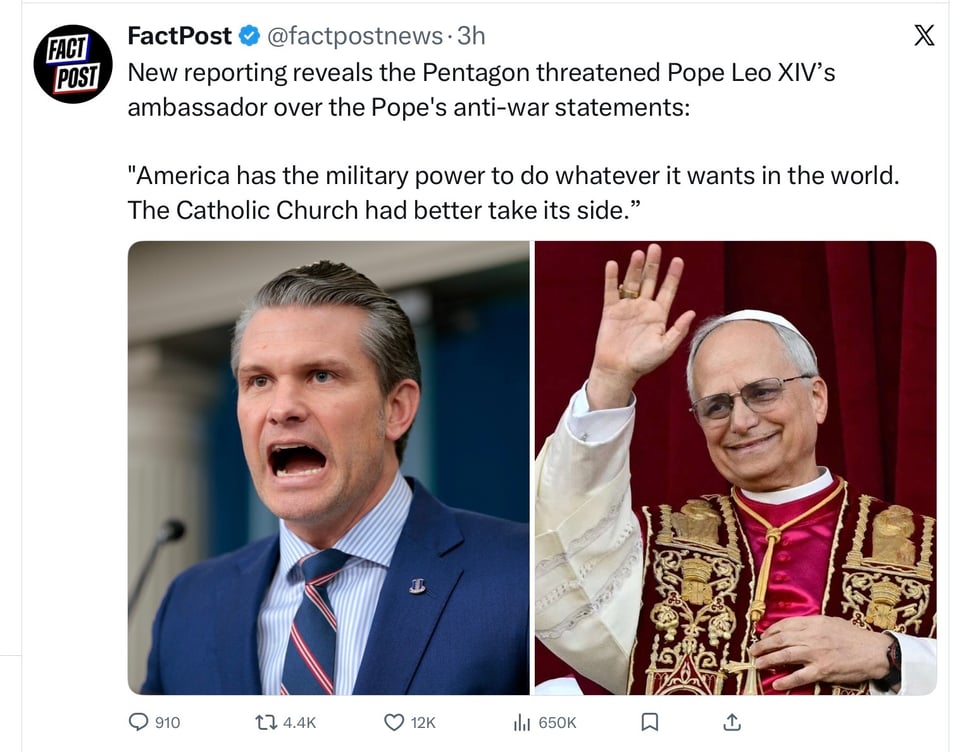
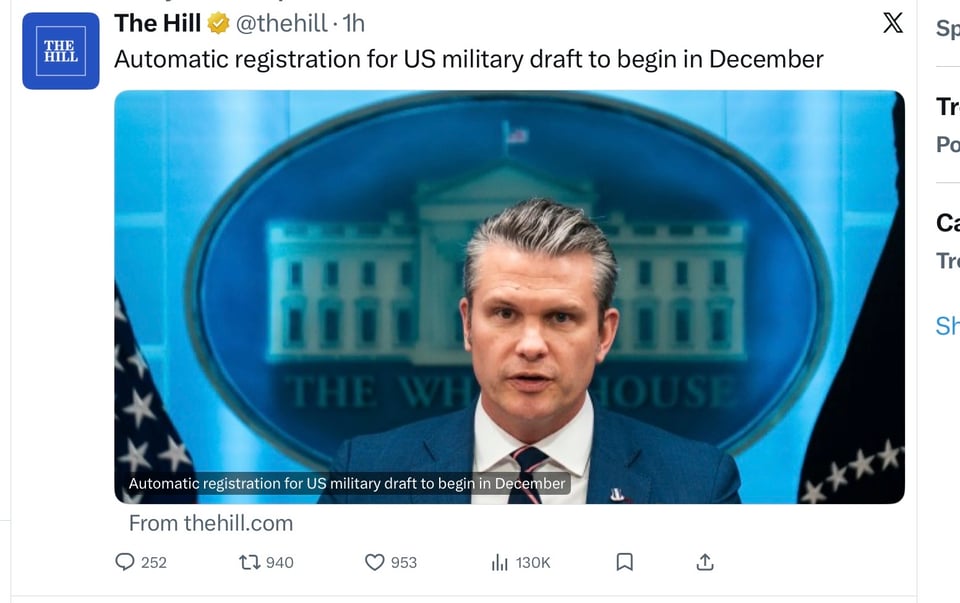
Hegseth clearly has more wars in mind.
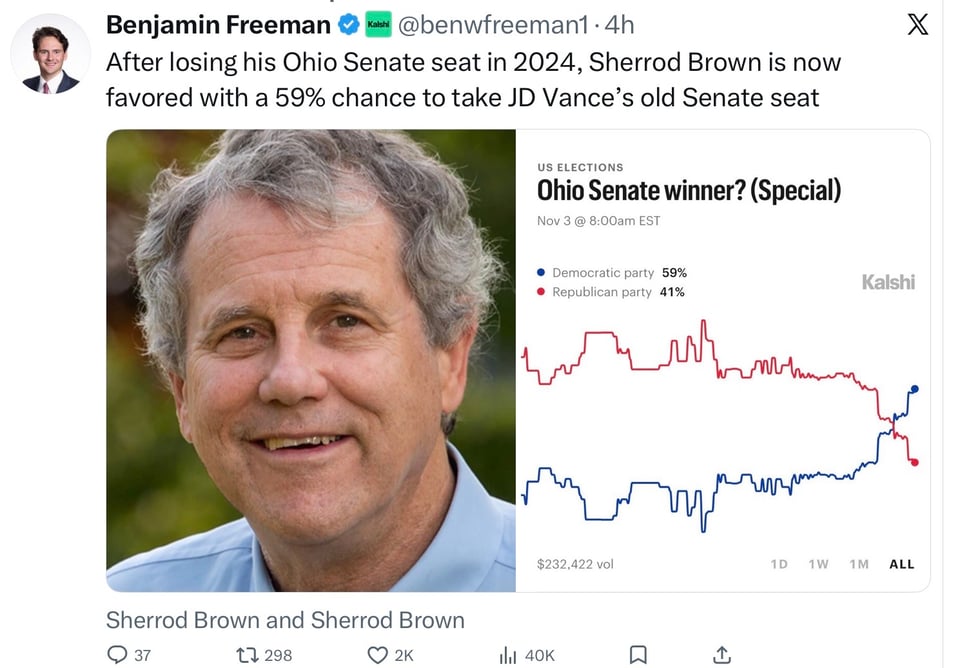
Ohio seems to have waken up.
Virginia needs to say yes. Spread the word.