Thursday, April 30,2026. Annette’s Roundup for Democracy.
The Supreme Court continues to gut the Voting Rights Act.
Will the Midterms now be up for grabs?
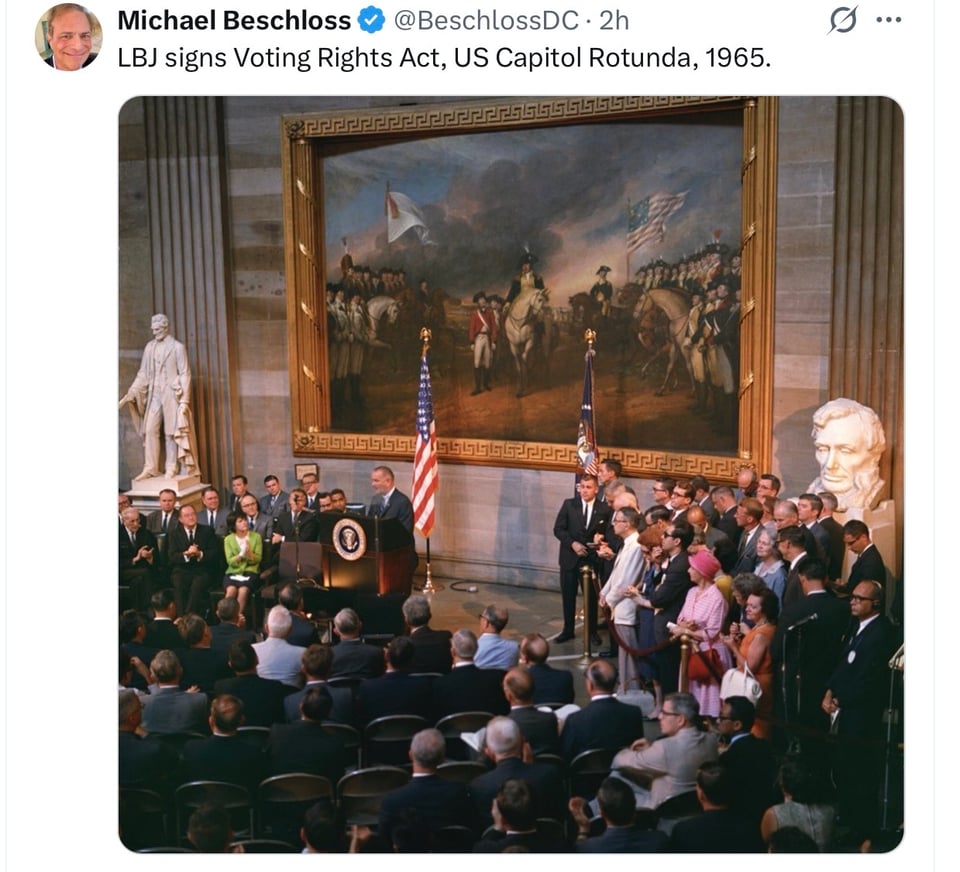
What is Louisiana v. Callais all about?
Wednesday’s decision marks the latest in a series of rulings by the justices (of the Supreme Court) that have weakened the Voting Rights Act of 1965, often considered the crown jewel of the civil rights-era laws.
The case, Louisiana v. Callais, arose from a dispute over a new voting map drafted by Louisiana lawmakers after the 2020 census. Before then, only one of the state’s six congressional districts was majority Black, even though Black Louisianans made up about a third of the state’s population.
Two groups of Black voters sued in 2022, after state lawmakers adopted a new map that still included only one majority-Black district. They argued Louisiana had violated the Voting Rights Act by packing Black voters into one district, which had the effect of diluting the power of their votes. A federal judge agreed.
In 2024, state lawmakers tried again, this time adopting a map that included a second majority-Black district. A group of white Louisiana voters then challenged that map, claiming it was an illegal racial gerrymander. They pointed to the boundaries of the new district, which snakes diagonally across the state from the southeast to the northwest.
Lawmakers initially defended the map, arguing that the odd shape was the result of politics, not race. They said that lawmakers created the second district’s area to protect high-profile politicians, including House Speaker Mike Johnson, a Republican. The court has said it is acceptable to draw maps motivated by partisan advantage. (New York Times)
Supreme Court limits Voting Rights Act.
In a 6-3 ruling, the justices narrowed how a key provision of the Voting Rights Act can be enforced.
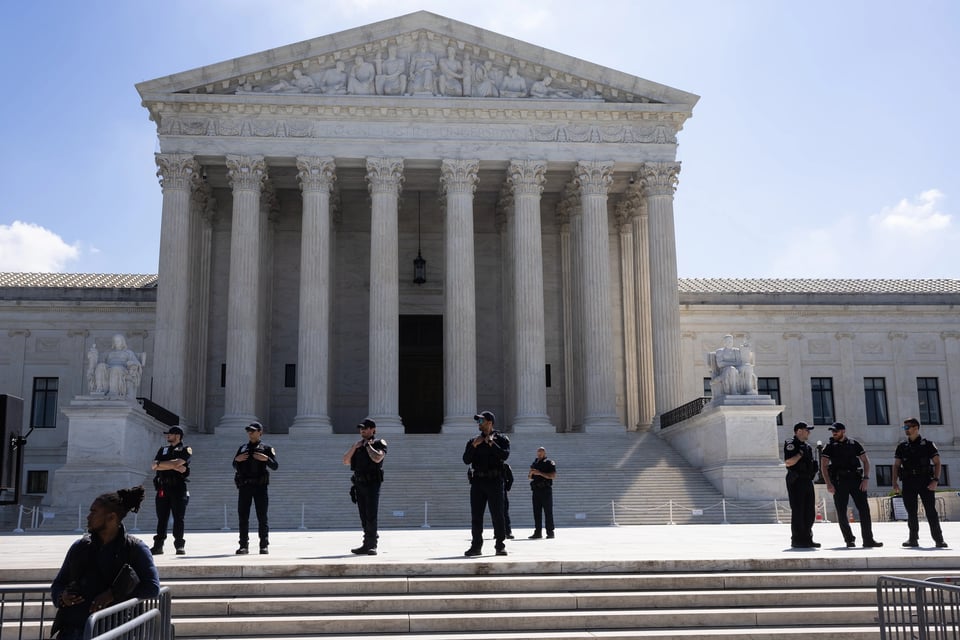
Supreme Court police guard the high court on April 27. | Francis Chung/POLITICO.
The Supreme Court significantly narrowed a key provision of the Voting Rights Act in a 6-3 ruling Wednesday, further eroding the impact of the landmark civil rights-era law.
For decades, Section 2 — a provision that broadly outlawed discrimination in voting on the basis of race — has been interpreted to allow, and sometimes demand, the use of race-conscious data in redistricting, to protect the voting power of minorities.
But the court’s new opinion, which split the justices along ideological lines, throws into question exactly how states can utilize race in their mapmaking process. The case involves a challenge to two majority-Black districts in Louisiana.
Liberal groups had feared the court would fully gut the law, allowing red states to redraw maps nationwide and effectively lock in GOP control of Congress.
Republicans, meanwhile, believe that considering race in drawing congressional districts is discriminatory and unconstitutional.
Now, the gray area left by the court’s ruling adds further uncertainty to redistricting, which has become a pivotal tool for both parties this cycle.
The ruling in the case, Louisiana v. Callais, raises questions about whether that state’s map, which currently has two majority-Black districts, will be in place for this year’s midterms.
Writing for the majority, Justice Samuel Alito said evidence of racial disparity in the drawing of earlier maps was too weak to justify the use of race to draw the new map.
“Because the Voting Rights Act did not require Louisiana to create an additional majority-minority district, no compelling interest justified the State’s use of race,” Alito wrote. “That map is an unconstitutional gerrymander, and its use would violate the plaintiffs’ constitutional rights.”
Alito said racial discrimination in previous maps doesn’t have to be proven outright to justify using race to draw a new map but that the past “circumstances must give rise to a strong inference of racial discrimination.”
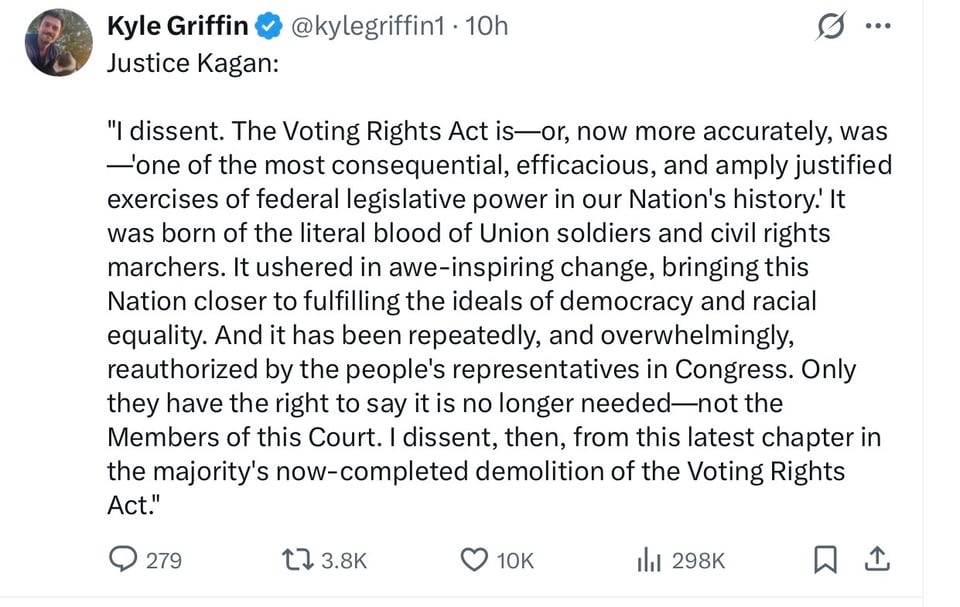
All three liberal justices joined a dissent by Justice Elena Kagan, who read portions of her opinion aloud from the bench — a sign of profound disagreement with the majority.
“Under the Court’s new view … a State can, without legal consequence, systematically dilute minority citizens’ voting power. Of course, the majority does not announce today’s holding that way. Its opinion is understated, even antiseptic,” Kagan wrote. But she said what the majority billed as mere updates actually “eviscerate the law” and amount to the “demolition of the Voting Rights Act.”
Under conservative Chief Justice John Roberts, the court has already curtailed many of the protections within the 60-year-old Voting Rights Act, with Section 2 one of the few remaining.
The case decided Wednesday turned on the interpretation of a change Congress made to the VRA in 1982. A Supreme Court ruling in 1980 said the statute required proof of actual racial discrimination tinged the process in order to require changes to voting maps or election practices.
Congress concluded that would make such cases almost impossible to pursue, since officials rarely admit to racial motivations. So, lawmakers passed an amendment creating an “effects” test, allowing remedies for maps that had the effect of diluting minorities’ voting power.
The courts have struggled with how to balance that provision with the Constitution’s requirement that all people be treated equally under the law.
Kagan argued Wednesday that the majority “makes a nullity of the” pivotal 1982 amendment, signed into law by President Ronald Reagan.
However, Alito said a revised interpretation of Section 2 was needed in part because of the Supreme Court’s 2019 ruling that the Constitution does not prohibit gerrymandering for partisan purposes. As a result, he suggested, plaintiffs in voting discrimination lawsuits are now often “dressing their political-gerrymandering claims in racial garb.”
“Failing to account for political considerations in redistricting … can allow plaintiffs to undo a State’s legitimate, non-racial decisions under the banner of Section 2,” Alito wrote, appearing to express concern that Democrats could use voting rights lawsuits for partisan purposes rather than to target racial discrimination.
“If race and politics are not disentangled and a Section 2 claim is cynically used as a tool for advancing a partisan end, the VRA’s noble goal will be perverted,” he wrote.
The high court’s decision is the culmination of a long-running battle in Louisiana over Black voters’ representation in Congress. The Supreme Court first heard argument in the case in March 2025, but the justices failed to issue a ruling and made the unusual decision to hear it again this term.
In the October rehearing, the justices asked far broader questions around the VRA and its implementation. (Politico)
Republicans push to redraw maps after Supreme Court deals blow to VRA
GOP candidates and elected officials in southern states are calling for special sessions to dismantle majority-minority districts ahead of the midterms.
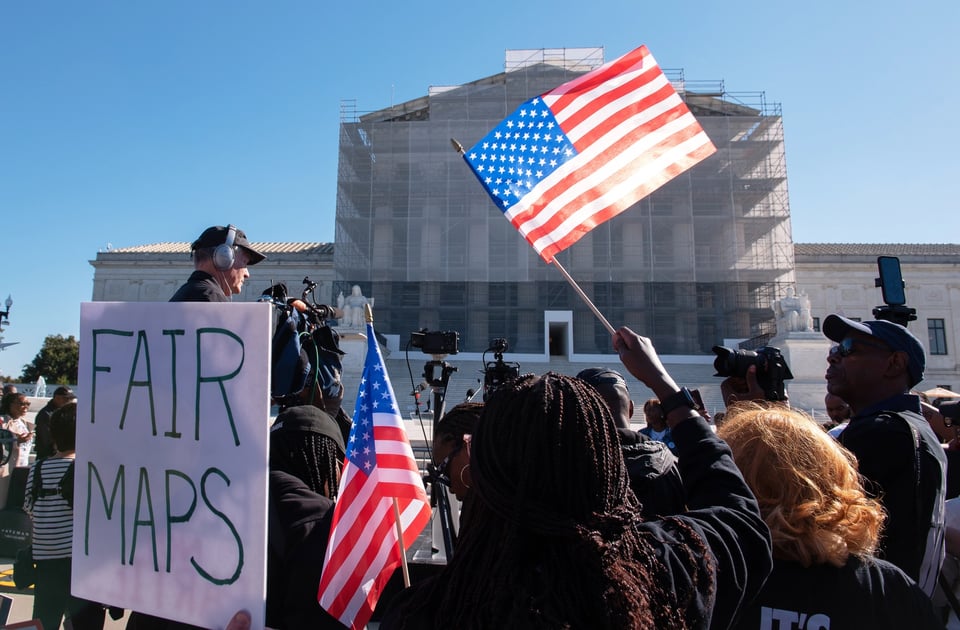
Voting rights activists gather outside the Supreme Court in Washington on Oct. 15, 2025, as the justices prepare to take up a major Republican-led challenge to the Voting Rights Act, the centerpiece legislation of the Civil Rights Movement. | Cliff Owen/AP
The Supreme Court just triggered a second wave of the redistricting wars — and Republicans are on the march.
The court blew a hole in the Voting Rights Act on Wednesday, triggering immediate calls from Republicans to redraw a slew of southern congressional maps as soon as possible to improve their chances of holding the House this fall and boost their power for years to come.
Top GOP candidates, elected officials and party chairs across Alabama, Georgia, Mississippi, Tennessee and South Carolina — as well as rafts of Republican lawyers and MAGA allies — called for special sessions in their states to dismantle minority-majority districts and create more aggressive gerrymanders benefitting their party.
“There is no time to waste,” billionaire Rick Jackson, a leading GOP candidate for Georgia governor, said in a statement.
“LET’S GO!” said Republican Sen. Tommy Tuberville, who is also running for governor in Alabama.
“I’ll do everything I can to make this map a reality,” said Sen. Marsha Blackburn, Republicans’ frontrunner for governor in Tennessee, while sharing a suggested map of her state with no Democratic-held districts.
The decision injects new life into the gerrymandering tug-of-war that President Donald Trump kicked off last year in Texas.
Republicans on Wednesday passed a new map in Florida that gives them a potential narrow edge over Democrats nationally, but many are now hoping they can significantly widen the gap following the court’s ruling.
Still, it remains unclear how much success the GOP will have in ramming through more maps before the midterms. Many filing deadlines have already passed, and primaries are rapidly approaching in other states, like Louisiana. And even redistricting wins across all of these states may not be enough to save Republicans from a treacherous midterm cycle.
But GOP operatives argue there is still time to redraw some states this year.
Jason Torchinsky, a top Republican election lawyer, wrote in a text message that “there are opportunities for states that want to adjust some maps, but lots depends on timing and where the state election machinery in each state stands.”
“I think there’s a path for a lot of [states], but these things always come down to a political question. They need the votes,” said Adam Kincaid, who leads the National Republican Redistricting Trust and was a key player in the White House’s push to redistrict. “They have to get the votes in these chambers to get it done.”
But he hedged when asked about a maximalist approach to 2026 redraws.
“I’m not going to say everyone should redraw,” he said. “What I am gonna say is that if you’re a state that has districts that were drawn intentionally on the basis of race, you really need to evaluate, one, whether you’re on any kind of strong footing to defend those maps, and two, at what point are you going to remedy those issues?”
Alabama Gov. Kay Ivey, a Republican, rejected calls from within her party to call a special session on Wednesday, citing a separate court ruling that prevents the state from redrawing its maps until 2030.
“While we are not in position to have a special session at this time, I hope in light of this new decision, the court is favorable to Alabama,” Ivey said in a statement.
But the outside pressure on state lawmakers in these GOP states will be immense.
Trump, speaking in the Oval Office Wednesday afternoon, said that he would encourage states like Louisiana, where early voting begins this weekend, to redraw their maps if they have the time to do so. He added that he hadn’t had time to review the Supreme Court’s ruling.
“I would say generally I would think that they would want to do it,” he said.
The powerful GOP-aligned super PAC Club for Growth Action, a close Trump ally which has poured millions into pressure campaigns related to redistricting, wants states “to be as aggressive as possible as soon as possible,” said one person familiar with the Club’s thinking who was granted anonymity to speak candidly.
“Any Republican Governor in any Southern state that isn’t huddling with their staff now to call a special session to redraw their maps should be primaried,” CJ Pearson, a co-chair of the Republican National Committee’s Youth Advisory Council, said on X.
Will Chamberlain, a senior counsel for the GOP-aligned Article III Project, urged GOP governors across the South to immediately call their Legislatures into a special session to redraw maps.
The decision to push forward with any redistricting effort relies heavily on the governors’ and state lawmakers’ ability and interest to return to session, as many — like Georgia — have already adjourned for the year. Candidate filing deadlines have already closed in many of these states and voting has already begun in states like Georgia, making it too late to change the maps in many cases. But those temporary roadblocks have not stopped several Republican candidates from swiftly calling for action.
An open race for governor in South Carolina has drawn a crowded field of five Republican candidates — four of whom were quick to demand state lawmakers in Columbia to eliminate longtime Rep. Jim Clyburn’s (D-S.C.) seat. Clyburn said in a post on X the court seems “hellbent” on eliminating “African American political representation in multiple Southern states.”
Tuberville, who’s running for Alabama governor, had already called for his home state to redraw their lines in a timely op-ed published Tuesday. The state, he argued, “by all rights should send an entirely Republican delegation to Washington” because Alabama votes overwhelmingly for the GOP. Tuberville reshared the article after the Supreme Court decision landed.
Blackburn, another senator running for governor in a GOP-controlled state, called for the legislature to reconvene to enact a new map of exclusively red districts.
In Georgia, the two front-runners locked in a competitive GOP primary for governor — Lt. Gov. Burt Jones and Rick Jackson — swiftly applauded the ruling and threw their support behind drawing new congressional maps. Sen. Greg Dolezal, who is running for lieutenant governor, called for an immediate special session.
“I agree that in a society built on the equal protection of law, no state should be directed to draw legislative maps on the basis of race. Given that Georgia was ordered to do so in its last round of redistricting, I fully support redrawing our state’s legislative maps in compliance with today’s decision,” Jones, who is endorsed by Trump in the primary, said in a statement.
Democrats nationally are trying to redistrict their way back to power, and what happened in Virginia is just the tip of the spear. There is no time to waste,” Jackson said in a statement.
Democrats are scrambling to figure out how best to respond against Republicans’ latest efforts. Some are dismissing the logistical likelihood of the GOP pushing through changes to current maps. Others called for restoring the VRA — but wouldn’t say more about their redistricting strategy. A few are ready to go on the offensive.
“I have long felt that we all have to play by the same set of rules and the Republican caucus has made it very clear that they want and are setting rules of partisan gerrymandering,” Democratic Rep. Alexandria Ocasio-Cortez told reporters after the court decision.
“I take 52 seats from California, and 17 seats from Illinois, because at the end of the day, they’re rigging this election to try to win. And we just can’t sit back here and do nothing. We’re going to play their game, and we’re going to beat them at it,” said Rep. Terri Sewell (D-Ala.), whose seat may be on the chopping block.
New York Democratic Gov. Kathy Hochul said she is working with the state’s legislature to “change New York’s redistricting process so we can fight back against Washington’s attempts to rig our democracy,” though that’s unlikely to happen before 2026. An effort from earlier this year was already blocked in court.
Democrats were able to mostly counter the GOP’s redistricting gains so far.
California voters passed a ballot measure, backed by Democratic Gov. Gavin Newsom, to give the party an edge in five more House seats, pegged as a response to Texas. Earlier this month, voters in Virginia passed a measure that could net the party four seats as well, though that measure faces a challenge in front of the state supreme court. While Florida lawmakers’ new map gives the GOP a slight advantage nationally over Democrats, it’s a far cry from the numbers the White House expected when it first kicked off this war.
Both parties have hit snags in their redistricting battles over the past year, with Indiana Republicans rebuking Trump and Democrats in Illinois and Maryland refusing to pass redraws. That leaves major uncertainty — especially given the rushed timeline — for the success of any more redraws this year.
And while the Supreme Court did narrow Section 2 of the Voting Rights Act, some Democratic lawyers saw openings in the ruling for future litigation, pointing to the 14th Amendment.
Regardless of how many states can get something across the board in time for the midterms, the redistricting rodeo that has encompassed American politics for the last two years is here to stay.
“There will be a lot of redistricting for the next couple years,” Kincaid said. (Politico)
Some Republicans wake up on Trump’s ballroom.
They notice that his ballroom might not be good for them.
Lindsay Graham, Republican of South Carolina up for re-election, continues to think that currying Trump’s help will be a help.
GOP pushes back on Trump ballroom push amid affordability worries.
Senate Republicans aren’t in the mood to vote on legislation to greenlight President Trump’s controversial plan to build a 90,000-square-foot White House ballroom, as some GOP lawmakers see it as a bad political move in the current political climate, especially if it would require taxpayer funding.
Republican senators generally support Trump’s call for the construction of a ballroom where the historic East Wing once stood, but some of them are warning that spending any taxpayer money on the project would be politically “tone-deaf.”
“Is it good politics to spend taxpayer dollars on a ballroom right before the election? Absolutely not,” said one Republican senator who requested anonymity to discuss the internal debate within the Senate GOP conference.
Senate Majority Leader John Thune (R-S.D.) told reporters Tuesday that legislation sponsored by Sen. Lindsey Graham (R-S.C.), a close Trump ally, to authorize $400 million for the construction of a ballroom and underground security complex will have to wait — despite Graham’s pressure on the GOP leader to hold a vote immediately.
“Right now, our goal is to get DHS funded and get the reconciliation bill done as quickly as possible. We’ll have, I’m sure, that conversation with our colleagues about that,” Thune said.
Thune did say Trump has a strong case to make about the need for a secure ballroom on the White House grounds after a 31-year-old suspect armed with a shotgun and handgun stormed the White House Correspondents’ Association dinner at the Washington Hilton hotel on Saturday.
“I think there’s a very solid argument to be made that they need a secure facility and building there at the White House to do events in, and there’s one there tonight,” Thune said, noting that Trump will host a state dinner with King Charles III of Great Britain.
Trump, Vice President Vance, Speaker Mike Johnson (R-La.) and several Cabinet officials were seated in the Hilton’s ballroom when law enforcement officers tackled the suspect a short distance from the room’s entrance.
Graham is calling on Thune to bring his bill to the floor as soon as possible. It would authorize $400 million for the construction of the White House ballroom and a military complex beneath it — including a Secret Service annex.
The legislation is co-sponsored by Sens. Katie Britt (R-Ala.) and Eric Schmitt (R-Mo.).
“The sooner we get the ballroom built, the more hardened it is, the better for the country,” Graham said at a press conference unveiling his bill. “I hope and pray that most people in the Senate after Saturday night will support this bill. This is not about Trump, it’s about the presidency of the United States.
He said he’d ask Thune to “expedite” the bill.
Graham’s push for an immediate vote on a proposal is running into opposition from Senate Republican colleagues who warn that spending money on a ballroom when millions of Americans are struggling to afford rising gas and food prices could boomerang back on GOP candidates in the November election.
“I need to know what the fully burdened cost of this building project is because it sounds like it’s double what it was just a few months ago,” said Sen. Thom Tillis (R-N.C.), who questioned why Congress should allocate $400 million for the ballroom when Trump has already raised $350 million for the project.
“It represents an exposure, no doubt about it,” Tillis said of a potential political backlash over the ballroom.
He also cited Trump’s decision to accept a luxury Boeing 747 from the Qatari royal family to be used as Air Force One as a salient issue.
Having taxpayers pay for a luxurious ballroom next to the White House when affordability has become a major issue in the 2026 midterm election would be “tone-deaf,” Tillis said.
Voting to authorize Trump’s ballroom is a touchy subject among GOP lawmakers as polls show his approval ratings sinking to new lows in his second term. A new Reuters/Ipsos poll conducted April 24-27 showed that only 34 percent of surveyed Americans approved of Trump’s job performance.
Sen. Josh Hawley (R-Mo.) said he wants private donors, not taxpayers, to pay for the ballroom.
“Assuming all the legality questions get resolved, I just assume the private donors pay for it, to be honest. I want all that to be public, but Jackie Kennedy renovated the entire White House with private donations, it didn’t cost the taxpayers anything,” he said.
Senate Republicans are more open to alternative proposals sponsored by Sens. Tim Sheehy (R-Mont.) and Rand Paul (R-Ky.) to authorize construction of the White House ballroom but not authorize federal funding for it.
Sheehy’s proposal, the Securing America’s Formal Events Act, would give the president the authority to manage, maintain and improve executive facilities, including construction of a ballroom.
It would allow private funding for the project on the condition that no donor receives preferential treatment, access or influence over federal policy.
Sheehy is planning to request unanimous consent on the Senate floor as soon as Wednesday to approve his bill.
Democrats are signaling that they will oppose any legislation to build a White House ballroom.
“Absolutely not,” said Sen. Jeanne Shaheen (D-N.H.) when asked whether she could support Graham’s bill. “At a time when Americans are struggling with the high price of gasoline — it just went up another 50 cents overnight — they’re struggling with the cost of groceries.”
“To provide $400 million for President Trump to build
a ballroom?” she said. “We want our president to be able to go out and talk to real people. The idea that we would create a complex that the president would never leave is not consistent with American democracy,” she said.
Democrats say letting private donors fund the project raises concerns about special interests gaining more influence over the administration.
Paul’s proposal is broader than Sheehy’s. His bill would set up an expedited process to approve the White House ballroom and other projects by future presidents without providing any federal funding.
Paul took a shot at Graham’s proposal on social media, panning it as a “bad” bill.
“Wanted to flag that my bill cost zero dollars for the taxpayer. It keeps the ballroom privately funded,” he posted on the social platform X. “There is another bill floating around the Senate that just hands 400 million tax dollars over to build the ballroom. It’s a different (and bad) bill.” (The Hill).
Trump Narcissism and Rudeness on display.
One very sick man.

Tracy Sturdivant, the Ms. Foundation's next leader, wants to expand the feminist funder's coalition.
Tracy Sturdivant will succeed Teresa Younger as the next president and CEO of the Ms. Foundation, the first national philanthropy run by and for women.
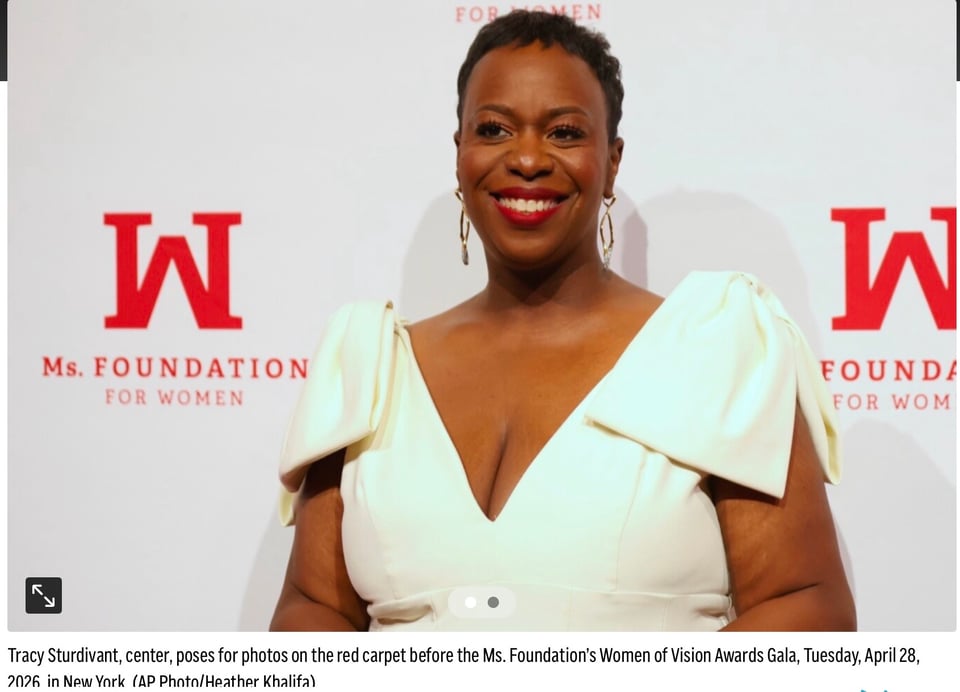
NEW YORK (AP) — It is rare, the Ms. Foundation’s next leader acknowledged, for a Black woman to take the helm of a major nonprofit from another Black woman. It is even rarer, she noted, for that organization to be financially healthy.
And yet that is the position Tracy Sturdivant will enter when she succeeds Teresa Younger as the president and CEO of the first national philanthropy run by and for women. The Ms. Foundation introduced Sturdivant on Tuesday at its annual New York City gala, where feminists such as #MeToo founder Tarana Burke were honored.
The foundation is “not in crisis,” but “ready for what’s to come” with Sturdivant in charge, Younger said in a statement shared ahead of the announcement. The foundation built a $100 million-plus endowment and explicitly centered women and girls of color during her tenure.
With that strong footing Sturdivant sees an opportunity to expand the coalition of people who see gender justice as their charge, too. As many funders disinvest from Black-led nonprofits, she is committed to “unapologetically” supporting marginalized groups while simultaneously inviting others to join the fight for economic equality and bodily autonomy.
“We need all hands on deck to make sure that we’re supporting women in the midst of what I call this perfect form of instability that they’re experiencing,” Sturdivant told The Associated Press in an interview.
The Detroit native comes to the foundation from The League, the nonprofit she founded to inspire civic engagement through culture. She credits past Ms. Foundation president Marie Wilson — who helped start “Take Our Daughters to Work” day to boost adolescent girls’ self esteem — with showing her the power of large-scale narrative change campaigns. They worked together on the White House Project, a nonprofit that aimed to advance women’s leadership across all sectors.
Narrative change has become a more necessary part of the foundation’s work, she said, as conservative movements nationwide seek to prohibit funding for diversity, equity and inclusion. Sturdivant sees the Ms. Foundation, a legacy institution that she said has weathered “many cultural shifts” since its 1973 founding, as poised to engage this next generation of feminists through more modern storytelling.
She pointed to Blair Imani, a historian and creator honored at Tuesday’s gala, as an example of the new voices she wants to elevate. Imani’s viral web series “Smarter in Seconds” offers a progressive education on issues of race and gender in short-form videos.
“They are leading the culture and being able to take some of our cues from them, I think, is gonna be really helpful,” Sturdivant said.
She’s also considering ways to increase grantmaking around equal pay, family leave and childcare — issues she championed as the co-founder of the Make it Work Campaign, a three-year initiative to improve women’s economic lives in the United States.
Men’s earnings are rising faster than women’s, and the gender wage gap has widened for two years in a row, according to the U.S. Census Bureau. A recent AP-NORC poll found that most working women in the U.S. believe they are disadvantaged when it comes to earning competitive wages — though the country is deeply divided over how to confront those disparities, with many men holding a different view.
“We’re really talking about what does it mean for folks to be able to lead a life where they are not just surviving but thriving, they feel safe and they’re secure,” Sturdivant said. “That’s going to be the work of the foundation under my tenure.” (Associated Press)
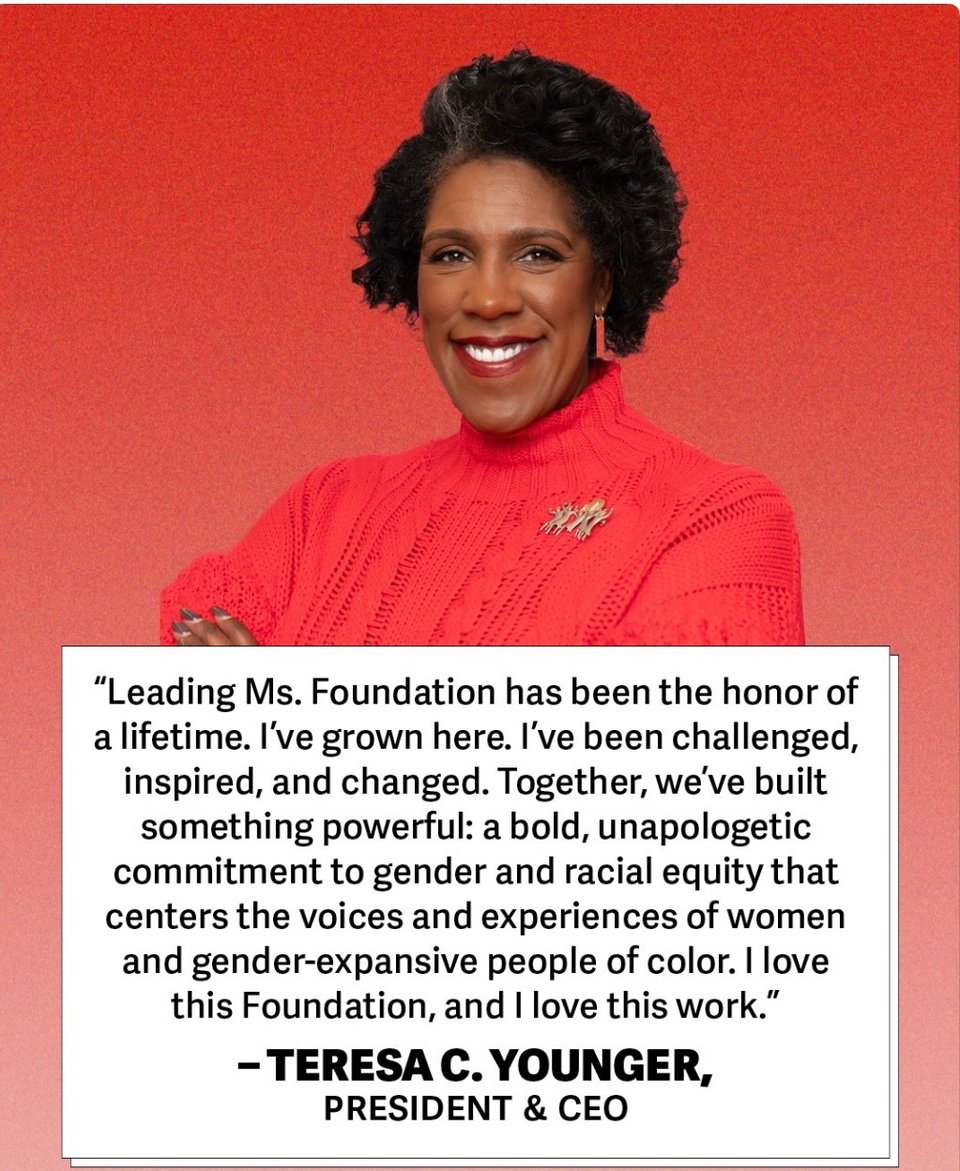
Teresa C. Younger, President and CEO of the Ms. Foundation for the past 13 years. It is her shoes that Tracy Sturdivant will fill.