Thursday, April 2, 2026. Annette’s Roundup for Democracy.
Mr. UnPopular. You know who I mean.
and he brings his enabling party with him.
Web Guide.
The share of Americans identifying as Democrats or Democratic-leaning independents reached 49% in the first quarter of 2026, matching recent highs, while the gap between Democrats and Republicans is the widest it has been since 2015. In New York specifically, as of March 2026, 47.60% of registered voters identify as Democrats.
National Trends in Democratic Identification
Recent data from early 2026 shows the share of Americans who identify as Democrats or lean Democratic is at 49%. This marks a significant lead over Republicans and Republican-leaning independents, representing the largest gap in party identification since 2015. While a new high of 45% of U.S. adults identified as independents in 2025, 27% identified directly as Democrats. When including those who lean Democratic, the figure rises to 47%.
Historically, the Democratic advantage in party identification has fluctuated. For instance, in 2024, 28% of Americans identified as Democrats, a slight decrease from 30% in 2020. However, by the second quarter of 2025, Democrats had regained an advantage, with 46% of U.S. adults identifying or leaning Democratic, compared to 43% for Republicans.
——————————————————-
Trump will not control mail-in voting.
Marc Elias was and is ready.👇
The Supreme Court this week.
Case # 1. The Court ruled 8-1 that the Colorado law banning conversion therapy violated the first Amendment.
On the Conversion Therapy Ruling by Grace Byron
As a conversion-therapy survivor, I was devastated to read that the Supreme Court struck down a Colorado state law barring the practice. In an 8–1 decision, delivered yesterday, on Trans Day of Visibility, the Justices found that such bans violated the First Amendment.
Only Justice Kentaji Brown Jackson dissented, reading from her thirty-five-page opinion from the bench. “Our First Amendment jurisprudence does not treat speech as existing in a vacuum,” she wrote, noting that the medical industry is sometimes regulated to protect public health. (Numerous medical organizations have condemned conversion therapy, including the American Psychological Association.)
Practitioners often call their process simply “counselling” or “gender exploratory therapy,” but the idea is the same—an attempt to steer youth away from becoming queer or trans. Kaley Chiles, the therapist who challenged Colorado’s ban on conversion therapy for young people, gave a statement framing transition and gender-affirming care as “state-approved goals.” Chiles argued that she offered people an alternative route to “help them when they choose the goal of growing comfortable with their bodies.”
Dysphoria is not a social contagion. Neither is transness an “orthodoxy,” as Justice Neil Gorsuch stated in his opinion. We are a tiny minority facing an avalanche of legislation that seeks to disrupt our daily lives. Transgender prison inmates have already been required to detransition and been subject to conversion therapy. In Kansas, transgender people were recently forced to surrender their driver’s licenses with little notice. These laws deny not just dignity but the right to live freely.
When former President Barack Obama called for an end to conversion therapy for children, in 2015, I worried that the momentum wouldn’t last. At the time, I was seeing a Christian counsellor who told me that if we healed the wounds of my past, I would be able to live in harmony with my “biological” gender and sexuality.
Not everyone who undergoes conversion therapy survives. Suicide is a real risk. Depression among trans people is often characterized by conservatives as evidence that their gender identity is the problem, when it can just as easily result from being constantly told by society, institutions, and therapists like the one I saw that something is wrong with them.
Conversion therapy did not stop me from going on hormone-replacement therapy or from getting a vaginoplasty—treatments that are becoming increasingly difficult for trans people to access today, under the Trump Administration. Seeing a conversion therapist did, however, do immeasurable damage to my psyche. Chiles says that she’s the kind of therapist “who will genuinely listen,” but if you ignore a child saying that they may be queer or trans, that’s simply suppressing free speech by another name. (The New Yorker).
Case #2. Oral Arguments. Birthright citizenship. To be ruled on in June.
Supreme Court appears skeptical of Trump’s bid to end birthright citizenship
President Donald Trump’s unusual presence at the Supreme Court on Wednesday didn’t seem to sway the justices, who sounded broadly skeptical about his attempt to upend the country’s long tradition of birthright citizenship.
Trump looked on from the front row of the public gallery as Solicitor General John Sauer attempted to defend Trump’s executive order that would deny U.S. citizenship to children of undocumented immigrants and foreigners on temporary visas.
The court’s conservative majority joined the liberals in aggressively questioning Sauer about the potential implications of disturbing the decades-long consensus on citizenship.
The president sat through about an hour of arguments before silently exiting after a lawyer for the American Civil Liberties Union stepped to the lectern to attack Trump’s policy as a violation of the Constitution’s 14th Amendment and Supreme Court precedent dating back to the 19th century.
Chief Justice John Roberts suggested it was strange for the administration to seize on some narrow exceptions to the birthright citizenship rule, such as an exclusion for American Indians and for children of diplomats, in order to justify denying citizenship to millions of children of undocumented immigrants and visitors.
“I’m not quite sure how you get to that big group from such tiny and idiosyncratic examples,” Roberts said.
Even Justice Samuel Alito, one of the court’s most strident conservatives, expressed some discomfort with the administration’s claim that the children of undocumented immigrants who’d spent years living in the U.S. could be denied citizenship on the grounds that their parents were not “domiciled” here. However, Alito laid blame for the situation at the feet of prior administrations.
“We have an unusual situation here because our immigration laws have been ineffectively and in some instances unenthusiastically enforced by federal officials,” Alito said. “So, there are people who are subject to removal at any time … but they have, in their minds, made a permanent home here and have established roots and that raises a humanitarian problem.”
Justice Neil Gorsuch also expressed doubt about the administration’s claim that one has to be living legally in the U.S. to be domiciled here and get citizenship for a child. He noted that when the 14th Amendment was adopted in the 1860s the U.S. had no real immigration laws and left foreigners free to take up residence here. “That was perfectly fine,” he said.
Roberts also responded sharply when Sauer claimed that illegal immigrants could be viewed as the modern equivalent of “temporary sojourners” that legislators never intended to permit to obtain citizenship for their children.
“It’s a new world. It’s the same Constitution,” the chief justice declared.
On Trump’s first day back in office last year, he signed an executive order declaring that children born in the U.S. to undocumented immigrants or those on limited-duration visas don’t get U.S. citizenship. The order was immediately hit with a flurry of lawsuits and never took effect, after being blocked by federal judges on both coasts, who said it violated long settled precedent.
Justice Amy Coney Barrett expressed concern that departing from the bright-line rule used for the past century, that almost anyone born on U.S. soil is a citizen, could lead to complicated disputes about the intent and status of the parents at the time.
“I can imagine it being messy in some applications,” she said.
Sauer repeatedly emphasized Wednesday that Trump’s order only applies to children that would be born in the future, but several justices said a ruling that the 14th Amendment doesn’t automatically confer citizenship on those born in the U.S. would also cast doubt on the citizenship of those already born and assumed to be citizens.
Trump held off until the arguments had concluded before weighing in on them via social media. “We are the only Country in the World STUPID enough to allow ‘Birthright’ Citizenship!” he wrote on Truth Social.
It was not an argument that seemed to have much traction with the justices, even the Trump appointees.
“We try to interpret American law with American precedent based on American history,” Justice Brett Kavanaugh said. “It’s certainly what I try to do. … Why should we be thinking about, even though as a policy matter I understand the point, ‘Gee, why don’t European countries have this?’”
Security at the court was stepped up for Trump’s visit with Secret Service agents shadowing Supreme Court police at the court’s entrances and elsewhere in the building.
Trump entered the ornate courtroom shortly before arguments began. He sat in a row of the gallery that is typically occupied by lawmakers and senior government officials.
Trump sat next to his White House counsel, David Warrington, with Commerce Secretary Howard Lutnick and Attorney General Pam Bondi sitting nearby in the same row.
Although many of the justices have been on the receiving end of sharp attacks and social media slams from Trump in recent weeks, the members of the court appeared nonchalant as they entered Wednesday. Alito looked briefly in Trump’s direction, but the president did not appear to monopolize any of their attention. (Politico)
One more thing.

More than 30 countries, mainly in the Western Hemisphere, guarantee citizenship to children born on their soil.
Trump off the rails
An aside. Here is how he gets such an idea.👇
————————————————-
Practical politics.
Election Day in Wisconsin is Tuesday, April 7.
Let’s protect the Blue Court. Vote and help get out the vote.
Sardi’s.
Why is Sardi's in NYC's Theater District Closing and When Will it Reopen?
This iconic restaurant in the Theater District is temporarily closing after 99 years in business
A year shy of its 100th birthday, the legendary Sardi's is going dark for renovations as the ownership changes.
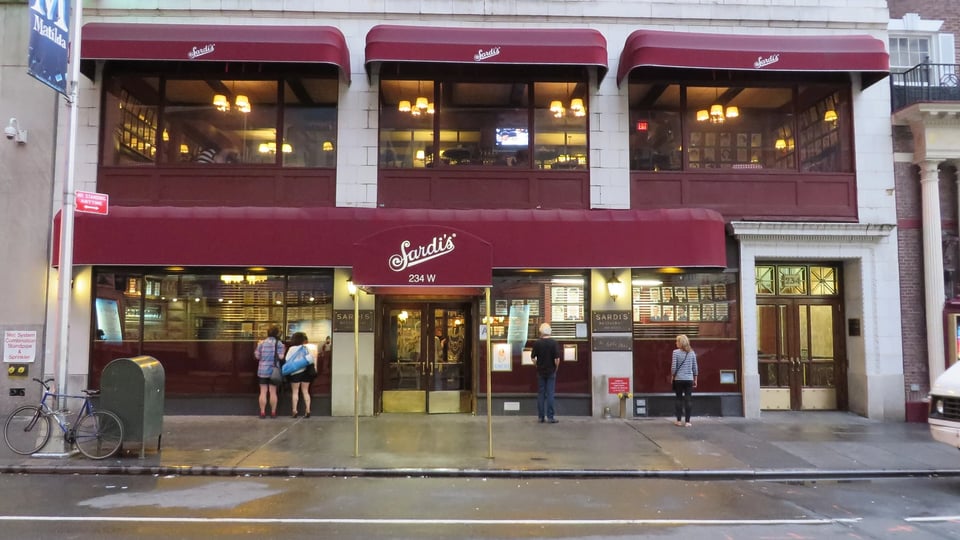
Few people know that Sardi’s, the Theater District restaurant known for its walls plastered with over 1,000 celebrity caricatures, was actually where the Tony Awards were first conceived. In the decades that ensued, the eatery has become a Broadway institution—serving as a gathering place for actors, producers, theater insiders and pre-show dining—by many considered to be the industry's unofficial clubhouse of sorts.
After 99 years in business, though, Sardi’s is getting ready for its next chapter. As first reported by the New York Times, the restaurant will close for renovations on June 24, just as current owner Max Klimavicius—who once worked there as a kitchen expediter—steps down after 33 years at the helm. Klimavicius recently sold the business to the Shubert Organization, the theater company that is also his landlord.
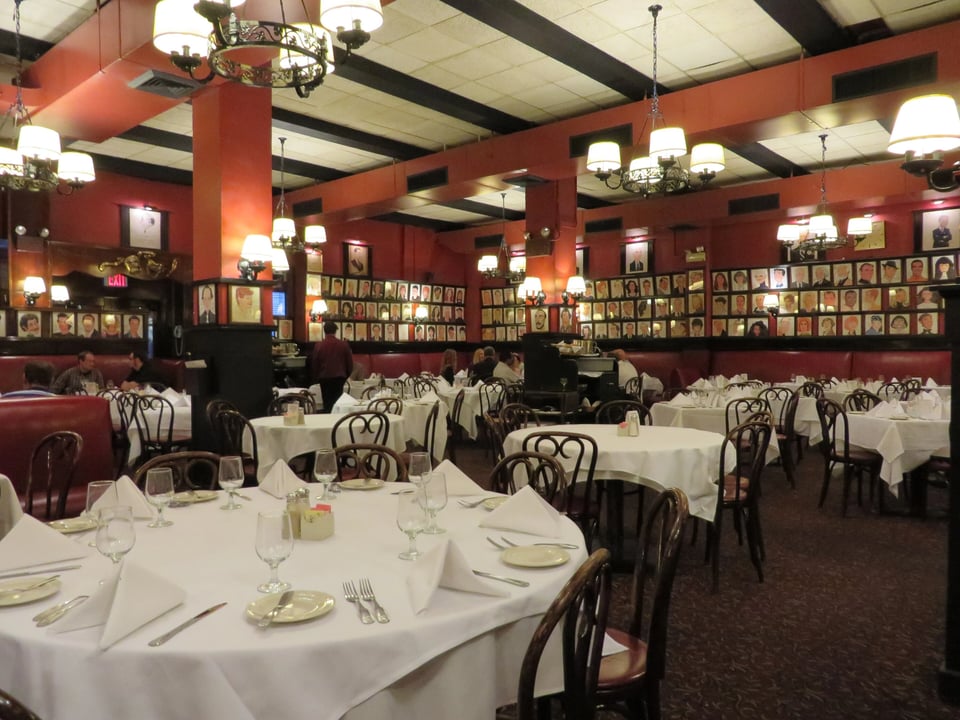
First things first: although Sardi’s will undergo a revamp, Klimavicius has been assured that the space will not be redesigned and, most importantly, those famous caricatures and burgundy banquettes will stay put. The restaurant's name will also remain the same.
No official timeline has yet been revealed, but the New York Times notes that a "freshened-up Sardi's should be ready to reopen" by the time the new musical Galileo will start previews at the Shubert Theatre across the street on November 10.
Although this is not a permanent closure—and it doesn’t sting quite as much given that a theater organization deeply aware of the restaurant’s legacy, and its importance to the industry, is taking the helm—the news still tugs at the heartstrings of New Yorkers who are to a constantly dealing with a shifting city. The announcement also follows a string of recent losses, including the shuttering of Elmo, one of the city’s longest-standing gay restaurants, and Barbetta, among its oldest Italian institutions.
At the very least, there’s some solace in the fact that places like Sardi’s have been immortalized in film and television—from The Muppets Take Manhattan to Smash and, most recently, Blue Moon (though the restaurant was recreated as a replica in Ireland)—ensuring their legacy lives on, even as the city around them continues to evolve.(timeout)

