Saturday, March 21, 2026. Annette’s Roundup for Democracy.
Some people want Americans to be healthy. Others do not.
Another reason to make sure Democrats win big in the Midterms - to take back the House and Senate, and yes, to control state legislatures.
How New Mexico Became an Obamacare Success Story.
Over the years, as the A.C.A. came under attack, state lawmakers took actions that protected those gains. When the federal tax on health insurers, originally part of the law, was repealed, New Mexico authorized an additional state-based surtax on the insurers in 2021 that created the state’s Health Care Affordability Fund.
While some of the money is used for general purposes, the fund is also used to lower the amount small businesses paid for coverage and to reduce the out-of-pocket costs for some people enrolled in Obamacare. It also provided the money to replace the federal subsidies, at least for a time.
The fund has become “a strong tool used to cushion folks from absorbing those costs,” said Abuko D. Estrada, the director of health care for the New Mexico Center on Law and Poverty. He added that the state had been “chipping away” at making insurance and health care more affordable to its residents, many of whom are poor.
Carmen Meyer, a nurse who now works as a consultant in Albuquerque, said she burst into tears last fall when she saw that the Obamacare premiums for her family were going up by about $1,500 a month. “It was so scary to see that,” she said. She and her husband would have had to raid their retirement savings to remain insured. With the state subsidies she is still paying $450 more than last year, but it is much less of a strain on her finances than she feared.
Similarly, when the first Trump administration ended the federal payments that provided incentives for insurance companies to offer plans that had lower deductibles and co-payments for low-income people, New Mexico found a way to make sure some residents were not priced out. New Mexico required that insurance companies calculate their prices in a way that made plans more affordable to a greater number of people.)
Affordable Care Act enrollment has dropped across the United States since the enhanced federal subsidies expired. But New Mexico has record numbers of people signing up.
When Congress did not extend the Obamacare subsidies that had been in place since the pandemic, JennTara Ward faced an increased health insurance bill for her family that was more than their monthly mortgage payment and about five times what they paid last year.
Beginning this year, their monthly cost would have soared to about $3,000.
Ms. Ward, who owns a yoga and wellness business in Santa Fe, N.M., and her husband, an acupuncturist whose job does not include health insurance, were not sure what to do. Could their teenage son play sports if he didn’t have coverage? Should they move to another country? Maybe she could find a different job with an employer that did offer health insurance?
The options were not great. So they were relieved to discover that New Mexico had fully replaced the expired federal subsidies with state money, the only state to do so. Without the subsidies, an estimated 27,000 New Mexicans would have dropped their insurance. Instead, sign-ups have surged, with an additional 10,000 people now covered.
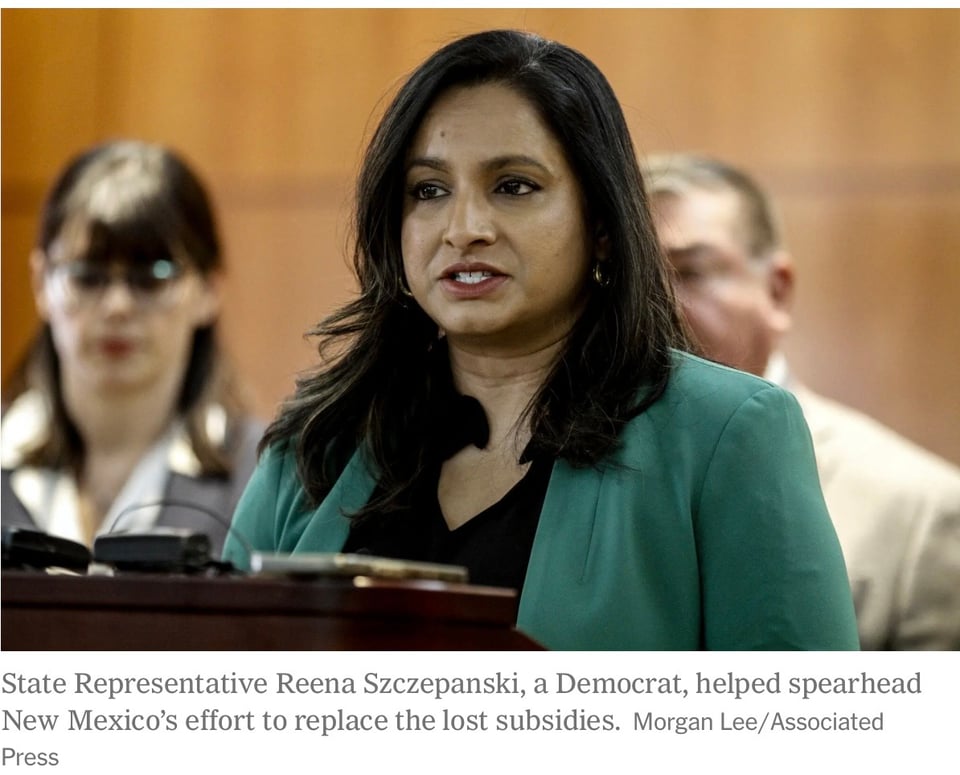
“We are so proud of the incredible enrollment on the health insurance exchange,” said State Representative Reena Szczepanski, a Democrat who helped spearhead the effort to replace the lost subsidies. “We’ve broken all records this year.”
In a special legislative session last fall, Representative Szczepanski, the House majority leader, and her colleagues, including some Republicans, agreed to make up for the missing federal subsidies until mid-2026. Then, this month, the governor signed legislation allowing New Mexico to make up the difference for at least another year, until mid-2027, using money from a special health care fund.
“Subsidies work, we know they work,” said Alex Sanchez, the chief experience officer for the New Mexico marketplace, BeWell.
Nearly two dozen states, including New Mexico, have taken actions that appear to have blunted the impact of the lost federal subsidies. Some of these moves were in direct response to the expiration of the subsidies, while others had been in place for years.
While only New Mexico found the money to fully replace the subsidies, other states, including California, Massachusetts and Vermont, offered their own subsidies that could help make up for some of the missing money.
Some states, including New York and Minnesota, have special programs for residents to help them with coverage.
Americans in other places have not been as lucky. Overall enrollment in Obamacare has declined nationally by more than one million people since early 2025, the first drop since 2020. In the coming months, policy experts say, they expect more people to cancel their coverage after receiving insurance bills that they cannot pay. The final tally will not be clear until the summer.
A follow-up survey released on Thursday by KFF, a nonprofit that conducts polling and research on health policy, found that 9 percent of the people it previously surveyed who were covered under the Affordable Care Act last year had dropped their coverage and were now uninsured. Among those who signed up again, 17 percent said they were not confident they would be able to afford their premiums this year.
Some states have already experienced substantial declines in enrollment. In North Carolina, it dropped by about 20 percent, or about 200,000 people. Insurance rates in the state were set to increase by an average of nearly 30 percent for 2026.
“Many just were shocked by the substantially higher premiums,” said Nicholas Riggs, the director of the NC Navigator Consortium, which helps people in the state enroll in Obamacare coverage. Many people he spoke with had concluded that they simply could no longer afford the cost of insurance, he said.
But New Mexico, which has Democratic majorities in the Legislature and a Democratic governor, has long embraced the Affordable Care Act. Before the law took effect, about a fifth of its population was uninsured. The state took advantage of the law’s insurance reforms, expanding Medicaid and enrolling people in Obamacare, to reduce that rate by roughly half.
Over the years, as the A.C.A. came under attack, state lawmakers took actions that protected those gains. When the federal tax on health insurers, originally part of the law, was repealed, New Mexico authorized an additional state-based surtax on the insurers in 2021 that created the state’s Health Care Affordability Fund.
While some of the money is used for general purposes, the fund is also used to lower the amount small businesses paid for coverage and to reduce the out-of-pocket costs for some people enrolled in Obamacare. It also provided the money to replace the federal subsidies, at least for a time.
The fund has become “a strong tool used to cushion folks from absorbing those costs,” said Abuko D. Estrada, the director of health care for the New Mexico Center on Law and Poverty. He added that the state had been “chipping away” at making insurance and health care more affordable to its residents, many of whom are poor.
Carmen Meyer, a nurse who now works as a consultant in Albuquerque, said she burst into tears last fall when she saw that the Obamacare premiums for her family were going up by about $1,500 a month. “It was so scary to see that,” she said. She and her husband would have had to raid their retirement savings to remain insured. With the state subsidies she is still paying $450 more than last year, but it is much less of a strain on her finances than she feared.
Similarly, when the first Trump administration ended the federal payments that provided incentives for insurance companies to offer plans that had lower deductibles and co-payments for low-income people, New Mexico found a way to make sure some residents were not priced out. New Mexico required that insurance companies calculate their prices in a way that made plans more affordable to a greater number of people.
Over the years, as the A.C.A. came under attack, state lawmakers took actions that protected those gains. When the federal tax on health insurers, originally part of the law, was repealed, New Mexico authorized an additional state-based surtax on the insurers in 2021 that created the state’s Health Care Affordability Fund.
While some of the money is used for general purposes, the fund is also used to lower the amount small businesses paid for coverage and to reduce the out-of-pocket costs for some people enrolled in Obamacare. It also provided the money to replace the federal subsidies, at least for a time.
The fund has become “a strong tool used to cushion folks from absorbing those costs,” said Abuko D. Estrada, the director of health care for the New Mexico Center on Law and Poverty. He added that the state had been “chipping away” at making insurance and health care more affordable to its residents, many of whom are poor.
Carmen Meyer, a nurse who now works as a consultant in Albuquerque, said she burst into tears last fall when she saw that the Obamacare premiums for her family were going up by about $1,500 a month. “It was so scary to see that,” she said. She and her husband would have had to raid their retirement savings to remain insured. With the state subsidies she is still paying $450 more than last year, but it is much less of a strain on her finances than she feared.
Similarly, when the first Trump administration ended the federal payments that provided incentives for insurance companies to offer plans that had lower deductibles and co-payments for low-income people, New Mexico found a way to make sure some residents were not priced out. New Mexico required that insurance companies calculate their prices in a way that made plans more affordable to a greater number of people. ( Reed Abelson, New York Times)
Unconstitutional and utterly unAmerican.
Here is a deeper dive into Hegseth’s Christian Nationalism.👇
Pete Hegseth’s Christian rhetoric draws renewed scrutiny after the US goes to war with Iran.
WASHINGTON (AP) — Since becoming defense secretary, Pete Hegseth has found no shortage of ways to bring his strand of conservative evangelicalism into the Pentagon.
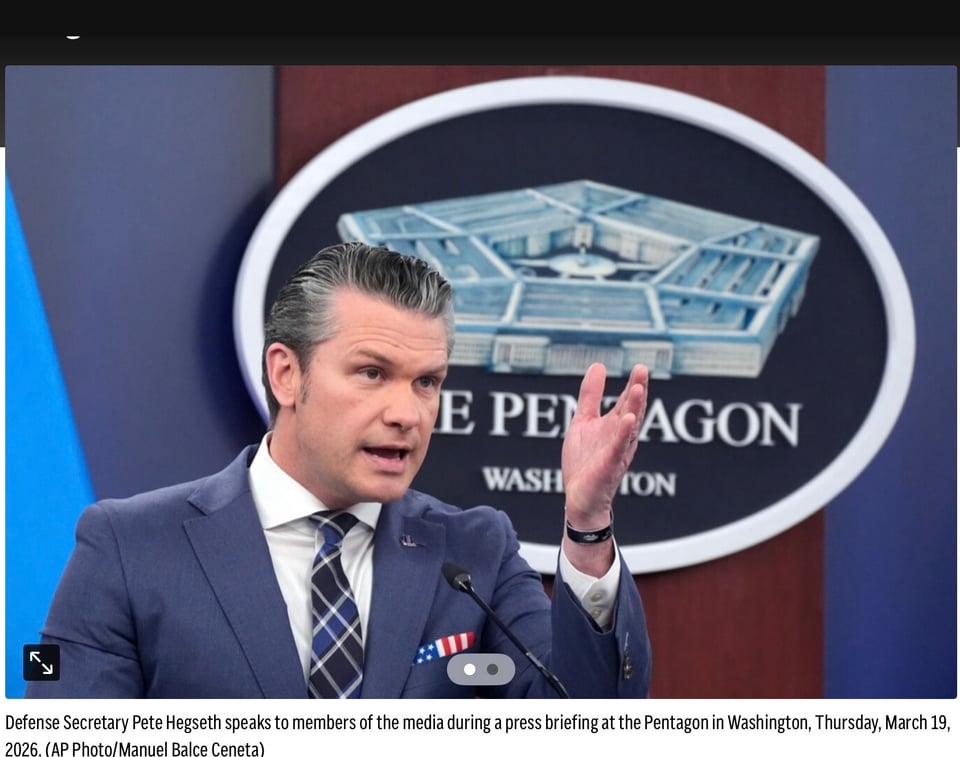
He hosts monthly Christian worship services for employees. His department’s promotional videos have displayed Bible verses alongside military footage. In speeches and interviews, he often argues the U.S. was founded as a Christian nation and troops should embrace God, potentially risking the military’s secular mission and hard-won pluralism.
Now the defense secretary’s Christian rhetoric has taken on new meaning after the U.S. and Israel went to war with Iran, an Islamic theocracy.
“The mullahs are desperate and scrambling,” he said at a recent Pentagon press briefing, referring to Iran’s Shiite Muslim clerics. He later recited Psalm 144, a passage of Scripture that Jews and Christians share: “Blessed be the Lord, my rock, who trains my hands for war and my fingers for battle.”
Hegseth has a history of defending the Crusades, the brutal medieval wars that pitted Christians against Muslims. In his 2020 book “American Crusade,” he wrote that those who enjoy Western civilization should “thank a crusader.” Two of his tattoos draw from crusader imagery: the Jerusalem Cross and the phrase “Deus Vult,” or “God wills it,” which Hegseth has called “the rallying cry of Christian knights as they marched to Jerusalem.”
Matthew D. Taylor, a visiting scholar at Georgetown who studies religious extremism and has been a frequent Hegseth critic, said, “The U.S. voluntarily going to war against a Muslim country with the military under the leadership of Pete Hegseth is exactly the kind of scenario that people like me were warning about before the election and throughout his appointment process.”
Taylor said Hegseth’s rhetoric and leadership “can only inflame and reinforce the fears and deep animosity that the regime in Iran has towards the U.S.”
When asked whether Hegseth views the war in Iran in religious terms, a Defense Department spokesperson pointed to a recent CBS interview in which Hegseth seemed to confirm as much.
“We’re fighting religious fanatics who seek a nuclear capability in order for some religious Armageddon,” Hegseth said of Iranian leaders. “But from my perspective, I mean, obviously I’m a man of faith who encourages our troops to lean into their faith, rely on God.”
** Allegations US military commanders cited biblical prophecies remain unverified.**
Generations of evangelicals have been influenced by their own version of Armageddon and the end of the world, circulated by books like the “Left Behind” series and “The Late Great Planet Earth,” or the horror film “A Thief in the Night.” Some evangelicals espouse prophecies in which warfare involving Israel is key to bringing about the return of Jesus.
Christian Zionist pastor John Hagee, head of Christians United for Israel, said of the Iran war, “Prophetically, we’re right on cue.”
The co-founder of Hegseth’s denomination, however, does not teach this theology. Pastor Doug Wilson of the Communion of Reformed Evangelical Churches identifies as a postmillennialist, meaning he believes most of the apocalyptic events of the Bible have already happened, paving the way for the gradual Christianization of the world before Christ’s return.
Hegseth has not said the Iran war is part of Christian prophecy. Yet days after the conflict began, claims went viral that U.S. military commanders were telling troops the war fulfilled biblical prophecies around Armageddon and the return of Christ.
The Associated Press has not been able to verify these claims, which stem from one source: Mikey Weinstein, the head of the Military Religious Freedom Foundation, a watchdog group. Based on allegations Weinstein said he received from hundreds of troops, 30 Democratic members of Congress asked the Pentagon inspector general to investigate.
In an interview with the AP, Weinstein declined to provide documentation or the original emails he received from service members. He said troops were afraid of retaliation, so they would not speak to the media, even if their identities remained protected.
Three major religion watchdog groups — the Freedom From Religion Foundation, the Anti-Defamation League and the Council on American-Islamic Relations — said they have not received similar complaints. The Pentagon declined to comment on the allegations.
Hegseth wants to reform the military chaplain corps.
Hegseth’s church network, the CREC, preaches a patriarchal form of Christianity, where women cannot serve in leadership, and pastors argue that homosexuality should be criminalized. Hegseth last year reposted a video in which a CREC pastor opposed women’s right to vote. Wilson, its most prominent leader, identifies as a Christian nationalist and preached at the Pentagon in February at Hegseth’s invitation.
Both Wilson and Hegseth have questioned Muslim immigration to the United States. Wilson argues the country should restrict Muslim immigration in order to remain predominantly Christian. In “American Crusade,” Hegseth lamented growing Muslim birth rates and that Muhammad was a popular boys’ name in the U.S.
As head of the armed forces, Hegseth has overseen changes that are in line with his conservative Christian worldview, including banning transgender troops, curtailing diversity initiatives and reviewing women in combat roles.
Youssef Chouhoud, a political scientist at Christopher Newport University, said, “The intrusion of Christian nationalist policy, not just Christian nationalist rhetoric … that is what’s troubling.”
Hegseth has pledged to reform the military’s chaplain corps, which provides spiritual care to troops of any faith and no faith at all. He scrapped the 2025 U.S. Army Spiritual Fitness Guide and wants to renew chaplains’ religious focus, which he said in a December video message has been minimized “in an atmosphere of political correctness and secular humanism.”
Rabbi Laurence Bazer, a retired U.S. Army colonel and chaplain, said it risks making service members feel like outsiders when the language of military leadership draws exclusively from one faith tradition.
“The U.S. military reflects the full diversity of this country — people of every faith step forward to serve,” Bazer said in a statement. “That diversity is a strength worth protecting.” (Associated Press)
One more thing.
Guess who is the opposite of Pete Hegseth.
Guess who is helping out in the Middle East.
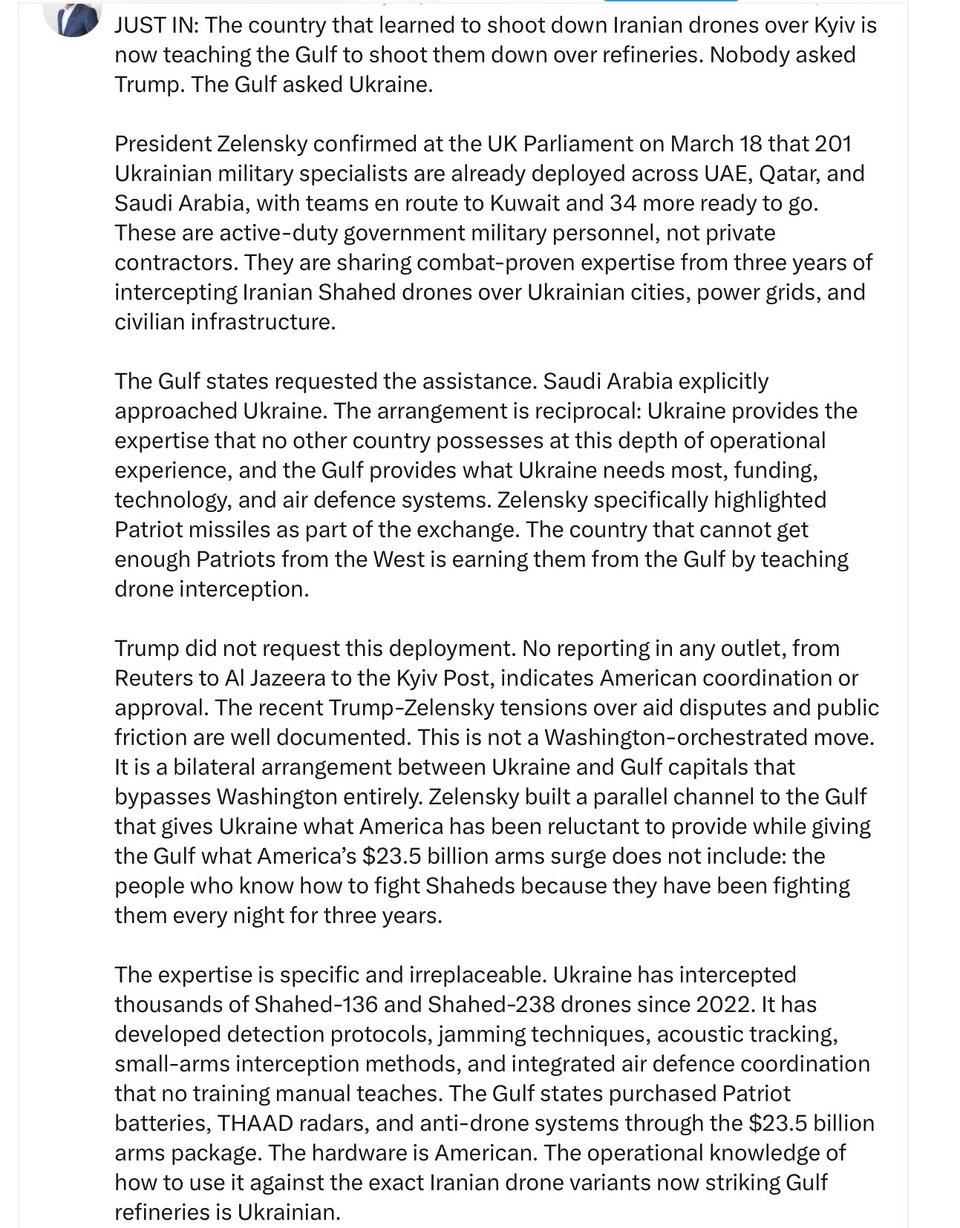
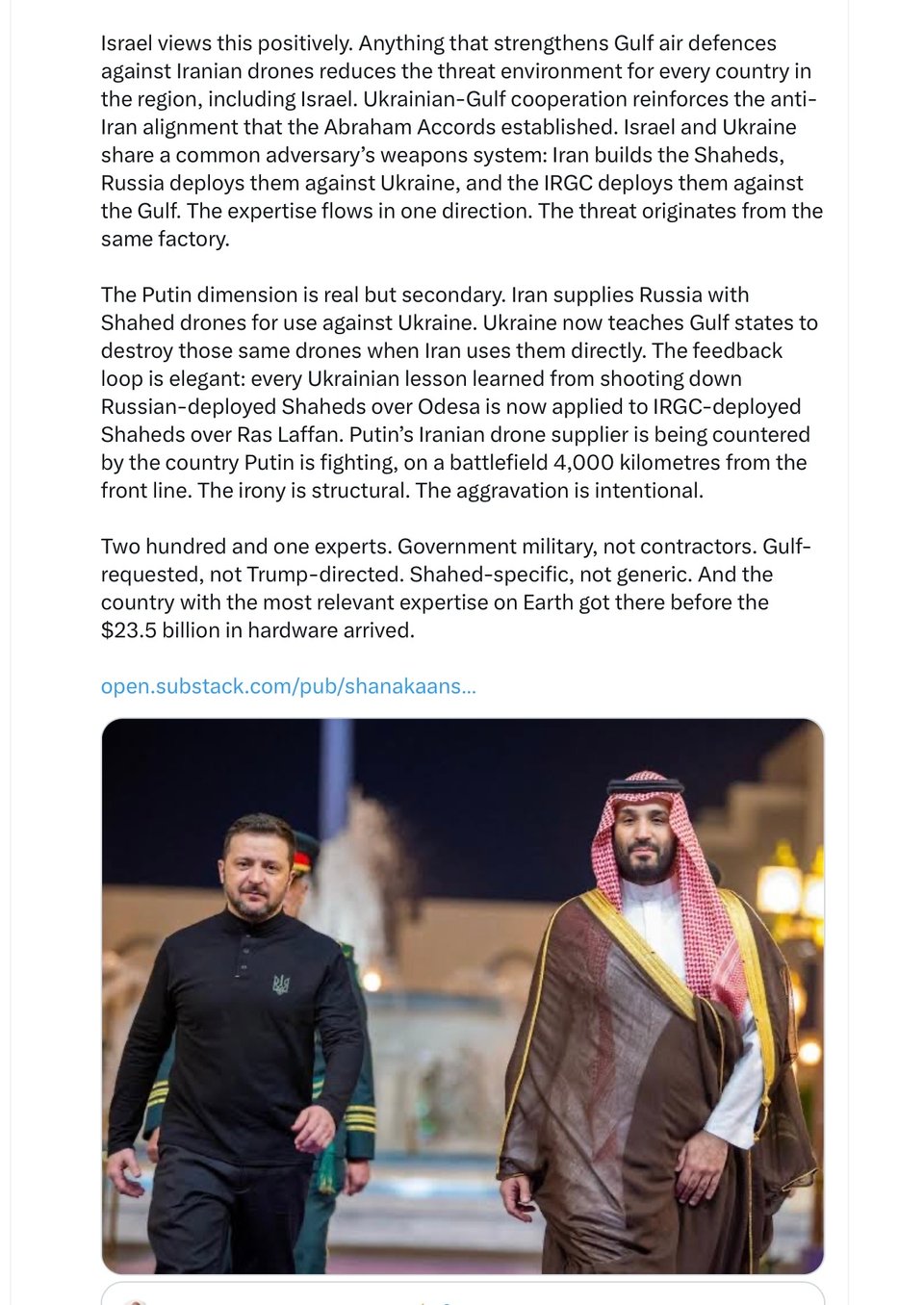
One more thing.
Some know how to show appreciation to Ukraine.
With a lying sociopath in the White House, who knows what to believe.
This was his announcement on Friday. What will happen on Sunday? Who knows.
Trump considers "winding down" Iran war without opening Hormuz Strait.
President Trump said on Friday he is considering "winding down" the war with Iran without solving the crisis over the closure of the Strait of Hormuz.
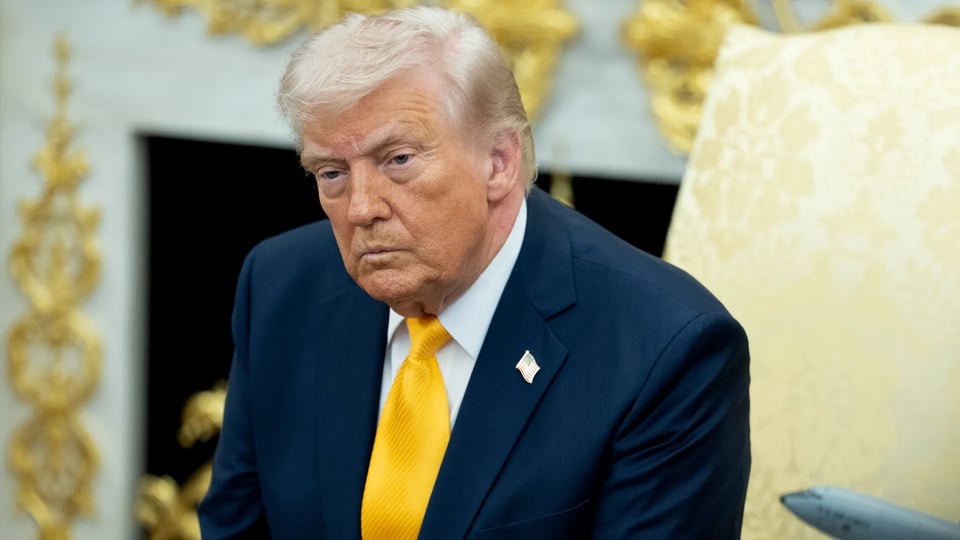
Why it matters: Trump has said for several days that the war could end soon, but this is the strongest signal yet that he's actively moving in that direction. If he does walk away without reopening the strait, the U.S. would be leaving other countries to clean up a hugely consequential economic quagmire.
What he's saying: "We are getting very close to meeting our objectives as we consider winding down our great Military efforts in the Middle East with respect to the Terrorist Regime of Iran," Trump wrote on Truth Social.
He listed degrading Iran's missile capability and industrial base, eliminating the Iranian navy and air force, preventing Iran from obtaining a nuclear weapon, and protecting U.S. allies in the Middle East, most of which were attacked during the war.
"The Hormuz Strait will have to be guarded and policed, as necessary, by other Nations who use it — The United States does not," Trump wrote. "If asked, we will help these Countries in their Hormuz efforts, but it shouldn't be necessary once Iran's threat is eradicated."
Reality check: A U.S. official said he doesn't think Trump's post signals an imminent end to the war.
"He just said we are getting close. In the meantime, the U.S. military is striking hard and continuously. It will be a couple of weeks."
The U.S. is sending thousands of Marines to the region and conducting extensive strikes to reduce Iran's capacity to menace the strait. Some Trump advisers still think ground operations are likely.
White House Press Secretary Karoline Leavitt said the "President and the Pentagon predicted it would take approximately 4-6 weeks to achieve this mission. Tomorrow marks week 3." Another White House official echoed the message that Trump was emphasizing that the mission was on target.
Between the lines: The Hormuz crisis has Trump trapped: He can't end the war on his terms unless he breaks Iran's chokehold on Gulf oil, but reopening the strait by force would risk escalation and potentially put U.S. troops in the line of fire.
Trump originally wanted to end the war before the end of March, sources say, but the crisis in the strait has compelled him to press on longer than he'd planned.
While Trump suggested in his post that securing the strait would be easy, his team has been flummoxed over how best to achieve it.
The White House has been discussing options, such as seizing Kharg Island off the Iranian coast, to force Iran to open the strait.
Inside the room: Allies and advisers who have spoken with Trump describe a president divided over the war.
On one hand, he's worried about the price of oil and annoyed he can't get allies to help solve the Hormuz closure.
On the other, he's thrilled with the raw exercise of military might obliterating Iranian leaders and military capabilities.
"We're hot! We're winning!" he told a confidant opposed to the war who relayed the remarks to Axios.
Polls show the war is highly unpopular overall, but Trump prefers to focus on the high percentage of MAGA Republicans who back it, his advisers say.
The flip side: Trump wanted NATO countries and other allies to send warships, minesweepers and aircraft as part of a coalition to reopen the strait.
Most U.S. allies refused. The U.K. managed to get several Western countries to sign a political statement supporting such a coalition, without committing to sending forces.
That statement didn't satisfy Trump. On Friday, he called NATO countries "cowards" and said that without the U.S., NATO is "a paper tiger."
The bottom line: It would be an extraordinary step to withdraw U.S. forces and support without solving a major economic crisis that resulted from the war and is driving gas prices up at home. (Axios,)
Picking your favorite candidates for the Midterms?
Michigan, Senatorial race.
Some have made up their minds.
Some updates to make you smile.
Time to march in protest again!

And from New York.
Yesterday was the first day of Spring.