Saturday, July 11, 2026. Annette's Roundup for Democracy.
Housing Bill becomes law without Trump.




Graham Platner is now officially out in Maine.
July 27 is the deadline for anew Democratic candidate to be named.

A remarkable artwork will now be seen in the place whose history it depicts.
The Bayeux Tapestry is at the British Museum after a secret journey from France.
LONDON (AP) — After almost 1,000 years, the Bayeux Tapestry is back on English soil.
In scenes like a heist movie in reverse, the priceless medieval artwork was spirited into the British Museum on Friday in the dead of night, after a high-tech, tight-security operation where any slip-up could have spelled disaster.
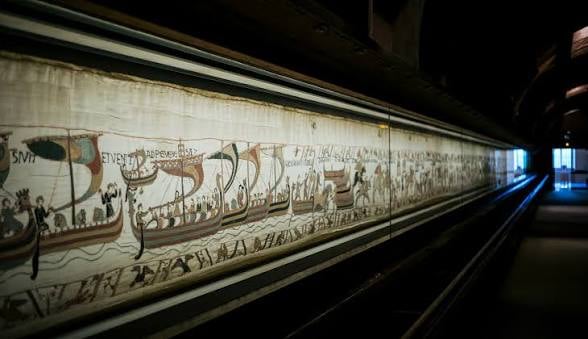

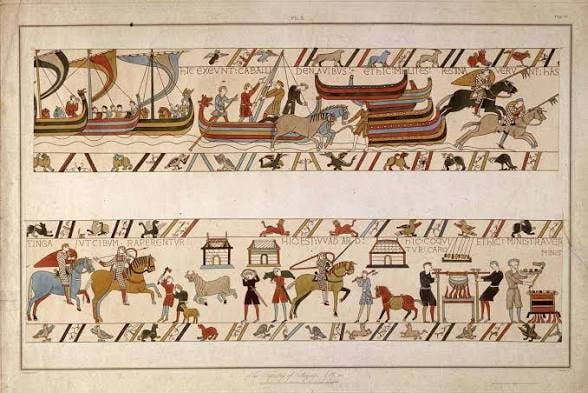

On loan from its home in France, the tapestry will go on display at the London museum from Sept. 10 until July 2027. It’s a public homecoming for a vivid visual record of the 1066 Norman invasion, the last successful conquest of England.
The tapestry’s arrival in London has been widely anticipated, but due to security concerns all details of when and how it would arrive were kept under wraps.
“It feels extraordinary that after so much work and planning and care and thought that it’s actually happening,” British Museum Director Nicholas Cullinan said as he waited outside the museum in the dark.
“It’s the first time in 1,000 years that such an important piece of British — French too — history is going to be on these shores,” he said. “It’s incredibly exciting.”
The 70-meter (230-foot) tapestry was folded accordion-style in a climate-controlled case that was placed inside a shock-absorbing cradle. That went into a truck that crossed from France on a vehicle shuttle train through the Channel Tunnel.
After an 11-hour, 350-mile (560-kilometer) trip, escorted by police, the truck backed slowly into a loading bay at the museum, where workers gingerly eased the container, the size of a small car, to the ground. Museum staff and British and French diplomats who had been watching in hushed silence broke into applause.
The priceless cargo will spend several days acclimatizing before it is carefully unpacked and unfolded for an exhibition that the museum expects to be one of the most popular in its 267-year history. Some 100,000 tickets were sold in their first day on sale this month.
“It was like trying to get tickets to Glastonbury,” Cullinan said. “I don’t take for granted that people care that much about a 1,000-year-old embroidery. I think that’s an amazing thing.”
The tapestry is a symbol of Anglo-French relations
Stitched in wool thread on linen fabric — technically an embroidery, rather than a tapestry — the artwork depicts events leading up to the Battle of Hastings in October 1066, when William, Duke of Normandy defeated King Harold’s Anglo-Saxon army. The invasion ended Saxon rule, made William the Conqueror the first Norman king of England and bound Britain and France more closely together.
Historians believe the tapestry was commissioned by Bishop Odo of Bayeux, William’s half brother, and was probably sewn by women in England — possibly nuns — before being taken across the Channel. It has spent most of the last millennium in the town of Bayeux in northwest France, apart from two short periods at the Louvre in Paris.
The tapestry symbolizes the sometimes fractious, intertwined histories of France and Britain, and securing the loan was a high-stakes diplomatic mission. It was announced during a state visit to the U.K. by French President Emmanuel Macron in July 2025.
The loan coincides with renovations at the museum in Bayeux that houses it.
In return, the British Museum will loan treasures from the Sutton Hoo hoard — artifacts from a 7th-century Anglo Saxon ship burial — and other items to museums in Normandy.
Macron said in an article for Friday’s Times of London that “our two countries are not merely lending each other artworks: they are sharing the great narratives of European history’s origins.”
Retired British diplomat Peter Ricketts, who helped cement the deal as the U.K.’s special envoy for the tapestry, said “it’s an extraordinary mark of friendship and confidence in the U.K. to entrust this object to us for a year.”
“Macron, when he offered us the tapestry, I think he understood that it would have far more impact in the U.K. than it does in France, because it’s more fundamental to our national story,” he said. “Everybody (in Britain) knows 1066.”
It’s a vivid record of 11th-century life and death
The tapestry features more than 620 people and 737 animals and tells its story in 58 scenes brimming with vivid and sometimes gory detail. There are scenes of hand-to-hand combat, mutilated bodies and the unlucky Harold, felled by an arrow through his eye.
“It has an emotional richness that is really difficult to get from written sources,” said Millie Horton-Insch, project curator for the British Museum exhibition. “It just brings people closer to this history than any other object can. It’s not the same as reading a text. You are looking at something that was handled by the people who lived through it and felt compelled to record these events in this way.”
She said the document’s survival for 10 centuries despite myriad dangers — “moths, mice, mold, damp, fire” — is miraculous, and may be partly due to its humble materials.
“It’s not really made of any blingy fabric,” she said. “It’s not gold, it’s not silver. There wasn’t the same temptation to cut it up and make it into vestments or repurpose it for anything.”
Some French cultural figures opposed the loan, arguing that moving the tapestry was too risky. Cullinan said the expert teams went to great lengths to ensure its safety, including making two trial runs of the journey to show it would not cause the fragile item too much stress.
“Such care has gone into it. I can’t think of a level of care for any other museum loan,” he said.
He said he understands why there are concerns.
“The tapestry arouses great interest and passion,” he said. “Which is a wonderful thing.” (Associated Press)
What does this mean? Are New York City public schools failing black children?
Just 3 Black students admitted to NYC's elite Stuyvesant High School, data shows
Just three Black students were admitted to elite Stuyvesant High School’s ninth-grade class of 777 in the last school year, according to the latest statistics from the city’s education department.
The new statistics are in keeping with a pattern that has persisted for years at the city’s eight specialized public high schools, which are some of the most competitive and well-regarded schools in the city.
Shortly before taking office, Mayor Zohran Mamdani said he would not seek to change the specialized high school entrance exam, which critics say exacerbates segregation in the system.
In 2025, just eight Black students made the cut for Stuyvesant, while 10 were admitted in 2024.
Every year, the tiny number of Black students admitted to the vaunted school captures headlines, and it has become shorthand for the persistent lack of diversity in the city’s public school system.
Many integration advocates have denounced the Specialized High School Admissions Test or SHSAT, which determines entry into the rigorous schools. Supporters of the test have defended it as an objective measure that rewards achievement.
Past efforts to replace the SHSAT have failed. Mamdani said while campaigning last fall that he has no plans to get rid of the SHSAT.
That marked a shift. Mamdani — who attended The Bronx School of Science — had said during his Assembly campaign years earlier that he favored abolishing the test. In an interview on WNYC’s “The Brian Lehrer Show” last summer, he called the low number of Black and Latino students admitted to the schools “jarring,” and said he hoped to address underlying inequities by boosting resources for all schools.
This year, 30 of the 726 students admitted to Mamdani's alma mater were Black.
City Hall did not immediately respond to a request for comment on the latest specialized high school admissions numbers. In a statement about the overall admissions data, Schools Chancellor Kamar Samuels acknowledged “more work ahead.”
"As we continue working to make our schools safer, more rigorous, and more integrated across every borough, I remain committed to building a system where every child, in every neighborhood, has access to a high-quality education where they can learn, thrive, and grow into tomorrow's leaders,” he said.
The city said approximately 26,100 eighth graders took the SHSAT this year, and about 4,000 received an offer based on their score. Just 140 Black students received an offer to any of the specialized schools.
About 800 students who just missed the cutoff will be invited to the Discovery program, “which provides opportunities for disadvantaged students” to attend one of the specialized schools.
In addition to the three Black students, Stuyvesant's freshman class includes three Native American students, 21 Latino students, 39 multiracial students, 133 white students and 534 Asian students. The races of 44 students are "unknown," according to data.
“The release of NYC's specialized high school offer numbers has become its own Groundhog Day,” said Nyah Berg, executive director of New York Appleseed, which advocates for integrated schools. “Every year we look at the glaring disparities in these numbers, and every year nothing is done about them. The question for City leaders continues to be how many years must pass before we address the stain of segregation on admissions to schools held up as some of the best in the country, yet among the most segregated?”
Overall, officials said 70,100 eighth graders applied to high schools across the city, with 58% receiving an offer to their first choice, and 82% receiving an offer to their first three choices.(The Gothamist)
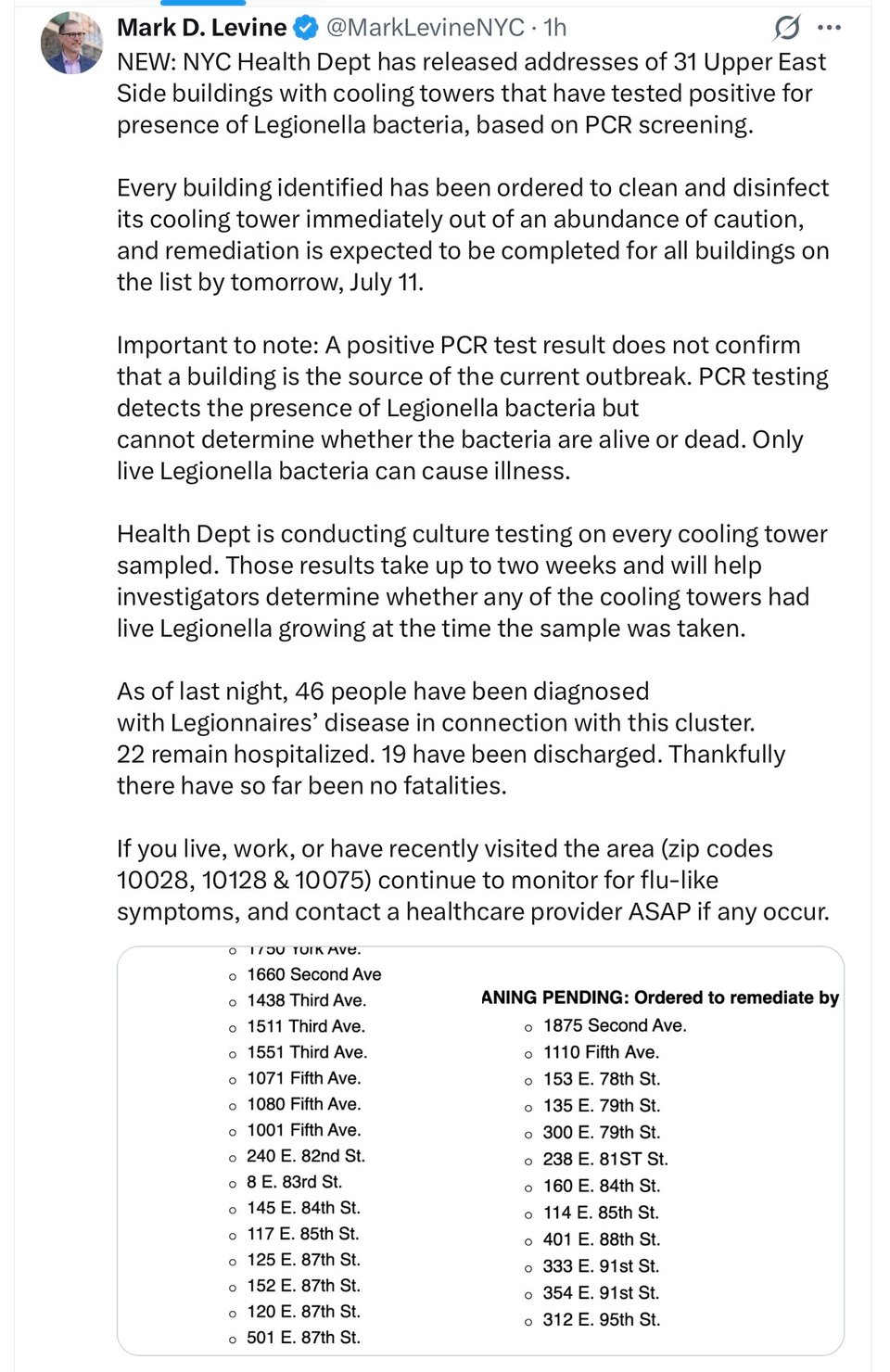
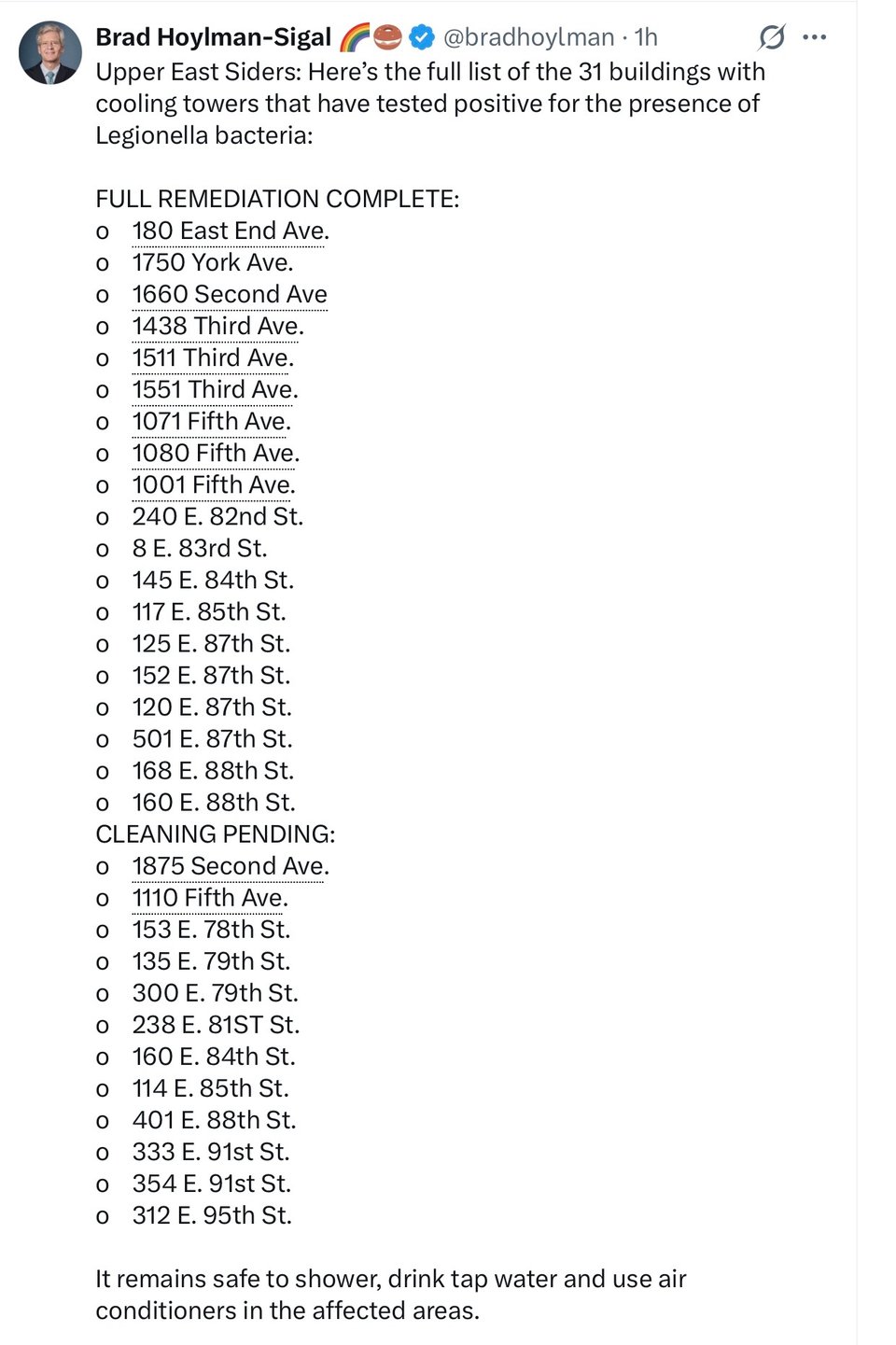
46 New Yorkers come down with Legionnaires Disease.
Local officials explain how the city is trying to protect its citizens.
The NYC Comptroller.
The Manhattan Borough President.
See you on Tuesday!

