Saturday, December 27, 2025. Annette’s Roundup for Democracy.
Trump’s feeble attempt at Kennedy Honors.
🚨JUST IN: CBS’s Kennedy Center Honors just hit an all-time ratings low. Preliminary Nielsen data shows only ~2.65M viewers tuned in to the Trump-hosted show, down from 4.1M in 2024. A stunning 35% year-over-year collapse. pic.twitter.com/45mH1kz01n
— MeidasTouch (@MeidasTouch) December 24, 2025
From Peter Marks, who until 2025 was the chief theatre critic of The Washington Post.
With apologies to “Let it Snow.”
Oh the Honors last year were toasted.
But this time an asshole hosted.
The whole damn shebang was botched.
No one watched, no one watched, no one watched.
They’ve plunged the show into crisis
The taste is Bari Weiss’s.
With an emcee whose hands are blotched
No one watched, no one watched, no one watched.
When the ratings came out next day
The ketchup was hid for safe keeping
And Melania was heard to say
“Vonce again vit him I’m not schleeping.”
He recited his fascist credo
Stuffed into a black tuxedo,
Another milestone for trump was notched,
No one watched, no one watched, no one watched!
Breakin’!
Before changing its name to the Trump-Kennedy Center, the board of trustees apparently forgot to secure the new website domain.
— CONSEQUENCE (@consequence) December 26, 2025
Unfortunately for them, the domain is now owned by comedian and former South Park writer Toby Morton.https://t.co/BP13EIivdS
BREAKING: New CNN Poll says Trump is the worst President in history. pic.twitter.com/9RHqu42AHP
— Morgan J. Freeman (@mjfree) December 26, 2025
The most powerful article I have read about Jeffrey Epstein and the complicit men who joined him.
The Epstein Files Should Not Have Been Released This Way

As we try to find some cozy solace with our families for the holidays, the Department of Justice is starting to — as required by a law that it took an open political revolt by the MAGA base to enact — release the Epstein files. It is doing so in what seems to be the most haphazard, obfuscatory and confusing a manner possible. As a result, we are not getting much closer to the truth about many of the fundamental facts of how Jeffrey Epstein ran his sex-trafficking ring, spun his favors and kept some of the most powerful men on the planet in his orbit.
Oh, actually, we do know something of how the last part went: He facilitated their receiving the attentions of young women. Some of this was plainly illegal — sex trafficking and rape. Much of the rest of it fell into the legal gray zone of abusive or exploitative. In any case, we seem no closer to getting justice for the women who were the victims of this vast scheme.
The release of the Epstein files was not supposed to be this way. The fight was to get them released, and then all would be revealed. Instead, social media is filled with a bewildering number of documents — some real, many not — and photographs with celebrities and without context. The contents have clearly been selectively released by the Department of Justice, a lot of it highly redacted, revealing little but stirring up much. (Referring to some of these materials, the department has said it “simply reproduced” redacted content.) The flood of files has created the worst possible outcome, an even more hyperpartisan blame game that is completely unfocused on justice for the victims.
And the powerful men that Mr. Epstein cavorted with, who in turn seemed to provide him with so much? Why did many of his 10 possible conspirators have their names shielded? Are they being protected?
For me, all of these pictures of life in the 1990s transported me back to my genteel but feral youth on the Upper East Side. The city was then still a little grimy, and Donald Trump was a tabloid peacock continually teetering on the edge of bankruptcy. The world I was raised in, which thought itself so cosmopolitan, was ruled by problematic men, all of whom were indulged without much compunction. My grandparents believed Alan Dershowitz—another notable man in Mr. Epstein’s circle—was “good for the Jews.”
My feminist mother loved Bill Clinton. He appears often in these recent releases, as if to just remind us how skeevy that former president always was (and, one assumes, distract us from how skeevy this current one is). There is one particularly troubling photo in which Mr. Clinton has his arm wrapped around a young girl or woman (we don’t know her age) practically sitting on his lap. Her face is covered by a black redaction box. I wonder what she has been through.
I’ve tangentially known the Epstein pal Woody Allen my entire life. He and my grandfather — the Communist then capitalist Howard Fast — lived in the same Fifth Avenue apartment building in the 1980s. I was in lower school at Dalton with one of his kids, Moses. Mr. Allen made movies (such as “Manhattan”) about young women and girls (a 17-year-old Dalton girl, more specifically) who fell in love with fabulous older men roughly the same age as their fathers. I always thought of myself (I was a private-school kid with a drug problem back then) as one of those girls.
Mr. Allen is in many of the newly released Epstein photos — on Mr. Epstein’s plane, on a movie set. As Ginia Bellafante pointed out in her Times column, “By his own account, Mr. Allen began going to the Epstein house in 2010, two years after Mr. Epstein had been sentenced for soliciting sex from teenage girls.”
I remember the time 22 years ago when I found myself at a party with Mr. Allen and my husband immediately thought he seemed creepy. “Stop scratching your stomach. You’re going to give the baby furrows,” Mr. Allen chastised me as I scratched my enormous and very itchy belly. I was 24 years old and pregnant with my first child. We were in Italy, at a party at a pricey hotel on the Grand Canal. It was summer, and the Venice Film Festival was in full swing. My husband, who was an academic, hated Mr. Allen and thought his movies were gross. I told my husband that he just didn’t get it.
It turns out, I was the one who didn’t get it. A lot of us didn’t. We’re just playing catch-up now.
Part of the reason I didn’t get it was that I was ultimately insulated from the kinds of things that Mr. Epstein did. I didn’t need a job as a masseuse or money for new sneakers. I had access to well-connected, well-off people who would believe me, and I was — am — a loudmouth. These two things probably protected me from the fate of the hundreds of victims of Mr. Epstein.
On Nov. 18, 2025, I traveled to Washington, D.C., to watch a troupe of now middle-aged women like me recount what Mr. Epstein and his friends did to them when they were young and, unlike me, vulnerable. One of these women, Maria Farmer, had been begging the American government for an investigation since 1996. She accused Mr. Epstein of stealing nude images of her siblings, information that was relayed in an F.B.I. report and then apparently ignored. Ms. Farmer’s report was one of the very few interesting things made public by the Department of Justice’s Epstein dump.
It was an unusual, bipartisan news conference, with the MAGA firebrand Marjorie Taylor Greene, the Silicon Valley Democrat Ro Khanna and Kentucky’s libertarian-leaning Thomas Massie all standing together. I walked from the Cannon Building to the little triangle of grass between the big limestone buildings, which was fenced off with gray metal crowd-control fencing. A man dressed as a pink frog carried a sign that said, “Justice Epstein survivors.” A group of survivors stood in front of the microphones; they held photos of themselves around the time of their abuse. The women holding the photos looked centuries older than their victim selves.
The Epstein survivor Haley Robson started speaking, “And to the president of the United States of America, who is not here today, I want to send a clear message to you,” she said. “While I do understand that your position has changed on the Epstein files and I’m grateful that you have pledged to sign this bill, I can’t help to be skeptical of what the agenda is.”
It was clear these women were never going to get the kind of justice they wanted. I looked over at a correspondent I knew. Her eyes were filled with tears.
And so it has gone. The files have been released in a way that seems to be designed to maximize the arguing, give succor to conspiracy-mongers and minimize the illumination of what happened.
Why did at least 16 files disappear soon after the Department of Justice site went live? The department later reposted disappeared content, including a photo of Mr. Trump and Mr. Epstein. And so it goes.
Failing these victims has been a nonpartisan activity. The victims have been failed by the Biden administration, by the Bush administration, by the Obama administration, by the Clinton administration, by the F.B.I. and probably countless others. These photos show a world filled with private planes and government leaders, sports cars and lots and lots of children under black boxes. These are the men who shaped policy, who went on television and who ruled the world.
The photos are revolting and also sad. Mr. Epstein’s tan, leathery skin is folded into a smile; in one photo a bit of blond hair is peeking out from under the large black redaction box. In another photo we see what looks like a young foot in a Croc. One photo shows a note that says someone (presumably a child) can’t come over tomorrow because of “soccer.” One of the photos shows just the hands of a girl who sits on Mr. Epstein’s lap.
I stare at the hands of the black-boxed girl and try to guess her age. I think about myself as a careless and brazen teenager, and I fear for those girls, the ones not insulated. Mr. Epstein is dead. But what about the other men? And what about the children, the ones behind the boxes, mostly grown up now, though some have died. What about the other young people out there caught in the web of other powerful men? Will they ever be safe, even now? (Molly Jong-Fast, guest columnist, New York Times)
One more thing.
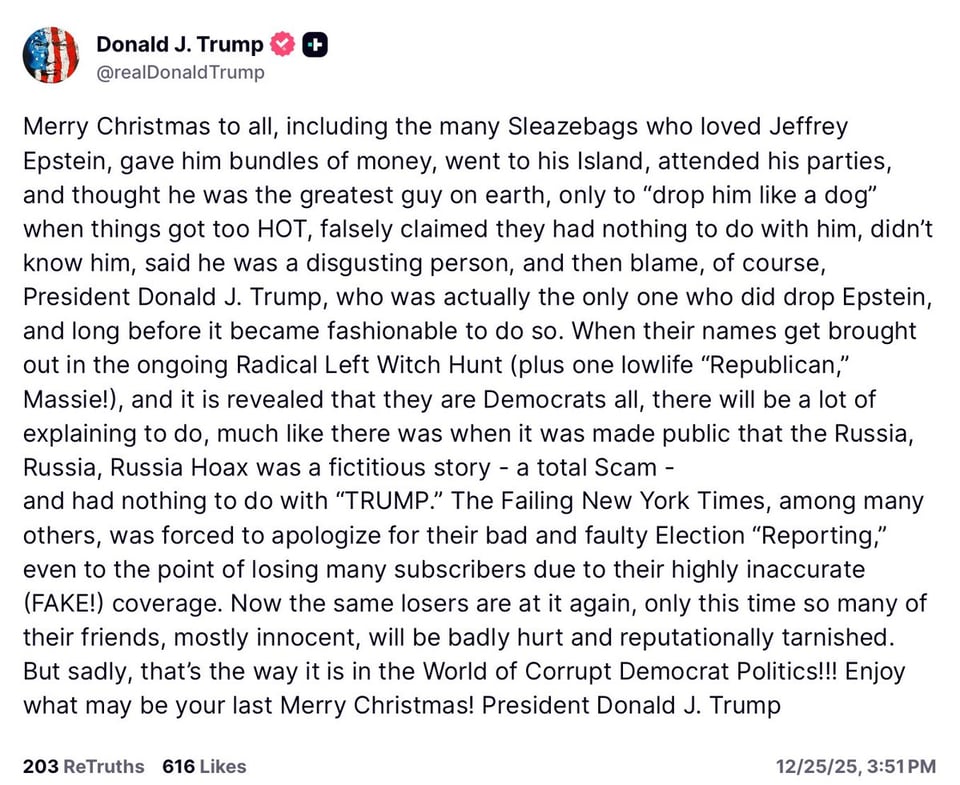
The sick man speaketh his Christman message.
Trump Is Getting Weaker, and the Resistance Is Getting Stronger
It has been a gruesome year for those who see Donald Trump’s kakistocracy clearly. He returned to office newly emboldened, surrounded by obsequious tech barons, seemingly in command of not just the country but also the zeitgeist. Since then, it’s been a parade of nightmares — armed men in balaclavas on the streets, migrants sent to a torture prison in El Salvador, corruption on a scale undreamed of by even the gaudiest third-world dictators and the shocking capitulation by many leaders in business, law, media and academia. Trying to wrap one’s mind around the scale of civic destruction wrought in just 11 months stretches the limits of the imagination, like conceptualizing light-years or black holes.
And yet, as 2025 limps toward its end, there are reasons to be hopeful.
That’s because of millions of people throughout the country who have refused to surrender to this administration’s bullying. When Trump began his second term, conventional wisdom held that the resistance was moribund. If that was ever true, it’s certainly not anymore. This year has seen some of the largest street protests in American history. Amanda Litman, a founder of Run for Something, a group that trains young progressives to seek local office, told me that since the 2024 election, it has seen more sign-ups than in all of Trump’s first four years. Just this month, the Republican-dominated legislature in Indiana, urged on by voters, rebelled against MAGA efforts to intimidate them and refused to redraw their congressional maps to eliminate Democratic-leaning districts.
While Trump “has been able to do extraordinary damage that will have generational effects, he has not successfully consolidated power,” said Leah Greenberg, a founder of the resistance group Indivisible. “That has been staved off, and it has been staved off not, frankly, due to the efforts of pretty much anyone in elite institutions or political leadership but due to the efforts of regular people declining to go along with fascism.”
In retrospect, it’s possible to see several pivot points. One of the first was a Wisconsin Supreme Court race in April. Elon Musk, then still running rampant at the so-called Department of Government Efficiency, declared the contest critical and poured more than $20 million into the race. Voters turned out in droves, and the Musk-backed conservative candidate lost by more than 10 points. Humiliated, Musk began to withdraw from electoral politics, at one point breaking with Trump. The tight bond between the world’s richest man and the most powerful one was eroded.
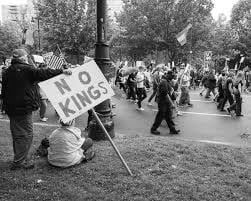
In June, Trump’s military parade, meant as a display of dominance, was a flop, and simultaneous No Kings protests all over the country were huge and energetic. A few months later, Charlie Kirk was assassinated, a tragedy that the administration sought to exploit to silence its opponents. When the late-night comedian Jimmy Kimmel made a distasteful comment on ABC that seemed to blame the right for Kirk’s killing, Disney, the network’s parent company, gave in to pressure to take Kimmel off the air. It was a perilous moment for free speech; suddenly America was becoming the kind of country in which regime critics are forced off television. But then came a wave of cancellations of Disney+ and the Disney-owned Hulu channel, as well as a celebrity boycott, and Disney gave Kimmel his show back.
Trump has thoroughly corrupted the Justice Department, but its selective prosecutions of his foes have been thwarted by judges and, more strikingly, by grand juries. Two grand juries refused to indict Letitia James, New York’s attorney general, whom the administration has accused of mortgage fraud, with no credible evidence. After Sean Dunn, a Justice Department paralegal, tossed a sandwich at a Customs and Border Protection officer during a protest in Washington, the administration sent a team of agents in riot gear to arrest him. But grand jurors refused to indict him on a felony charge. Dunn was eventually charged with a misdemeanor, only to be acquitted by a jury. Jeanine Pirro, the former Fox News personality whom Trump made U.S. attorney in Washington, tried three times to secure a federal indictment for assault against a protester who struggled while being pushed against a wall by an immigration agent. Three times, grand juries refused.
Granted, all these grand juries were in liberal jurisdictions, but their rejections of prosecutors’ claims are still striking, since indictments are usually notoriously easy to secure. “I think you’re seeing reinvigorated grand jury processes,” said Ian Bassin, a founder of the legal and advocacy group Protect Democracy. “Nobody actually knows what’s going on in those grand juries, but the outcome of them seems to suggest that people are actually holding the government’s feet to the fire and being unwilling to simply be a rubber stamp.”
Trump ends the year weak and unpopular, his coalition dispirited and riven by infighting. Democrats dominated in the November elections. During Joe Biden’s administration, far-right victories in school board races were an early indication of the cultural backlash that would carry Trump to office. Now, however, Democrats are flipping school board seats nationwide.
Much of the credit for the reinvigoration of the resistance belongs to Trump himself. Had he focused his deportation campaign on criminals or refrained from injuring the economy with haphazard tariffs while mocking concerns about affordability, he would probably have remained a more formidable figure. He’s still a supremely dangerous one, especially as he comes to feel increasingly cornered and aggrieved. After all, by the time you read this, we could well be at war with Venezuela, though no one in the administration has bothered to articulate a plausible rationale for the escalating conflict.
But it’s become, over the past year, easier to imagine the moment when his mystique finally evaporates, when few want to defend him anymore or admit that they ever did. “I think it’s going to be a rocky period, but I no longer think that Trump is going to pull an Orban and fundamentally consolidate authoritarian control of this country the way that it looked like he was going to do in March or April,” said Bassin, referring to Prime Minister Viktor Orban of Hungary. If Bassin is right, it will be because a critical mass of Americans refused to be either cowed or complicit. (Michelle Goldberg, Opinion column, New York Times)
Some This ‘n That.
Around 57% of Americans today seldom or never attend religious services, a jump from 40% in 2000
— Mike NC (@jmsexton_) December 26, 2025
An unprecedented 15,000 churches are expected to shut their doors this year, far more than the few thousand expected to openhttps://t.co/dI6puCAoEq

Hope you had a happy Christmas and a restful Boxing Day.🎄🎁

