Saturday, December 13, 2025. Annette’s Roundup for Democracy.
Replace Schumer as Senate Democratic Leader? Everyone says yes. Replace House Minority Leader Hakeem Jeffries as too? Your call.
This Guest Essay in the New York Times suggests why that should be in play.
If you think the same or otherwise, email me your thoughts.
NYTimes: The Pardon That Represents the New Era of Corruption

Last week, President Trump issued yet another pardon that’s corrosive to the rule of law — this one to Representative Henry Cuellar, a Texas Democrat who was awaiting trial on federal bribery charges. This pardon was exceptionally brazen. Mr. Trump publicly acknowledged that he had issued it to induce Mr. Cuellar to switch parties, and attacked him for a “lack of LOYALTY” when he declined to do so.
It is notable for another reason. Rather than be critical or perhaps stay silent, the House minority leader, Hakeem Jeffries, welcomed the pardon and engaged in shameful pandering, apparently to maintain Mr. Cuellar’s party loyalty. Most disturbingly, Mr. Jeffries did so by attacking the legitimacy of the criminal case against Mr. Cuellar, publicly dismissing the indictment against him as “very thin.”
As former federal prosecutors who spent our careers rooting out public corruption, we see this for the wagon-circling that it is. The jury’s detailed, 54-page, multicount indictment against Mr. Cuellar was anything but thin, and he should have had to stand trial before a jury of his peers.
Mr. Jeffries’s embrace of Mr. Cuellar was a disturbing sign that Democratic leaders, when it is politically advantageous, may be willing to join in Mr. Trump’s degradation of the justice system. The way to combat a corrupt deal is to repudiate it — loudly, constantly and on a bipartisan basis — by forcefully advocating the rule of law. Anything less by the leaders of either party will only harden and justify Americans’ deteriorating faith in government and the justice system.
The allegations against Mr. Cuellar, approved by a federal grand jury in Texas and upheld by a Federal District Court judge there, were serious. (While at the Justice Department, we worked on an investigation that led to his prosecution in this case.) Mr. Cuellar was charged in 2024 with taking about $600,000 worth of bribes from two foreign interests — Azerbaijan’s state-owned oil company and a Mexican bank — in exchange for his promises to influence U.S. policy. At the time, Mr. Cuellar was a high-ranking congressman with access to sensitive government information.
If the allegations against him are true, Mr. Cuellar was willing to sell out the United States for personal gain and was, and still is, a national security threat. Elected leaders should have pushed for the case to be resolved fairly, fully and promptly in court. Instead, Mr. Trump and Mr. Jeffries sacrificed those interests in pursuit of partisan advantage.
Stop and think about this for a moment: We have entered an era of such diminished respect for the rule of law that the president openly admitted that he pardoned a congressman — who was indicted and awaiting federal bribery charges — because he expected political loyalty in exchange. And instead of principled opposition from Congress, the leading Democrat in the House appears to have engaged in a corrupt bargain of his own, premised on unfounded criticism of the prosecution, to secure the pardon recipient’s loyalty.
Mr. Jeffries most likely made the political calculation that retaining a House seat was worth engaging in the sort of unethical deals for which Democrats criticize Mr. Trump. Such a shortsighted choice to put party over country is harmful in several ways. Mr. Jeffries’s embrace of Mr. Cuellar validates Mr. Trump’s corrupt deal-making and helps the president and his allies brush off valid criticism. After all, the next time Mr. Trump is questioned about a pardon quid pro quo, why shouldn’t he point to Mr. Jeffries’s support of this one? And Mr. Jeffries’s unsupported criticism of the case against Mr. Cuellar contributes to Mr. Trump’s effort to dismantle public corruption laws by excusing anyone charged with violating them.
All of this serves to weaken our democracy. Citizens who believe that government officials are corrupt and that nothing can be done about it are less likely to be engaged. And citizens who mistrust the justice system are less likely to participate meaningfully as witnesses, jurors or litigants, making it harder to protect public safety.
The way to oppose Mr. Trump’s era of corrupt deal-making is to present the American people with a clear and principled alternative. Democrats should see the cautionary tale represented by today’s Republican Party in Congress — whose blind allegiance to Mr. Trump has rendered its members unable to criticize even the most corrupt exercises of executive power, which risks losing them public confidence.
The last opportunity to hold Mr. Cuellar to account — and to inspire public trust — rests with the bipartisan House Ethics Committee, which has an open inquiry into the allegations against him. Both parties should insist that the committee resolve the allegations swiftly and impartially. If it sustains the allegations, the House should expel Mr. Cuellar with the unanimous support of Democrats.
Voters must enforce objective anti-corruption principles at the ballot box. That means prioritizing candidates’ opposition to corruption and rejecting representatives of any party who participate in or tolerate any sort of the corrupt dealing and assault on the justice system on display here. (J.P. Cooney and Molly Gaston - Mr. Cooney and Ms. Gaston were corruption prosecutors in the District of Columbia U.S. attorney’s Office and in the Justice Department. New York Times)
Our Democracy often depends on small, even odd traditions. Here is another Trump is trying to shred.
What Are 'Blue Slips' and Why Is Trump Fighting to End Them?

President Donald Trump has renewed his plea for the Senate’s century-old “blue slip” process to be axed in a bid to ensure his U.S. district court nominations, along with those for U.S. attorneys’ offices, can proceed without being blocked by home-state Senators.
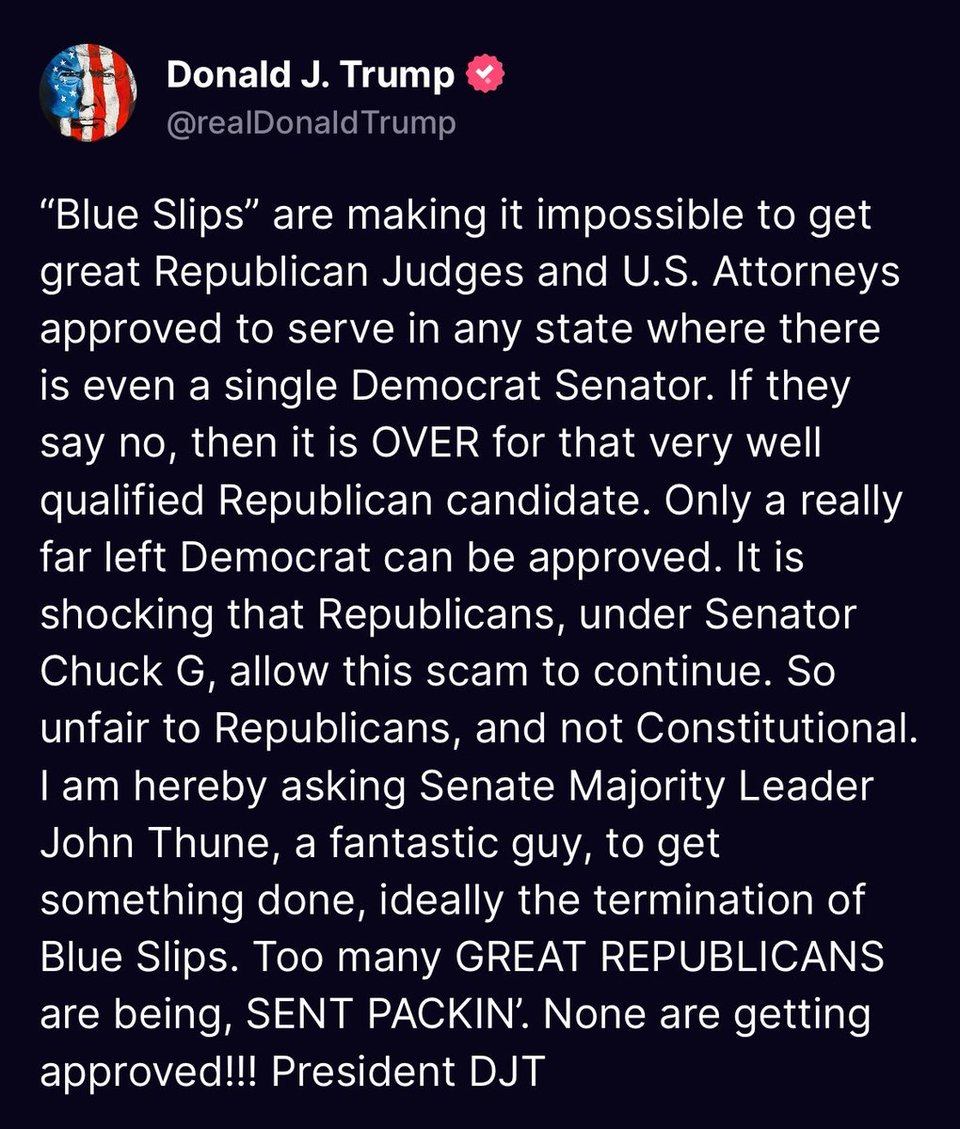
“‘Blue slips’ are making it impossible to get great Republican judges and U.S. attorneys approved to serve in any state where there is even a single Democrat Senator,” bemoaned Trump on Thursday. “It is shocking that Republicans, under Senator Chuck [Grassley], allow this scam to continue. So unfair to Republicans, and not constitutional.”
Trump went on to make a public plea to Senate Majority Leader John Thune, asking that he “get something done—ideally the termination of blue slips.”
But in a rare move in opposition of Trump, the majority of Republicans seem reluctant to axe the tradition that is largely respected on both sides of the aisle.
Sen. Thune appeared to dash the President’s hopes, saying he doesn’t think the blue slip process is going to change as it has strong bipartisan support.
“This is a procedure that’s been in place for a long time, that both Republicans and Democrats support, because it gives them some input, particularly in those judicial appointments that are made in their individual states,” Thune told Fox News on Thursday. “There are Republicans on and off the Judicial Committee who support this—and support it strongly.”
Thune acknowledged Trump’s frustrations over his nominations, but insisted that the majority of Trump’s nominees—outside of the judiciary ones—have been processed at a “record rate.”
We have moved his [Trump’s] nominees through the process at a record rate. We will, by the end of this year, have a record number of his nominees approved to the executive branch. We got his Cabinet confirmed at the fastest rate possible. We’ll continue to work on the judiciary,” he said.
Trump’s renewed push to axe the blue slip process comes as the White House attempts to advance its nomination for Lindsey Halligan as U.S. Attorney for Virginia’s Eastern District. Reuters reported on Thursday that the Senate Judiciary Committee had received a copy of Halligan's 28-page questionnaire laying out her background and qualifications. It’s widely predicted that Virginia's Democratic Senators Tim Kaine and Mark Warner will block the nomination. Halligan, who previously worked as a personal lawyer for Trump after his first term, has proven to be among the President’s more controversial picks. She has no notable previous experience as a prosecutor.
In July, Trump was forced to withdraw the nomination of his former defense attorney, Alina Habba, to serve as a federal prosecutor in New Jersey after the blue slip process saw the state's Democratic Senators Cory Booker and Andy Kim oppose her nomination. Habba was then appointed on an interim basis in an “acting role,” as the Trump Administration sought other means of approval. But Habba stepped down from her acting role on Dec. 8, days after a federal appeals court found she had been unlawfully serving as the U.S. attorney for New Jersey.
Now, with Trump once again calling for the end of blue slips, here’s what you need to know about the long-standing tradition.
What exactly is the blue slip process?
The blue slip process used by the Senate Judiciary Committee applies to nominations for district court judges and U.S. attorneys' offices. After a President picks a nominee, the chairman sends a blue-coloured slip to the home state Senators and they are given the opportunity to sign off on the nominee. Per Congress, “if a home state Senator has no objection to a nominee, the blue slip is returned to the chairman with a positive response. If, however, a home state Senator objects to a nominee, the blue slip is either withheld or returned with a negative response.”
Although in place since around 1917, the blue slip process has changed somewhat over the years.
Previously, circuit court nominations were also beholden to approval via blue slips. However, this changed in 2017 during Trump’s first term, when the Republican-led judiciary panel fronted by Sen. Charles Grassley of Iowa scrapped the process.
What has Trump said about the blue slip process?
Trump has long sought to end the Senate tradition, similarly to how he has pleaded on numerous occasions to end the filibuster.
Earlier this year, when fighting for the advancement of Habba, his nominee for federal prosecutor in New Jersey, Trump aired his frustrations and called on Sen. Grassley to end the tradition, arguing that he could “solve the blue slip problem” with a “mere flick of the pen.”
Trump revisited the topic in August, insisting the blue slip process is "unconstitutional" and threatening to file a suit about it.
"It's a gentlemen's agreement that's about 100 years old… It’s based on an old custom. It's not based on a law. And I think it's unconstitutional,” he said in the Oval Office.
The battle came to the forefront once more in October, as Trump lamented that his U.S. attorney nominations had been stalled. “Democrats have convinced Chuck Grassley to honor the stupid and outdated ‘blue slip’ tradition, which precludes very talented and dedicated people from attaining High Office,” Trump said via Truth Social. “These great people’s careers have been badly hurt by the radical left Democrats, using an old and ridiculous custom strictly to their advantage. What a shame.”
How have lawmakers responded to Trump’s plea to end the Blue Slip process?
Despite curtailing the practice in regards to circuit court nominations during Trump’s first term, Sen. Grassley has steadfastly defended the blue slip tradition in relation to nominees to district courts and U.S. attorneys’ offices.
The blue slip preserves the ability of lawmakers to shape the types of prosecutors and judges who serve the public, uphold the rule of law and resolve disputes in the community. It provides an assurance that the White House will consult with home-state senators during the nomination process,” said Grassley during a Q&A in August.
“For years, I’ve consistently pushed back on misguided efforts to abolish the blue slip that would neuter the Senate’s authority of advice and consent.”
Sen. Thom Tillis of North Carolina, a Republican member of the judiciary committee, has also strongly denounced the idea of axing the largely-respected tradition, arguing that it could—in turn—hurt the GOP.
“Getting rid of the blue slip is a terrible, short-sighted ploy that paves the path for Democrats to ram through extremist liberal judges in red states over the long-term,” he said. “It’s why radical liberal groups have been pushing to get rid of the blue slip for years—Republicans shouldn’t fall for it.” (Time Magazine)
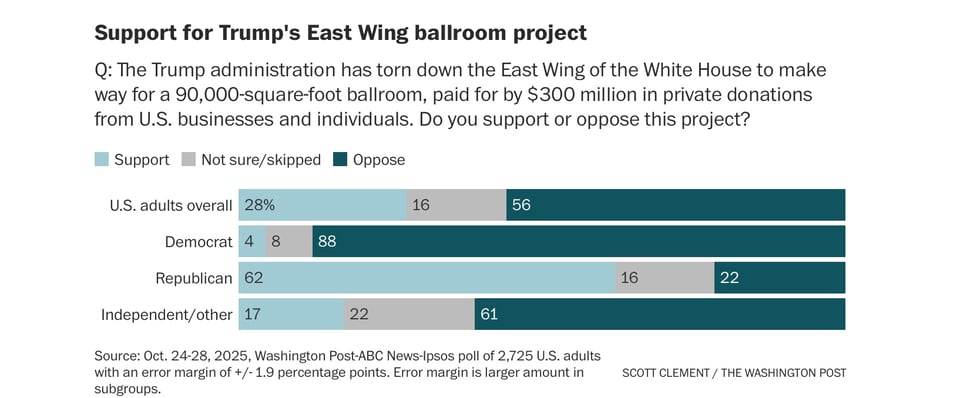
Do you hate everything connected to Trump’s intended ballroom? You are not alone.
National Trust sues to stop Trump’s ballroom construction
The organization, which is charged by Congress with historic preservation, has retained President Barack Obama’s former lawyer as it seeks to pause the project.
Historic preservationists begged President Donald Trump in October not to rapidly demolish the White House’s East Wing annex for his ballroom project, urging him to wait for federal review panels and allow the public to weigh in. Now a group charged by Congress with helping to preserve historic buildings is asking a judge to block construction until those reviews occur, arguing that the ongoing project is illegal and unconstitutional.
The lawsuit from the nonprofit National Trust for Historic Preservation, which was filed Friday in the U.S. District Court for the District of Columbia, represents the first major legal challenge to Trump’s planned 90,000-square-foot addition and is poised to test the limits of his power. The organization argues that the administration failed to undergo legally required reviews or receive congressional authorization for the project, which Trump has rushed to launch in hopes of completing it before his term ends in 2029.
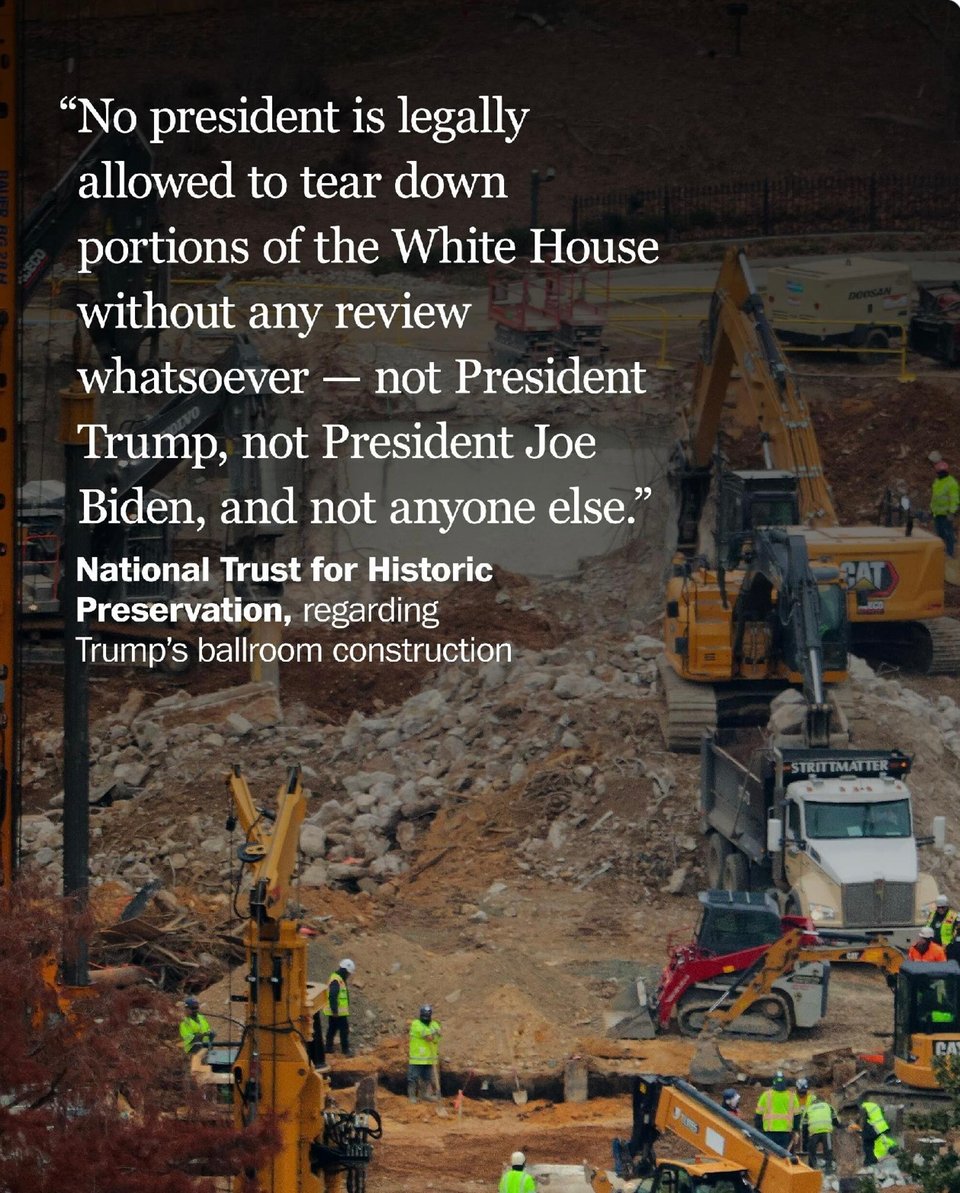
“No president is legally allowed to tear down portions of the White House without any review whatsoever — not President Trump, not President Joe Biden, and not anyone else,” the complaint says.
The administration in October rapidly demolished the East Wing to make way for the ballroom over the objections of the National Trust and other historic preservationists who urged the White House to pause its demolition, submit its plans to the National Capital Planning Commission and seek public comment.
Officials responded by saying they would work with the commission, a board that oversees federal building projects and is now led by Trump allies, “at the appropriate time.” NCPC chair Will Scharf, Trump’s former personal lawyer who is now White House staff secretary, said his administration colleagues have told him they will submit the project plans to the commission this month. It has yet to do so, even as work continues on the former East Wing site.
“The lawsuit is our last resort,” Carol Quillen, National Trust’s CEO, said in an interview. “We serve the people, and the people are not being served in this process.”
The administration did not respond to questions Friday about the National Trust’s specific claims or when it would submit ballroom plans to the commission. Officials have maintained that Trump has authority over White House grounds and is working to improve them at no cost to taxpayers, dismissing critics as “unhinged leftists” who seized on the imagery of bulldozers tearing down what has been called “the People’s House” as a metaphor for the opening year of his term.
“President Trump has full legal authority to modernize, renovate, and beautify the White House — just like all of his predecessors did,” Davis Ingle, a White House spokesman, wrote in a statement.
The National Trust is seeking a temporary restraining order on construction as the court reviews its claims, its lawyers said. One of those lawyers is Greg Craig, a Foley Hoag lawyer who previously served as White House counsel to President Barack Obama, and who is working pro bono on the case. Craig also served as President Bill Clinton’s lawyer during Republicans’ efforts to impeach Clinton in the late 1990s.
Trump has made the ballroom a focus and frequent talking point in the opening year of his second term, and administration officials have acknowledged that he is involved to the point of micromanagement.
“In a very short period of time — like about a year and a half — you’re going to have the best ballroom anywhere in the country,” Trump told lawmakers at the White House on Thursday night.
The president has also maintained that he is not bound by typical building restrictions or the need to seek construction approvals, citing conversations with advisers and experts.
“They said, ‘Sir, this is the White House. You’re the president of the United States, you can do anything you want,’” Trump said at an October dinner to celebrate the ballroom’s donors.
Several polls have shown that the ballroom project is broadly unpopular, and Democrats have consistently attacked it, eager to contrast the president’s focus on a luxurious ballroom against many Americans’ concerns about affordability. Some conservatives have also questioned Trump’s plans and pace, asking why the administration did not undergo a formal review process before tearing down part of the symbolic seat of government. The president and his original handpicked architect battled over Trump’s desire to expand the ballroom’s size before Trump replaced him, The Washington Post previously reported. (Washington Post)
Keep this 👇 in mind when you get glum.
The RNC chair spoke clearly.
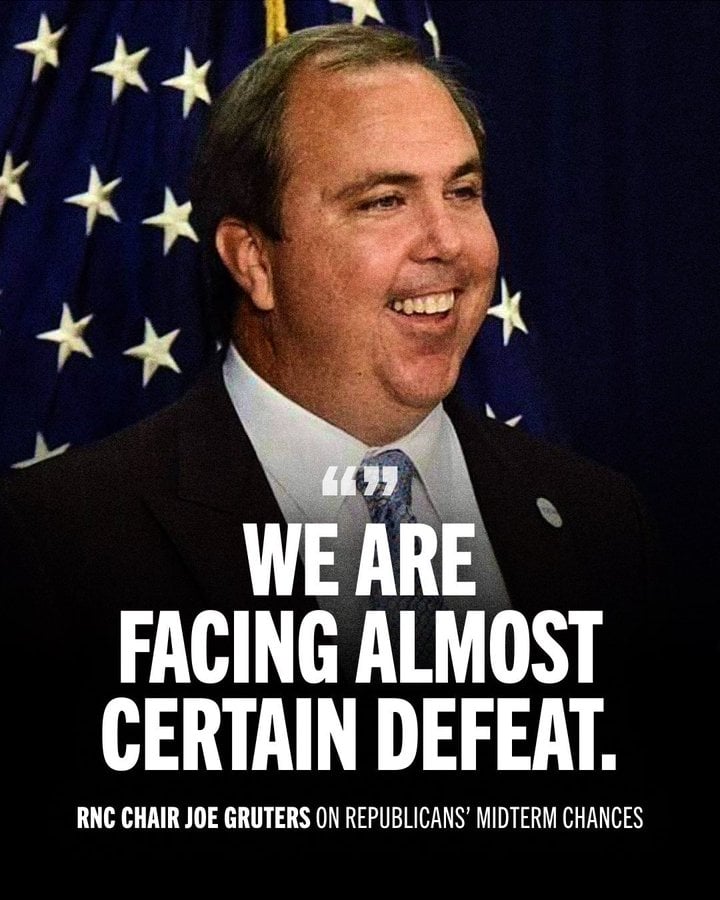
Let’s make the Ohio Governorship one of the MAGA losses in 2026.
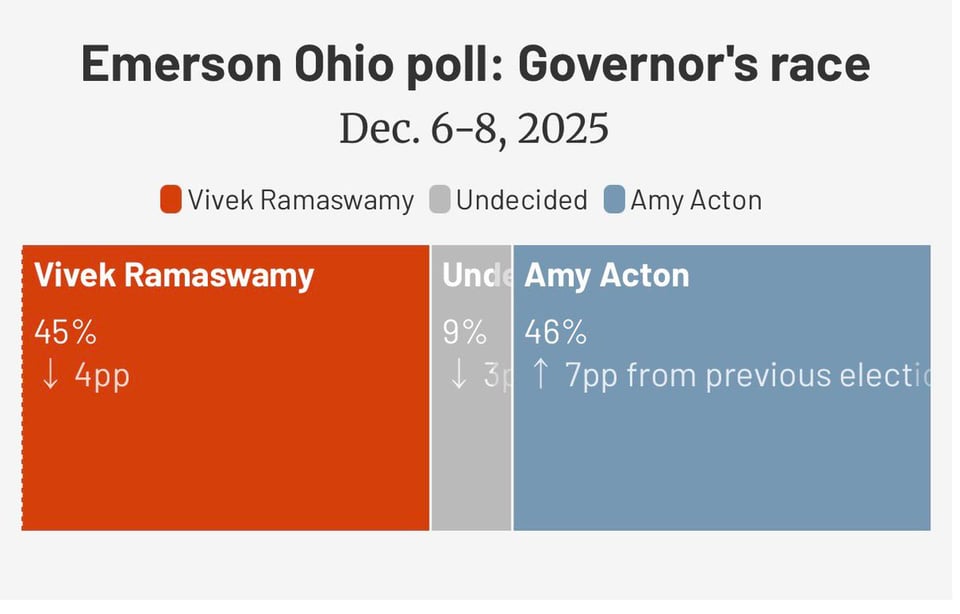
🚨NEW: Democrat Amy Acton is leading GOP challenger Vivek Ramaswamy by 1 point in a new poll of the Ohio Governor’s race.
— Protect Kamala Harris ✊ (@DisavowTrump20) December 12, 2025
RETWEET if you support @AmyActonOH as she runs to flip Ohio Blue! pic.twitter.com/yQvh15O2iI
We still have time to save healthcare for millions of Americans.
We have until December 19th, before 15 million Americans will lose their healthcare coverage.
— Congresswoman Mary Gay Scanlon (@RepMGS) December 12, 2025
The Senate blocked an extension of the ACA tax credits, and @HouseGOP only has "concepts of a plan."@HouseDemocrats have a discharge petition to extend the tax credits and save… pic.twitter.com/tzBUq6llGS
Make calls while you still can.
Nothing is too small or too sacred to escape the cruel and disgusting attacks of Trump and his minions.
New quarters were set to honor women's suffrage and civil rights. Trump is canceling them.
Quarters that were meant to honor the abolition of slavery, women’s suffrage, and the civil rights movement will no longer be produced.

Three of five special quarters that were planned to be released in 2026 have been jettisoned by the Trump administration.
Quarters that were meant to honor the abolition of slavery, women’s suffrage, and the civil rights movement will no longer be produced, The Wall Street Journal reports. Instead, the Treasury Department will replace those with designs honoring the Mayflower, the Revolutionary War, and the Gettysburg Address.
Quarters that were going to feature Frederick Douglass, a women’s suffrage marcher, and Ruby Bridges will now have Presidents George Washington, Thomas Jefferson, Abraham Lincoln, and James Madison.
The Trump administration gave no reason for the shift. But it has pushed to dismantle Diversity, Equity, and Inclusion (DEI) programs, and has more criticized "woke" ideology. President Donald Trump has criticized museums, including the Smithsonian, for focusing too heavily on what he says are negative parts of the country's history. Treasury Secretary Scott Bessent gave final approval to the new coins.
The change-up in quarters, though, contradicts the law that authorized the celebration currency, which was signed during Trump's first administration. One quarter was required to show a woman’s contribution to either the birth of the U.S. or some other important moment.
Still under discussion is a $1 coin featuring Trump. No Trump coin was unveiled by the U.S. mint in the unveiling of the new designs.
The quarter isn't the only coin changing for America's Semiquincentennial celebration. The dime, nickel, and half-dollar will also get new looks. The dime will revert to its previous look in 2027. The quarter and half-dollar will celebrate Youth and Paralympic Sports as part of a new four-year program.
“The designs on these historic coins depict the story of America’s journey toward a ‘more perfect union,’ and celebrate America’s defining ideals of liberty,” acting Mint Director Kristie McNally said in a statement. “We hope to offer each American the opportunity to hold our nation’s storied 250 years of history in the palms of their hands as we Connect America through Coins.” (Qz.com)
Our favorite holiday card of 2025.
We received many holiday cards that we love, but this card from our friends, Heather Arnet and David Shumway, said it all for us.
Heather is the remarkable CEO of the Heckscher Museum in Huntington, Long Island, where the first show to recognize Emma Stebbins (1815–1882) as one of the most significant American sculptors of the 19th century is currently on view.
Stebbins was the first woman in the U.S. to receive a major public art commission and our glorious Bethesda Fountain in Central Park was the result.
If you’re looking for a worthwhile nonprofit dedicated to the arts to support as the year ends, think about Heckscher. It is the little museum of art that roars, as does its fierce leader, as you can surely tell.