Friday, May 29, 2026. Annette’s Roundup for Democracy.
Republicans want to make the Texas Senate race about manliness
In his first general election ad, Republican Ken Paxton accused his opponent, Democratic state Sen. James Talarico, of not having enough testosterone.
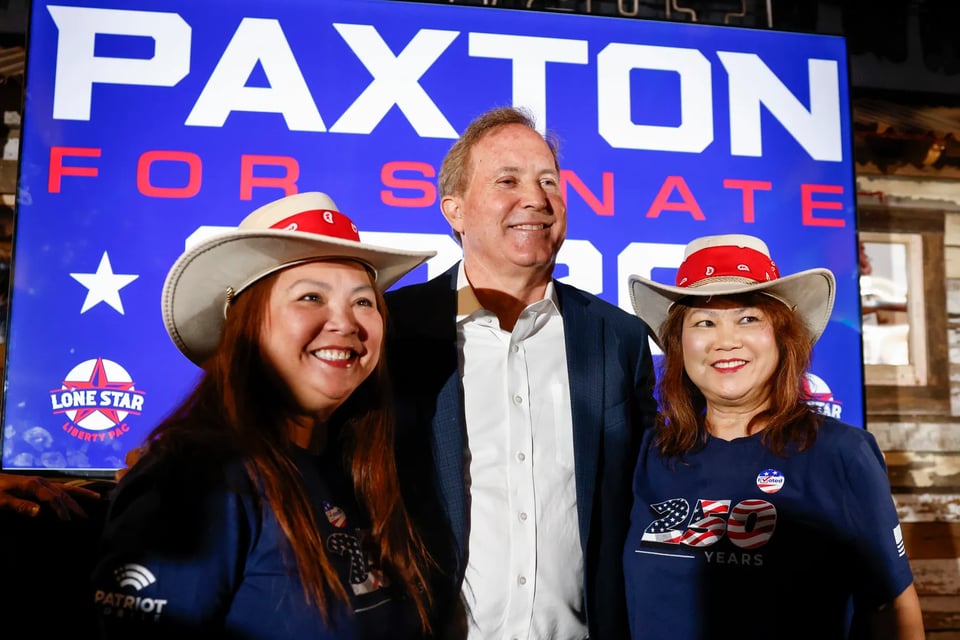
Texas Attorney General Ken Paxton, a Republican candidate for the U.S. Senate, poses with supporters during a campaign rally at Matt's Rancho Martinez on Tuesday, May 19, 2026, in Allen.
Republicans are focusing on one question in one of November’s top races: Is the Democrat a real man?
Texas Attorney General Ken Paxton, who clinched the GOP’s nomination for U.S. Senate on Tuesday night, released a new ad Wednesday —his first of the general election — accusing his opponent, state Sen. James Talarico, of being too “low-T for Texas.”
“Low-T” is a reference to testosterone levels and often used as an insult by influencers in the so-called manosphere, who say low testosterone makes someone weaker.
White House deputy chief of staff Stephen Miller, the architect of President Donald Trump’s immigration policy and one of his top advisers, picked up on a similar line of attack, posting on the social media platform X on Wednesday that Democrats had nominated the “their first transgender senate candidate.” Talarico is cisgender and identifies as an LGBTQ+ ally; he is in a relationship with a woman.
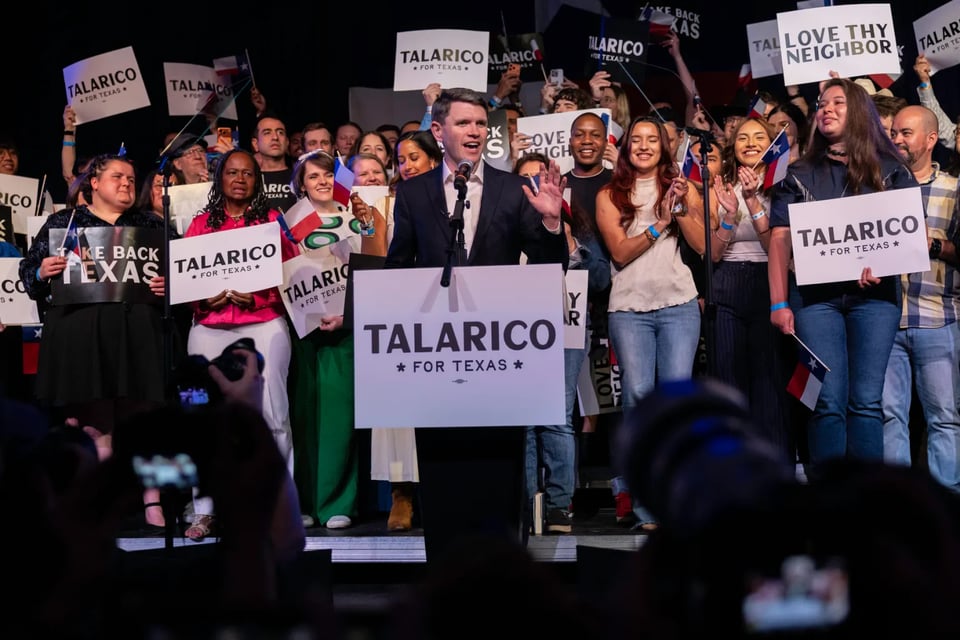
Texas Senate candidate James Talarico (D-TX) addresses supporters on election night on March 03, 2026, in Austin, Texas.
Texas has not elected a Democrat to the Senate since 1988. But Talarico, a former middle school teacher and seminarian, has energized Democrats, who hope that record-setting campaign fundraising could help flip the seat.
Polling suggests a close general election contest between Talarico and Paxton, who was endorsed by Trump and won the runoff with incumbent Sen. John Cornyn handily but who has been embroiled in controversy for much of his time in the public eye. In 2023 he was impeached by the Republican-led state House of Representatives on charges of bribery, abuse of office and obstruction of justice. He was then acquitted. After Paxton’s Tuesday night victory, the Cook Political Report updated its assessment of the race from “Likely Republican” to only “Lean Republican.”
In his first ad of the general election, Talarico has focused on Paxton’s impeachment trial, highlighting news clips to argue that the scandal-ridden attorney general is corrupt. In a television interview, he called his opponent the “most corrupt politician in America.” Many Republicans have expressed concern that Paxton’s baggage — his wife filed for divorce last July on what she called “biblical grounds” — could make him a weaker candidate.
Paxton, meanwhile, is focusing on gender, asserting that a more conservative vision of masculinity will sway Texas voters.
In his same ad on Wednesday, Paxton highlighted a clip from 2021 in which Talarico said there are “six biological sexes” — a reference to the fact that humans can have six chromosomal karyotypes, including XX, XY, XXY, XYY, XXXY and X. The ad also points to an interview where Talarico expressed compassion for trans children.(19News).
A Secret to fund-raising.
The Megalomaniac in the White House.
31 U.S. Code § 5114(b) — “Only the portrait of a deceased individual may appear on United States currency and securities.”
More proof Trump hasn’t a clue what he is doing in the Middle East.
The Mideast Is Baffled by Trump’s Call to Expand Abraham Accords
The president said more countries should be required to recognize Israel as part of a deal to end the war with Iran. Analysts say the chances of that happening are close to zero.
The social media post by President Trump made it sound straightforward. The United States would orchestrate a deal to end the war with Iran and, in exchange, a slew of countries across the Middle East and South Asia would join an agreement, called the Abraham Accords, establishing relations with Israel.
In fact, he said, that “should be mandatory.” But half of the countries he named — such as Egypt, Jordan and Turkey — already have relations with Israel. And the other half — including Saudi Arabia, Qatar and Pakistan — have no interest in establishing them anytime soon.
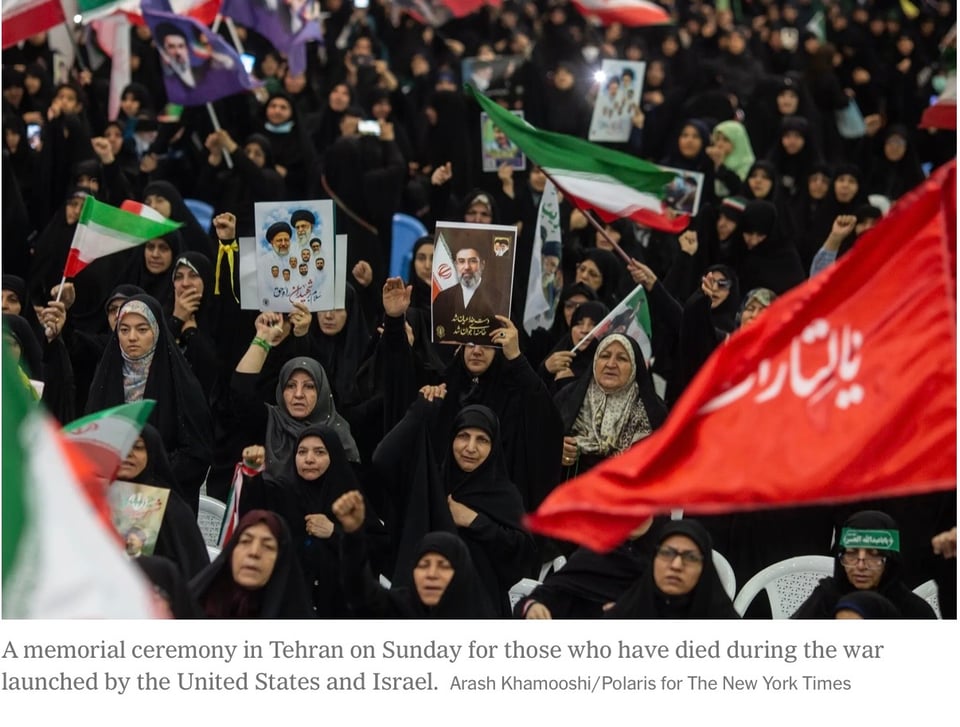
As a result, the meandering ultimatum that Mr. Trump shared on Monday was met with a mix of silence and bemusement across the Middle East. Regional analysts said they were not even sure that they understood the rationale behind his proposal. Why would ending the war, which the United States and Israel initiated by bombing Iran on Feb. 28, provide an incentive to recognize Israel for countries like Qatar, which had lobbied desperately to prevent the war in the first place?
“It’s just bizarre,” said Yoel Guzansky, a senior fellow at the Institute for National Security Studies at Tel Aviv University in Israel. “What’s the connection between a deal with Iran and that? I’m honestly puzzled.”
Two Western diplomats in the region said that no one was really taking the idea seriously. They spoke on the condition of anonymity to discuss diplomacy.
Asked to explain the connection between peace negotiations with Iran and expanding the Abraham Accords, a White House spokeswoman did not answer directly. Instead, she referred to remarks made by Mr. Trump on Wednesday, when he suggested that U.S. agreement on a deal with Iran could be made contingent upon countries such as Saudi Arabia and Qatar agreeing to recognize Israel.
“I think those countries owe it to us,” he said. “I’m not sure we should make the deal, if they don’t sign.”
The Saudi and Qatari governments did not respond to requests for comment.
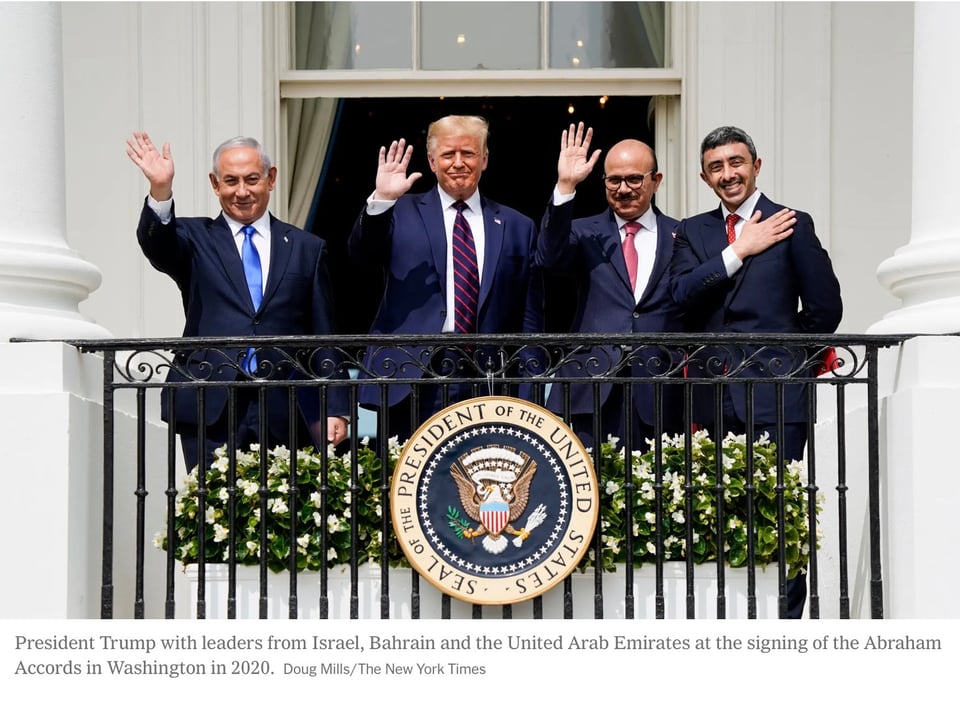
Under the Abraham Accords — a deal brokered by the first Trump administration in 2020 — the United Arab Emirates, Bahrain and Morocco agreed to establish diplomatic relations with Israel. A wide range of American politicians have portrayed the pact as a major diplomatic achievement, and have frequently referred to the accords as a “peace deal.”
Scholars from the region say that is merely a turn of phrase, belying the fact that there has never been a war between Israel and Bahrain or the Emirates. In effect, the deals bypassed the central conflict — between Israel and the Palestinians — declaring harmony between parties that were not fighting.
Since then, the Abraham Accords have created opportunities for expanded trade, security cooperation and tourism between the countries that signed them. The Emirates, the Arab architect of the accords, has grown especially close to Israel. But the accords did not usher in a new era of regional peace — far from it — and the Emirates’ warm ties with Israel have increasingly made it an outlier in the Middle East.
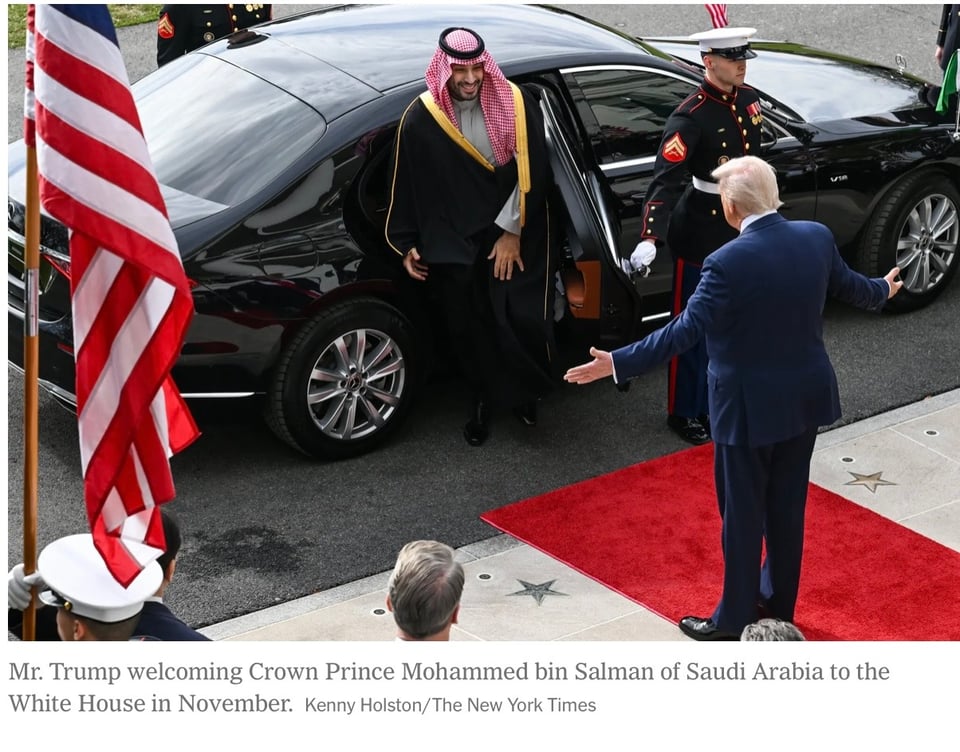
For Israel, the crowning of the Abraham Accords would be the normalization of diplomatic relations with Saudi Arabia, the largest Arab economy and home to Islam’s holiest sites. Saudi Arabia does not formally recognize Israel, although successive U.S. administrations have made it their goal to change that.
Few consider that a possibility now. Over the past couple of years, Saudi officials have consistently predicated ties with Israel on the creation of an independent state for Palestinians. Israel’s current government — the most right-wing in the country’s history — vehemently opposes the establishment of a Palestinian state and is unwilling to even talk of a pathway to one.
“Saudi Arabia will not be rushed into a historic decision that ignores Palestinian statehood,” said Salman al-Ansari, a Saudi political analyst. “Saudi Arabia’s commitment to a two-state solution is not a slogan, and it is not a bargaining chip.”
Mr. Trump’s language implied that he was giving an order, not making a request.
“It should start with the immediate signing by Saudi Arabia and Qatar, and everybody else should follow suit,” he said. “If they don’t, they should not be part of this Deal in that it shows bad intention.”
Perhaps even Iran — Israel’s archenemy — could join the Abraham Accords, Mr. Trump mused.
“Wow, now that would be something special!” he wrote.
Soon after, Senator Lindsey Graham, Republican of South Carolina, who had recently slammed the potential deal with Iran, wrote his own post on social media calling it a “simply brilliant” idea to link the deal with the expansion of the Abraham Accords.
“I expect our Arab allies to embrace this,” he wrote.
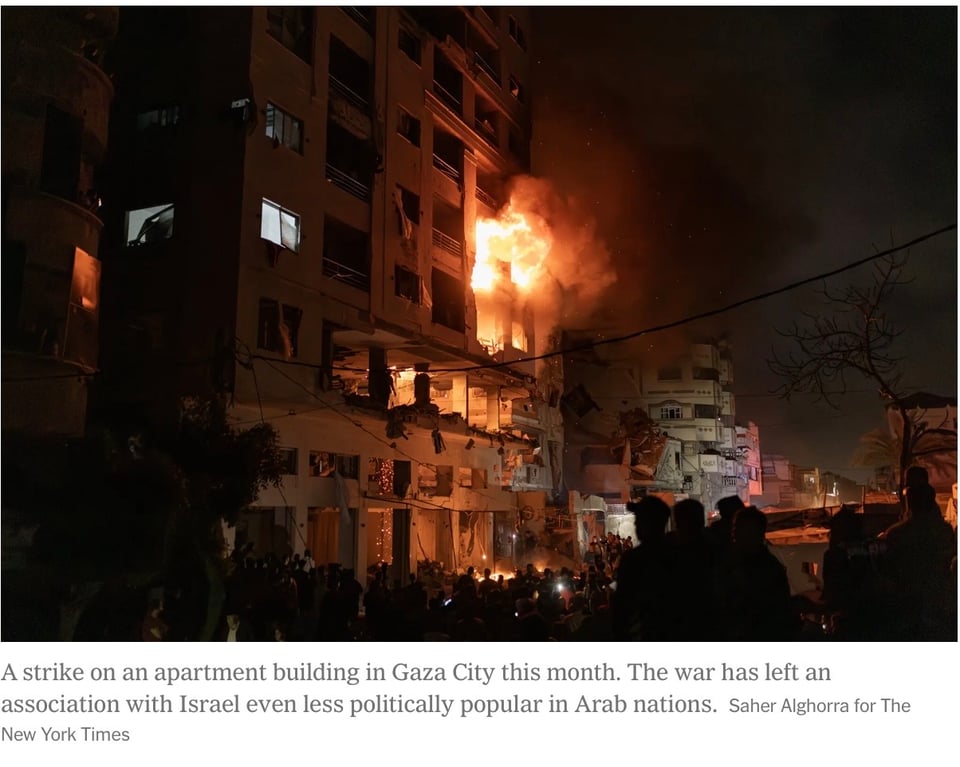
If taken at face value, those statements would seem to indicate an ignorance of political dynamics in the Middle East, analysts said. An association with Israel — never popular among Arab populations — has become even more toxic for many governments in the Middle East as a result of the devastating wars that Israel has waged in Gaza, Lebanon and Iran since the deadly Hamas-led attack on Israel in October 2023.
The more that American officials push for normalization as an imposition rather than as part of a mutually beneficial deal, “the more unpalatable it becomes,” said Abdulaziz Alghashian, a Saudi scholar and senior nonresident fellow at the Gulf International Forum, a research organization.
Under the Biden administration, the Saudi crown prince had been seeking substantial incentives from the United States in exchange for establishing ties with Israel, including access to American nuclear technology and a U.S.-Saudi defense pact.
The extent to which Mr. Trump’s mandate came across as a complete non sequitur in the Middle East made Mr. Alghashian think that the Abraham Accords were possibly “the only clear strategy the U.S. has in the region,” he said.
A deal with Iran appears shaky at best, and fighting has continued to flare as diplomats have negotiated the details. In Israel, Mr. Trump’s linkage between that deal and an expansion of the Abraham Accords has been largely met by baffled silence.
Prime Minister Benjamin Netanyahu of Israel has not reacted publicly to Mr. Trump’s pronouncement. Analysts have said that the phased deal with Iran the president has proposed would most likely be hard for Mr. Netanyahu to swallow. If the bid to include an expansion of the Abraham Accords were meant as some kind of sweetener, the Israeli prime minister was not letting on.
The more that American officials push for normalization as an imposition rather than as part of a mutually beneficial deal, “the more unpalatable it becomes,” said Abdulaziz Alghashian, a Saudi scholar and senior nonresident fellow at the Gulf International Forum, a research organization.
Under the Biden administration, the Saudi crown prince had been seeking substantial incentives from the United States in exchange for establishing ties with Israel, including access to American nuclear technology and a U.S.-Saudi defense pact.
The extent to which Mr. Trump’s mandate came across as a complete non sequitur in the Middle East made Mr. Alghashian think that the Abraham Accords were possibly “the only clear strategy the U.S. has in the region,” he said.
A deal with Iran appears shaky at best, and fighting has continued to flare as diplomats have negotiated the details. In Israel, Mr. Trump’s linkage between that deal and an expansion of the Abraham Accords has been largely met by baffled silence.
Prime Minister Benjamin Netanyahu of Israel has not reacted publicly to Mr. Trump’s pronouncement. Analysts have said that the phased deal with Iran the president has proposed would most likely be hard for Mr. Netanyahu to swallow. If the bid to include an expansion of the Abraham Accords were meant as some kind of sweetener, the Israeli prime minister was not letting on.
“Those countries won’t take a step before the elections in Israel and before seeing what the deal with Iran yields,” Mr. Guzansky said, adding, “We are still in such a fog of war.”
Mr. Trump even suggested that Pakistan — which has mediated between the United States and Iran to end the war — should join the accords.
In Pakistan, one of the world’s most populous Muslim-majority countries, officials and analysts greeted that call with a flat no. Pakistan does not recognize Israel, and its passports explicitly state that holders are barred from traveling there.
Pakistan’s defense minister, Khawaja Muhammad Asif, said on local television that joining the accords would clash with the country’s “fundamental ideologies.”
Mr. Trump’s statement might have been an attempt to please parts of his domestic audience — such as Iran hawks who view the potential deal with the Iranians as a disappointment — Pakistani analysts said. They called the proposal a distraction from the peace negotiations between the United States and Iran.
“Trump may be trying to divert attention with his Abraham Accords statement, but it is a poor effort at that,” said Maleeha Lodhi, a former Pakistani ambassador to the United States and the United Nations.
In the end, Mr. Trump appeared to give himself an offramp — raising questions about why he had made the proposal in the first place.
“It may be possible,” he wrote in the post, that some of the countries he named have acceptable reasons for not recognizing Israel, he said. (New York Times)
But the rest of the countries, he said, should be ready to join in — making his settlement with Iran “a far more Historic Event than it would, otherwise, be.” (New York Times)
One more thing.
More proof that Trump doesn’t know what he is doing. Period.
California’s got me so upset.
Though it seems at least one Democrat will be in the final two.
From ABC News.
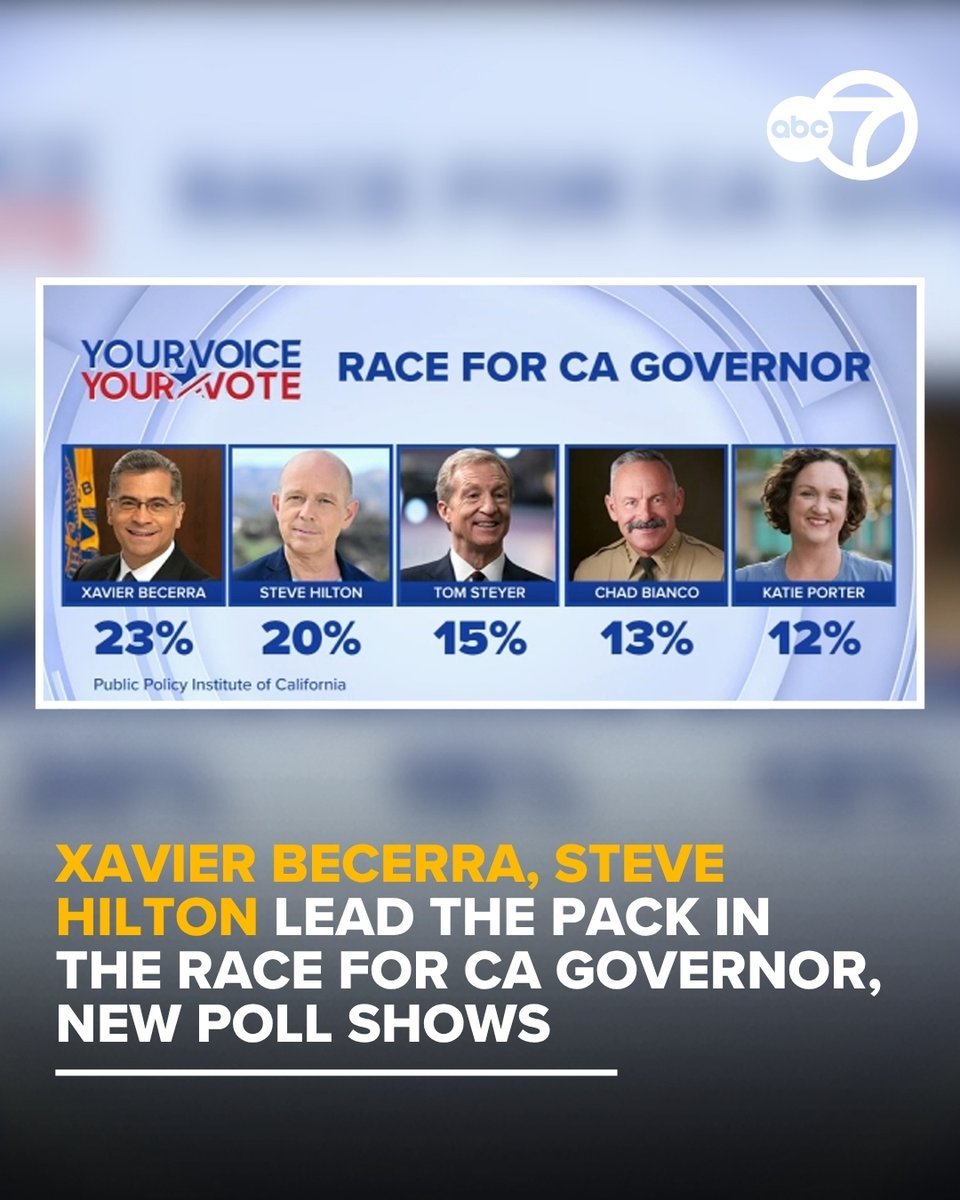
With just days to go until the June 2 primary election, a new poll is shedding some light on which candidates for California governor are pulling ahead.
The new numbers from the Public Policy Institute of California show five candidates have double-digit support. Democrat Xavier Becerra and Republican Steve Hilton are solidly at the top of the pack, followed by Democrat Tom Steyer, Republican Chad Bianco and Democrat Katie Porter.
Election Day is Tuesday.
What is happening in NYC?
Musical Chairs in Bryant Park.12th year.

