Friday, May 1, 2026. Annette’s Roundup for Democracy.
Historian Heather Cox Richardson on racist Trump and the pro-Democracy King.
Letters from an American, April 29, 2026.
I will have plenty to say about the Supreme Court’s decision today in Callais v. Louisiana, but tonight I want to make sure that yesterday’s speeches by President Donald J. Trump and King Charles III of the United Kingdom don’t get lost in the tidal wave of news. They presented a very clear picture of what is at stake in the United States today.
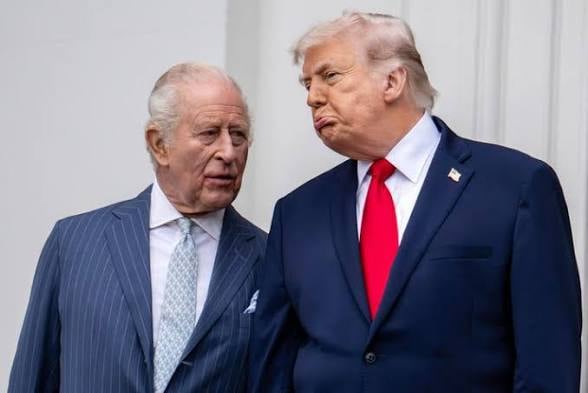
King Charles and Queen Camilla are in the U.S. on a state visit, and in his speech welcoming them to the White House yesterday, Trump redefined the United States from a nation based on the principles of the Enlightenment, as it has historically been understood, to one based in the white nationalist ideas of blood and soil.
“Long before Americans had a nation or a constitution, we first had a culture, a character, and a creed,” Trump said. “For nearly two centuries before the Revolution, this land was settled and forged by men and women who bore in their souls the blood and noble spirit of the British. Here on a wild and untamed continent, they set loose the ancient English love of liberty and…Great Britain’s distinctive sense of glory, destiny, and pride.”
Weirdly, Trump’s speech then turned the American Revolution—which included a war against the British to create an independent country—into a celebration of unity between the Patriots and their English countrymen. “The American patriots who pledged their lives to independence in 1776 were the heirs to this majestic inheritance. Their veins ran with Anglo-Saxon courage. Their hearts beat with an English faith in standing firm for what is right, good, and true,” Trump said.
And then he got to the heart of the matter. In words that sounded far more like White House deputy chief of staff Stephen Miller—who has been clear he wants to see the nation purged of nonwhite people—than like Trump himself, the president rejected the longstanding belief that the United States is based on the profound idea articulated in the Declaration of Independence: “We hold these truths to be self-evident, that all men are created equal, that they are endowed by their Creator with certain unalienable Rights, that among these are Life, Liberty and the pursuit of Happiness,” and “[t]hat to secure these rights, Governments are instituted among Men, deriving their just powers from the consent of the governed.”
In 1776 the idea that men were born equal and had a right to a say in their government was a revolutionary idea indeed. It was one that shaped the new nation and then set the world on fire.
But Trump rejected that idea in favor of the idea that a nation is about bloodlines. “In recent years, we’ve often heard it said that America is merely an idea, but the cause of freedom did not simply appear as an intellectual invention of 1776. The American founding was the culmination of hundreds of years of thought, struggle, sweat, blood, and sacrifice on both sides of the Atlantic,” he said.
The American and the British people “share that same root,” Trump said. “We speak the same language. We hold the same values. And together, our warriors have defended the same extraordinary civilization under twin banners of red, white, and blue.”
After riffing on his parents for a bit, during which he said his mother “had a crush on Charles” when he was younger, Trump turned the Atlantic Charter, drafted in 1941 by British prime minister Winston Churchill and President Franklin Delano Roosevelt, into an affirmation of a shared gene pool. In fact, the Atlantic Charter was the founding document for the post–World War II order that Trump is deliberately destroying. It defined a post–World War II order based on territorial integrity, national self-determination, economic growth, and alliances to protect those values. It was the basis for most of the postwar international institutions that have protected a rules-based order ever since.
Ignoring the substance of the Atlantic Charter, Trump said the meeting illustrated “our nations’ unique bond and role in history.” He concluded: “If they could see us today, our ancestors would surely be filled with awe and pride that the Anglo-American revolution in human freedom was never, ever extinguished, but carried forward across centuries, across oceans, and across history until it became a fire that lit the entire world…. Let us remember what has made our countries the two most exceptional nations the world has ever known, and together let us go forward with even stronger resolve to carry on our sacred devotion to liberty and to the traditions of excellence that have been our shared gift of all mankind.”
Later, King Charles addressed a joint session of Congress. He was the second British monarch to do so; the first was his mother, Queen Elizabeth II, in 1991. He began by noting that “our destinies as Nations have been interlinked.” But, unlike Trump’s, his understanding of that linkage underscored the traditional understanding of the United States of America.
He began by defining Congress as “this citadel of democracy created to represent the voice of all American people to advance sacred rights and freedoms.”
His picture of the United States also was markedly different from Trump’s. He noted that the Founders “united thirteen disparate colonies” by “balancing contending forces and drawing strength in diversity.” When they created a nation “on the revolutionary idea of ‘life, liberty and the pursuit of happiness,’” they “carried with them, and carried forward, the great inheritance of the British Enlightenment—as well as the ideals which had an even deeper history in English Common Law and Magna Carta.”
King Charles noted that at least 160 Supreme Court cases have cited the Magna Carta. That observation was not idle. It was the heart of his message. The Magna Carta, or Great Charter, hammered out in 1215 by King John of England and a group of rebel barons, established the concept that kings must answer to the law. It prohibited unlawful imprisonment and protected the right to trial by jury.
Famously, it put into writing that: “[n]o free man shall be seized, imprisoned, dispossessed, outlawed, exiled or ruined in any way, nor in any way proceeded against, except by the lawful judgement of his peers and the law of the land.” It also stated:“To no one will we sell, to no one will we deny or delay right or justice.”
The Magna Carta placed limits on the king’s ability to tax his subjects and established the law as an authority apart from the king. Anticipating the idea of checks and balances, it set up a council of barons to make sure the king obeyed the charter. If he did not, they could seize his lands and castles until he made amends.
When the Founders came together to stand against taxation without representation and to demand jury trials, all in the understanding that the king could be checked by the people, they were standing on the principles enshrined in the Magna Carta.
King Charles recalled Congress to this tradition, reminding them that “it is here in these very halls that this spirit of liberty and the promise of America’s Founders is present in every session and every vote cast.” Rejecting Trump’s blood and soil nationalism, he added that political debate is enriched “by the deliberation of many, representing the living mosaic of the United States. In both of our countries,” he said, “it is the very fact of our vibrant, diverse and free societies that gives us our collective strength.”
Rather than centering the friendship of the U.S. and the U.K. in what Trump had defined as their cultural and genetic heritage, he said instead that “the essence of our two Nations is a generosity of spirit and a duty to foster compassion, to promote peace, to deepen mutual understanding and to value all people, of all faiths, and of none.”
King Charles reminded Congress that the North Atlantic Treaty Organization (NATO) has invoked its collective defense Article 5 just once: after the U.S. was attacked on 9/11. He recalled the decades in which the U.S. and U.K. have stood together under NATO, and he called for continued cooperation. He called for the “same unyielding resolve” to help the people of Ukraine fight off the Russians.
“We do not embark on these remarkable endeavours together out of sentiment,” he said. “We do so because they build greater shared resilience for the future, so making our citizens safer for generations to come.
King Charles explained: “Our common ideals were not only crucial for liberty and equality, they are also the foundation of our shared prosperity. The Rule of Law: the certainty of stable and accessible rules, an independent judiciary resolving disputes and delivering impartial justice. These features created the conditions for centuries of unmatched economic growth in our two countries.”
In addition to celebrating the past, King Charles looked forward to the future, asking his audience to “reflect on our shared responsibility to safeguard Nature, our most precious and irreplaceable asset.” He noted: “[O]ur generation must decide how to address the collapse of critical natural systems, which threatens far more than the harmony and essential diversity of Nature.”
King Charles urged the U.S. to “ignore the clarion calls to become ever more inward-looking,” and reminded his listeners that “America’s words carry weight and meaning, as they have since Independence. The actions of this great Nation matter even more.” He called for the U.S. and the U.K. to “rededicate ourselves to each other in the selfless service of our peoples and of all the peoples of the world.”
Appearing to miss the point completely, at about the time King Charles finished his speech, the official social media account of the White House posted a picture of Trump and King Charles with the caption “TWO KINGS.” (Substack)
I am posting this video again 👇 so you can keep in your thoughts what a crude, selfish boor Trump is.
Janet Mills did one thing right yesterday.
Long a great and wise political force in Maine politics, she saw which way the wind was blowing.
She withdrew.
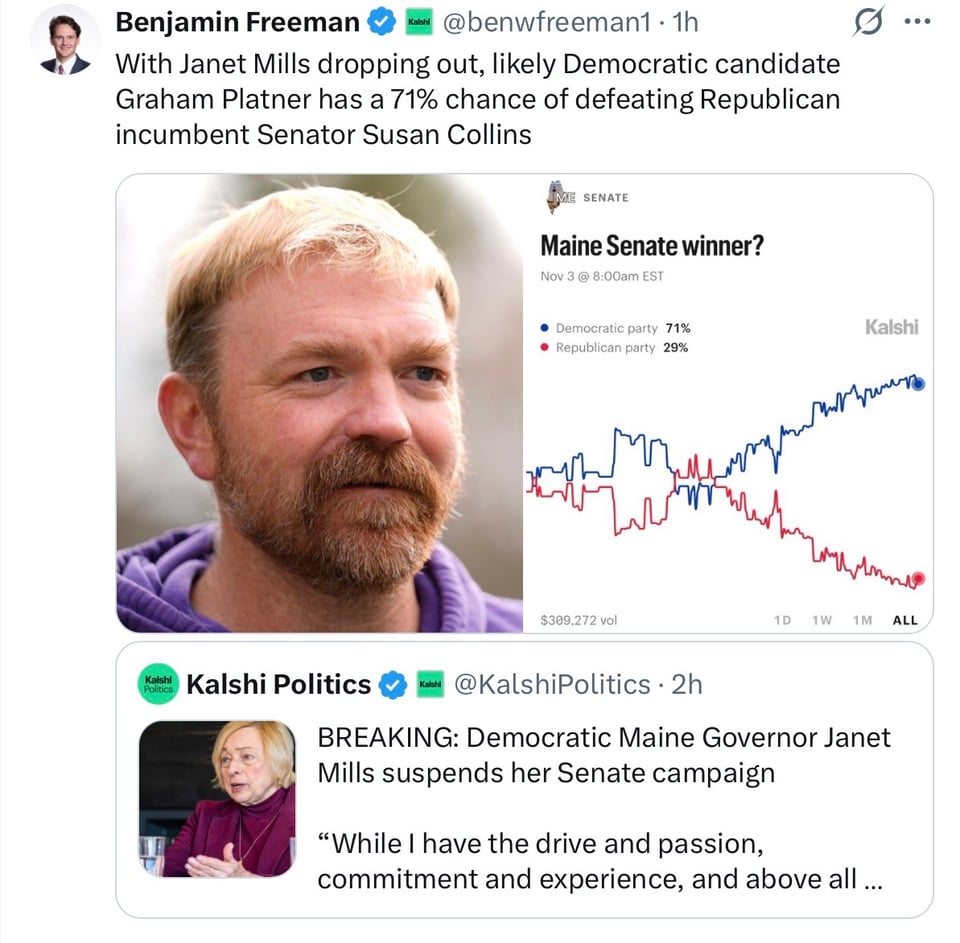
Now, in the name of party unity and to make sure a united Democratic Party beats Susan Collins, she needs to endorse the presumptive Democratic nominee, Graham Platner.
Janet Mills Bows Out of Maine Senate Race as an Insurgent Democrat Rises.
Her withdrawal reflects the energy of the party’s left and voters’ unease with older candidates and paves the way for Graham Platner to challenge Senator Susan Collins in November.
Gov. Janet Mills of Maine, the Democratic establishment’s choice to run for the Senate seat long held by Senator Susan Collins, a Republican, suspended her campaign on Thursday, saying she no longer had the financial resources to compete against Graham Platner, a progressive political newcomer.
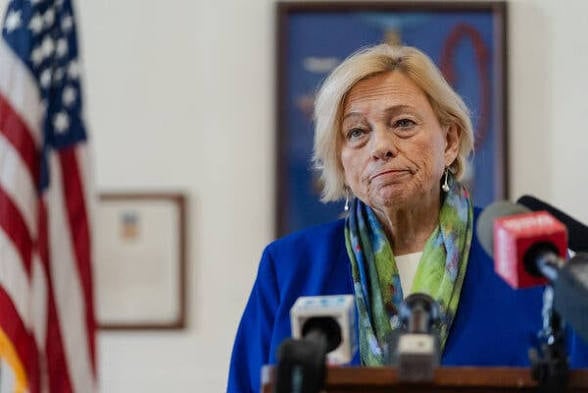
Her exit paves the way for Mr. Platner, 41, an oysterman who has led her in polls, to become the Democratic nominee in a crucial Senate race that the party must win to regain control of the chamber.
“While I have the drive and passion, commitment and experience, and above all else — the fight — to continue on, I very simply do not have the one thing that political campaigns unfortunately require today: the financial resources,” Ms. Mills, 78, said in a statement.
She did not mention or endorse Mr. Platner; in an interview on Monday, she had declined to commit to backing him if he became the nominee. Tommy Garcia, a spokesman for Ms. Mills, said on Thursday that the governor “has never voted for Susan Collins, and she will not do so in this election either,” adding that Ms. Mills would “continue to hear and watch how Graham Platner works to earn the support of Maine voters.”
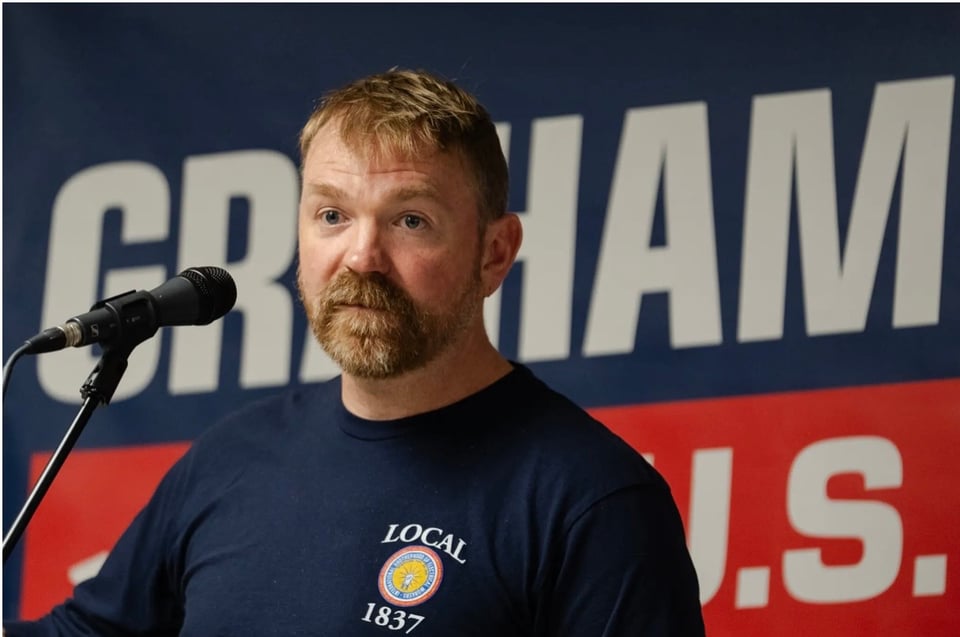
Mr. Platner, a progressive running as an economic populist, is aiming to appeal to blue-collar workers who have become disaffected with the Democratic Party
Surrounded by supporters, Mr. Platner claimed victory on Thursday morning in Augusta. After praising Ms. Mills’s experience in the state, he said his campaign was in the process of “taking back what is ours.”
“We will defeat Susan Collins,” Mr. Platner said. “We will go to Washington and we still start tearing down the system that for far too long has forgotten and written off the people who make Maine and this country what it is.”
The effective coronation of Mr. Platner as the Democratic nominee is a blow not only to the two-term sitting governor but also to Senator Chuck Schumer of New York and the Democratic Party establishment that he leads. Mr. Schumer, the minority leader, has for almost two decades chosen his party’s Senate candidates with little internal opposition, and he encouraged Ms. Mills to enter the race.
Her decision to withdraw reflects a political environment being rapidly reshaped by a restive Democratic grass-roots that is demanding a new, younger and far more combative generation of leadership. Her failure to gain traction also underscores how the mechanics of campaigns have shifted: Ms. Mills, who had insisted that the state already knew her well, struggled to break through Mr. Platner’s dominance on social media and liberal podcasts, and she did not try to match his far more robust campaign schedule.
Almost instantly, attention turned to the expected matchup between Mr. Platner and Ms. Collins, a battle-tested lawmaker who has repeatedly dashed Democratic dreams of seizing her seat during her three decades in office. Democrats argue that this year is different because of President Trump’s sinking approval ratings and Ms. Collins’s votes for some of his cabinet and Supreme Court nominees.
Mr. Platner’s candidacy has emerged as a key test of whether Democrats trying to flip Republican seats should run to the center or to the left.
Mr. Platner is aligned with the progressive wing of the Democratic Party, considers himself an ideological ally of Senator Bernie Sanders of Vermont and is running as an economic populist. Democrats hope he can appeal to blue-collar workers who have become disaffected with the party.
But he has also called to abolish Immigration and Customs Enforcement, strongly defended the rights of transgender Americans and promised voters that he would be arrested protesting Mr. Trump. His candidacy will measure how much sway cultural issues have among the working-class voters Democrats are trying to claw back.
Mr. Platner, who has a long history of making inflammatory statements online — he has apologized for many of them — is also untested on the national stage. At a campaign event on Tuesday night, at least two voters expressed concerns to him about whether he would be able to withstand the scrutiny and Republican attacks; he insisted he would.
“They will tear him apart if he’s the nominee,” Ms. Mills told The New York Times in an interview last month. In January, the main super PAC for Senate Republicans announced its largest-ever investment in Maine — $42 million — to support Ms. Collins.
On the ground, though, Ms. Mills’s struggles were palpable. And her light campaign schedule, complete absence from the airwaves and lagging fund-raising had worried and bewildered supporters from Washington to Maine.
They wondered why the pugilistic two-term governor — the daughter of a prominent political family who has spent decades in public life — wasn’t taking a more vigorous approach to a race that had appeared, for weeks, to be slipping out of reach.
She left the race just a week before the candidates were scheduled to meet for their first debate, a moment her supporters hoped could move the race back toward Ms. Mills.
The next big question is how rapidly the party coalesces around Mr. Platner.
Mr. Schumer and Senator Kirsten Gillibrand of New York, the chair of Senate Democrats’ campaign arm, praised Ms. Mills on Thursday as she departed the race.
“We are grateful for her hard-fought and principled campaign, and we respect her decision to continue her service to Maine as governor,” they said in a statement. “After years of allowing Trump’s abuses of power, Senator Collins has never been more vulnerable, and we will work with the presumptive Democratic nominee, Graham Platner, to defeat her.”
Ms. Mills had been more circumspect in an interview on Monday evening, saying she would not support Ms. Collins but declining to explicitly commit to backing his candidacy should she lose the primary race.
She had spent the day at a low-key housing policy round table in a fluorescent-lit room, followed by a modest meet-and-greet at a brewery in Portland. There, she mingled with a mix of anxious supporters and other bar-goers, sipping a beer, snacking on popcorn and snagging a few fries from an attendee’s order. But she did not make remarks.
Even before Ms. Mills’s announcement, Mr. Platner’s campaign had all but declared victory in the primary race. At a town-hall meeting on Wednesday evening, he made no mention of his Democratic opponent, focusing his attacks on billionaires, technology moguls and Ms. Collins.
“I don’t know if we’re moving past — I don’t even know if we were ever, like, focused,” he said, when asked in an interview after the event if he was already looking beyond the primary. “The only time I really talk about the governor is when people ask what are the distinctions and I lay them out.”
The Democratic establishment’s challenges are increasingly apparent. In a year when the party has grown increasingly bullish about its chances of winning back a Senate majority, some of Mr. Schumer’s preferred candidates have struggled to gain traction in their primary contests.
His explicit and subtle efforts to influence competitive primary races have prompted pushback from a group of liberal Senate colleagues who have made a point of endorsing rivals to his preferred candidates.
Several candidates have made opposition to Mr. Schumer’s leadership central to their campaigns. In Illinois in March, Lt. Gov. Juliana Stratton won her state’s Senate primary race while pledging to oppose a future Schumer bid to be party leader.
The rebuke will only grow stronger if those candidates do well in November, after which Mr. Schumer could face a serious challenge to his leadership post in the Senate.
Mr. Schumer has also recruited candidates in Alaska, North Carolina and Ohio who are on glide paths to the general election.
In Maine, Mr. Schumer saw Ms. Mills, an eighth-generation Mainer with deep political roots in the state, as a proven candidate with the renown and popularity to challenge Ms. Collins.
But Ms. Mills, whose delay in entering the race last year raised questions about her hunger for the job, could not catch up with Mr. Platner’s fund-raising or his standing in polls of Maine Democrats. Her campaign announced it had raised $2.6 million during the first three months of 2026, a relative pittance for a top-tier Senate candidate backed by Mr. Schumer and party leaders.
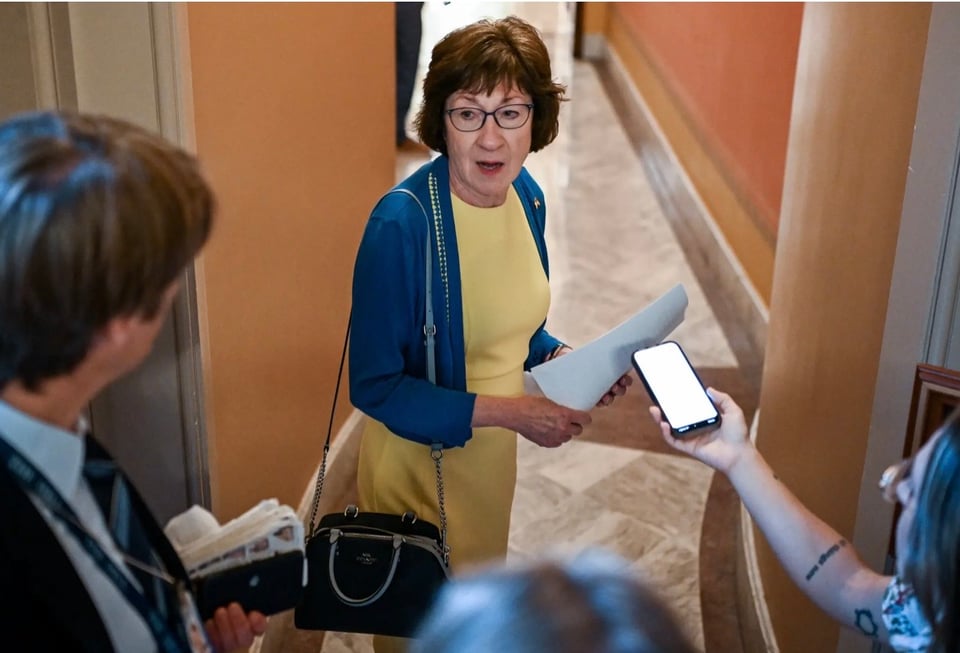
Senator Susan Collins, a Republican, has repeatedly dashed Democratic dreams of seizing her Maine seat during her three decades in office.
Ms. Mills and her allies tried to knock Mr. Platner out of the primary with a series of damaging stories and then advertisements about offensive things he had written online about women and rape, as well as a tattoo on his chest that resembled a Nazi symbol. Mr. Platner later obscured the image with a new tattoo.
Ms. Mills faced criticism from some fellow Democrats for pressing those issues, since they could potentially damage Mr. Platner if he became the Democratic nominee.
But in the general election, Ms. Collins and her Republican allies will face no such constraints as they try to defeat Mr. Platner.
“Washington Democrats always fall short in Maine and will again, because they just nominated a dishonest radical,” said Senator Tim Scott of South Carolina, the chairman of Senate Republicans’ campaign arm.
(New York Times)
Governor Kathy Hochul of New York knows how to fight.
Gov. Kathy Hochul wants assurances from President Donald Trump’s administration that a very specific federal immigration officer isn’t operating in New York: The ICE agent who fatally shot Renee Good.
The Democratic governor sent a letter this week to Trump border czar Tom Homan insisting he confirm whether the reportedly redeployed agent, Jonathan Ross, is now working in the Empire State.
“If Jonathan Ross has been reassigned to work in New York, I demand that he be immediately removed and not redeployed unless cleared after a full, independent investigation,” Hochul wrote in the previously unreported letter. “I have no confidence that Ross can be trusted to safely interact with the public. Nor should you.”
The White House did not immediately respond to a request for comment.
The notice is the latest effort by Hochul to place guardrails around Trump’s sweeping deportation policies — a push that includes direct White House outreach and expected legislative action to limit the reach of federal immigration agencies like ICE.
The two-track approach underscores how New York officials, including the governor, have been desperate to avoid a potentially destabilizing surge of federal immigration officers in the five boroughs, home to an estimated 560,000 undocumented immigrants.
The push also highlights how Hochul stands to benefit politically from taking an assertive posture against Trump’s immigration policies as she runs for reelection. The president rode back to the White House pledging to remove millions of people living illegally in the United States, only for voter support to quickly erode following the deaths of Good and Alex Pretti during January’s Minnesota crackdown.
A Siena University poll in February found 67 percent of New York voters believe federal immigration tactics had gone too far. The same survey found 59 percent of voters did not want to see more ICE agents flow into New York City.
Trump has dialed back the publicly aggressive deportation effort, but that’s done little to assuage the Hochul administration. The February death of Nurul Amin Shah Alam, a blind refugee who was left in front of a Buffalo coffee shop by federal agents, further inflamed New York officials.
“I have repeatedly stated that any agents involved in these types of incidents must be properly investigated and held accountable to the fullest extent of the law — not simply reassigned to administrative or investigative duties or shuffled to other states,” Hochul wrote in the letter.
Homan, who has become the Trump administration’s blue state ambassador following the deadly unrest in Minneapolis, met privately with her in Albany last month, and the governor urged him to not conduct a similar operation in the Big Apple.
To that end, Hochul and Democratic state lawmakers are also on the verge of approving a package of sanctuary-like measures meant to erect legal barriers around federal immigration enforcement in New York.
The measures would prohibit federal authorities from carrying out civil deportation warrants in sensitive locations like education facilities and houses of worship. It would also ban formal agreements between agencies like ICE and local police departments from coordinating operations and sharing equipment. And New York is poised to make it easier to sue federal officers if a person believes their constitutional rights have been violated.
The expected package of protections amounts to a sweeping blue state rebuke of Trump’s immigration and deportation policies. It also marks a change for Hochul, a moderate who as a local official two decades ago opposed allowing undocumented immigrants to obtain state driver’s licenses.
Yet some left-leaning state lawmakers worry that Hochul’s opposition to a strict ban on local police communicating with federal immigration authorities will leave undocumented immigrants exposed even as existing sanctuary protections will remain in place.
One legislator, granted anonymity to speak frankly, said the likely agreement is “really inadequate, arguably harmful, because her proposal would create an illusion of legal protections while still proactively permitting law enforcement to share info.” (Politico)
Read Governor Hochul’s letter to Trump border czar Tom Homan by tapping on this link.
Trump signed the bill [yesterday]… afternoon, resolving uncertainty over whether thousands of federal security workers would be paid next month. NEw York Times)
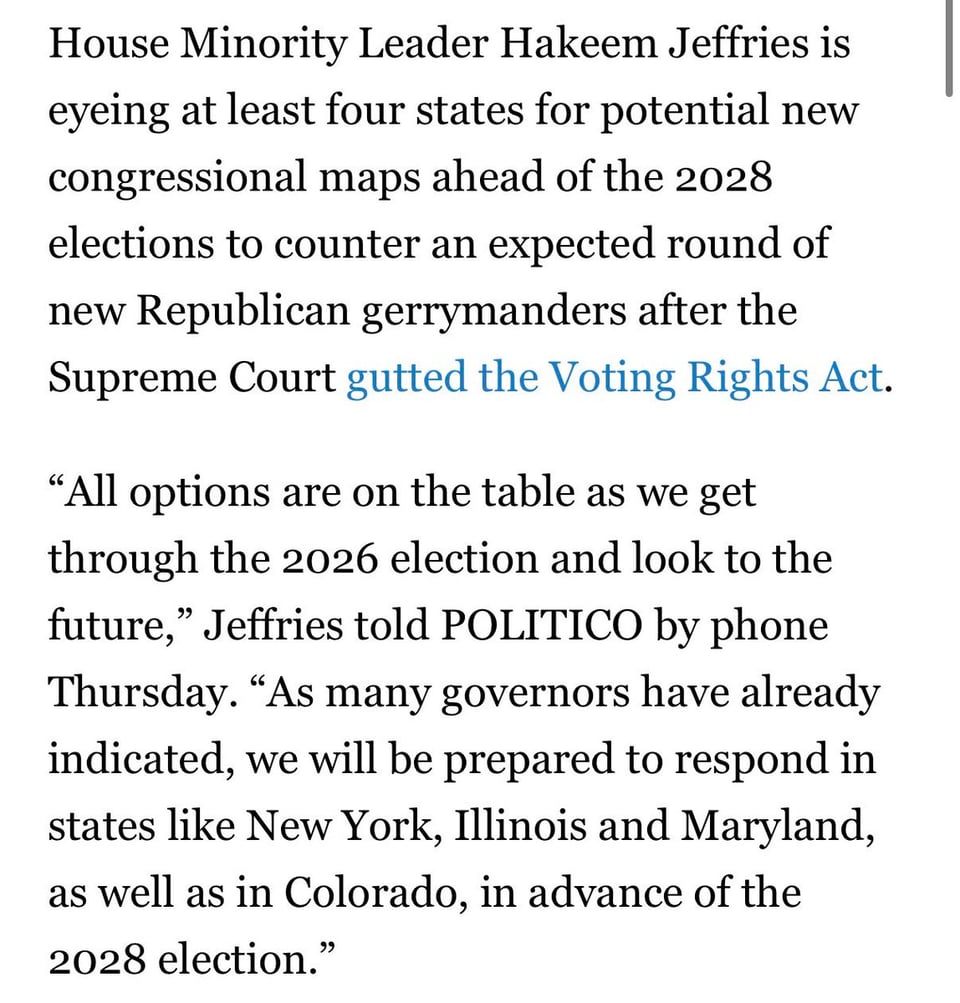
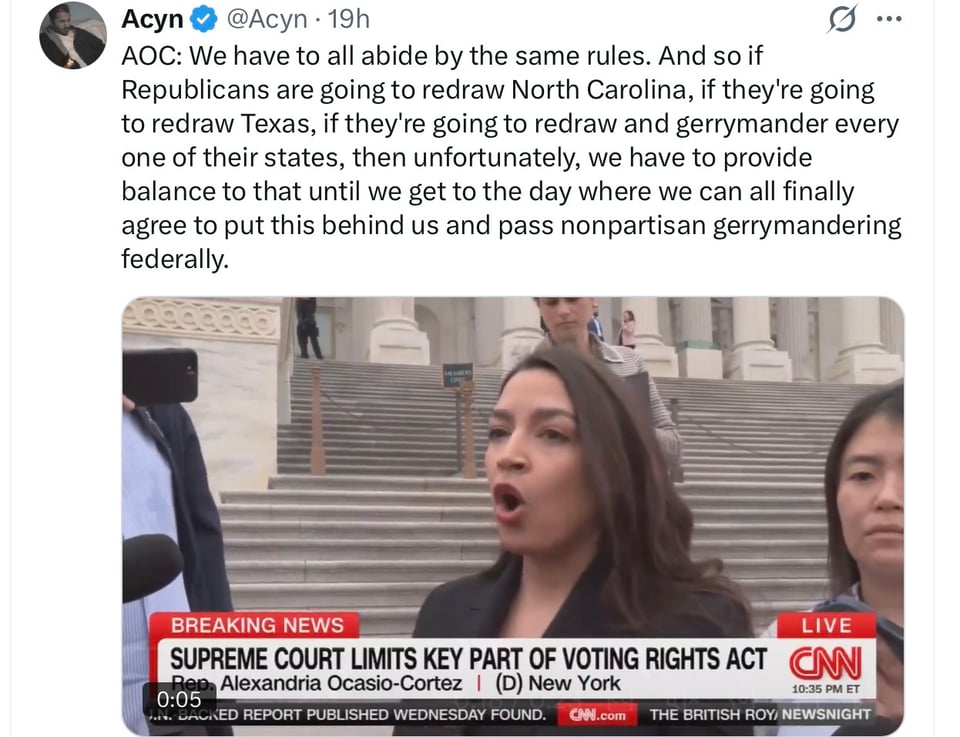
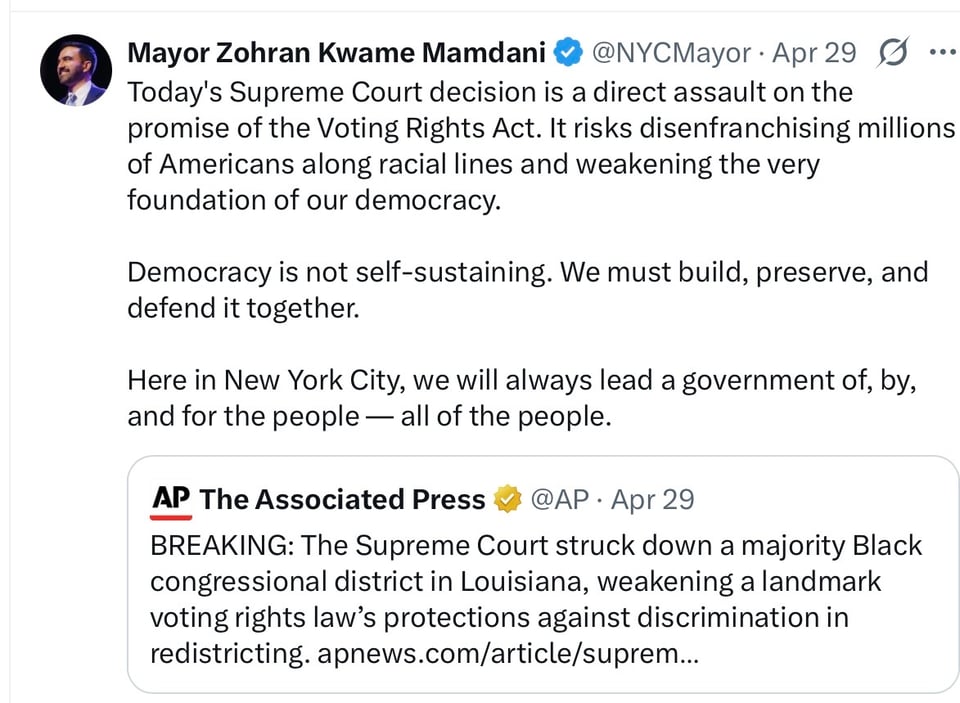
Immediate Fallout from the Supreme Court’s gutting the Voting Rights Act.