Friday, June 5, 2026. Annette's Roundup for Democracy.
Finally, Congress expressed its power and stopped Trump.
These Republicans Broke With Trump on the War in Iran.
Four Republicans from different ideological factions crossed party lines to vote with Democrats in favor of reining in the president’s power to wage war unilaterally.
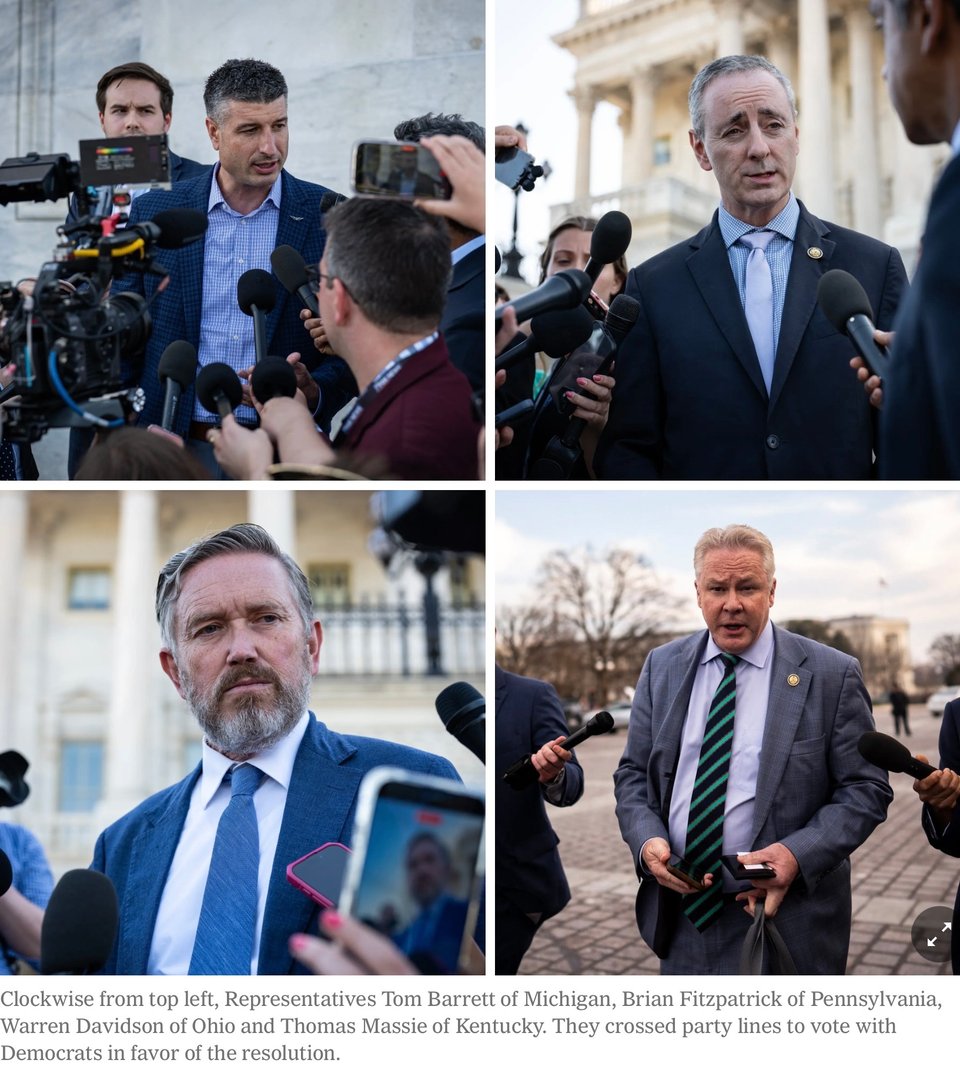
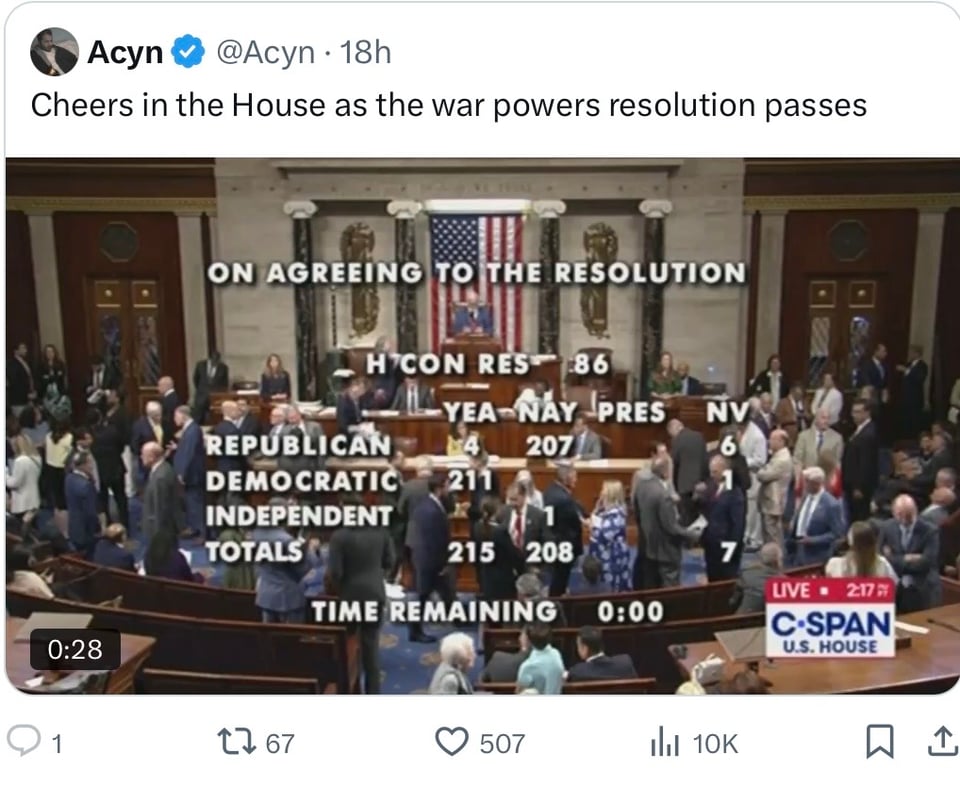
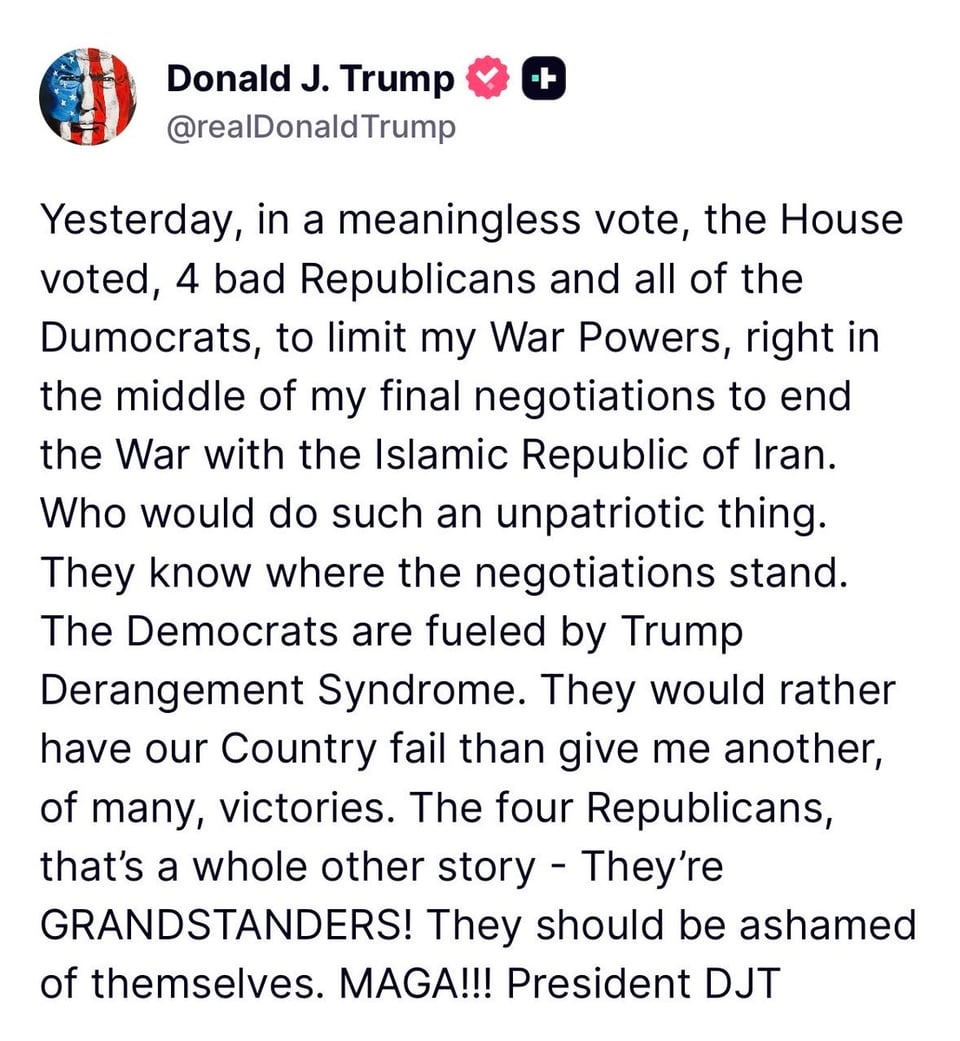
Four House Republicans crossed party lines on Wednesday and voted to limit President Trump’s power to continue directing military action in Iran without congressional authorization, delivering a rebuke of the war that recently entered its fourth month.
The four hail from different factions within the G.O.P.; two are staunch conservatives with libertarian views that include opposition to foreign military intervention, while the other two are more mainstream Republicans from competitive districts where backing for the war could be a political liability. All of them expressed a firm belief that Congress, not the president alone, must weigh in on the scope and objectives of the war.
The measure they supported does not require a presidential signature but still faces long odds of being enacted — and even if it were, it would likely be challenged by the administration. But its adoption, along with a similar measure advancing in the Senate in recent weeks, was a clear repudiation of Mr. Trump’s handling of the war in Iran. It reflected growing uneasiness within his own party about an unpopular war that has dragged on well past when the president said it would.
Here is a look at who defected, and why.
Warren Davidson of Ohio
Representative Warren Davidson of Ohio, is a conservative and a libertarian who has long argued that Congress, not the president, should decide whether the United States enters military conflicts.
A former member of the House Freedom Caucus and a frequent ally of Mr. Trump on domestic policy, Mr. Davidson has often broken with leaders of both parties on questions involving war powers, surveillance authorities and executive branch power.
He was among the first Republicans to break with Mr. Trump on the war in Iran, siding with Democrats in March on the first war powers resolution they offered after the conflict began. But after facing pressure from the White House and Republican leaders, he had reversed himself and joined the rest of his party in opposing two similar measures in April and May, helping the party maintain a largely united front behind the president’s handling of the conflict.
On Wednesday, however, Mr. Davidson reverted to his original stance and voted with Democrats to advance the measure, helping secure its adoption.
Afterward, he defended the vote in a brief statement: “Define the mission. Authorize the mission. Accomplish the mission.”
Tom Barrett of Michigan
Mr. Barrett, a first-term Republican and former Army helicopter pilot who faces a tough re-election race in his competitive Lansing-area district, has emerged as one of the most junior members of his party willing to publicly question the administration’s handling of the war in Iran.
Earlier this spring, he introduced legislation that would authorize military action against Iran for a limited period while imposing a firm deadline for winding down the conflict and barring the use of U.S. ground troops. At the time, Mr. Barrett, whose deployments over more than two decades in the military included Iraq and Kuwait, framed the bill in part as an effort to ensure the current operation in the Middle East had more clearly defined mission objectives and deadlines than previous conflicts.
Mr. Barrett, who has voted with Mr. Trump on the overwhelming majority of issues, was initially aligned with Republican leaders during the first two House votes on the war in Iran. But in May, he broke with his party and sided with Democrats.
“My support of this resolution tonight is consistent with my belief that it is time for Congress to decide the scope of the mission and the appropriate limits on the use of force in Iran,” he said in a statement on Wednesday.
Brian Fitzpatrick of Pennsylvania
Mr. Fitzpatrick, whose suburban Philadelphia district is also competitive, is one of the most centrist Republicans in the House.
A former F.B.I. agent, he has frequently broken with his party on a range of foreign policy and national security issues.
Like Mr. Barrett, Mr. Fitzpatrick initially voted with Republicans against war powers measures, but he flipped his position in May, arguing that the legal window for the president to act without authorization from Congress had expired and that lawmakers could no longer defer to the executive branch.
“We must keep the world safe, and we must also follow the law,” he said in a statement following that vote. “The War Powers Act of 1973 states that any conflict exceeding 60 days must be brought to Congress.”
Thomas Massie of Kentucky
Mr. Massie, a libertarian, has been by far the most vocal and frequent Republican defector from Mr. Trump in Congress, a distinction that cost him his seat last month when he was defeated by the president’s handpicked primary challenger.
Mr. Massie, who has long opposed American military intervention abroad, has been the leading Republican advocate in the House for forcing Congress to vote on the conflict in Iran.
A conservative and deficit hawk, Mr. Massie has often broken with his party and presidents of both parties on war, spending and — in Mr. Trump’s case — the release of the Epstein files. (New York Times)
One more thing.
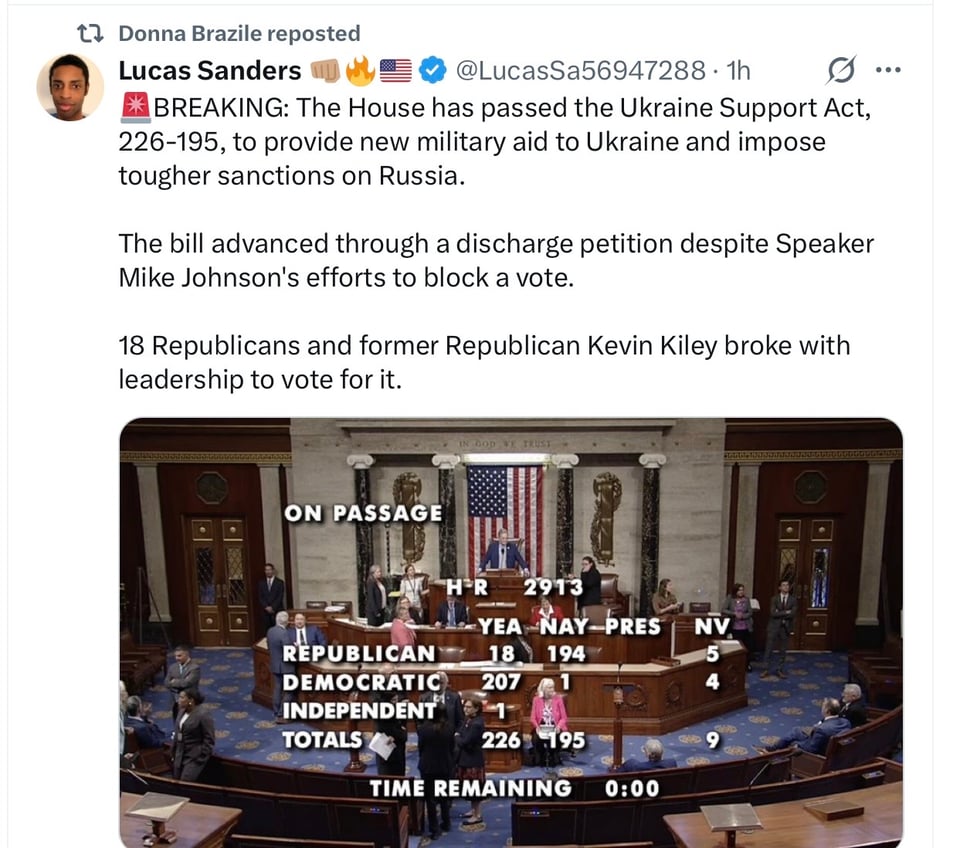
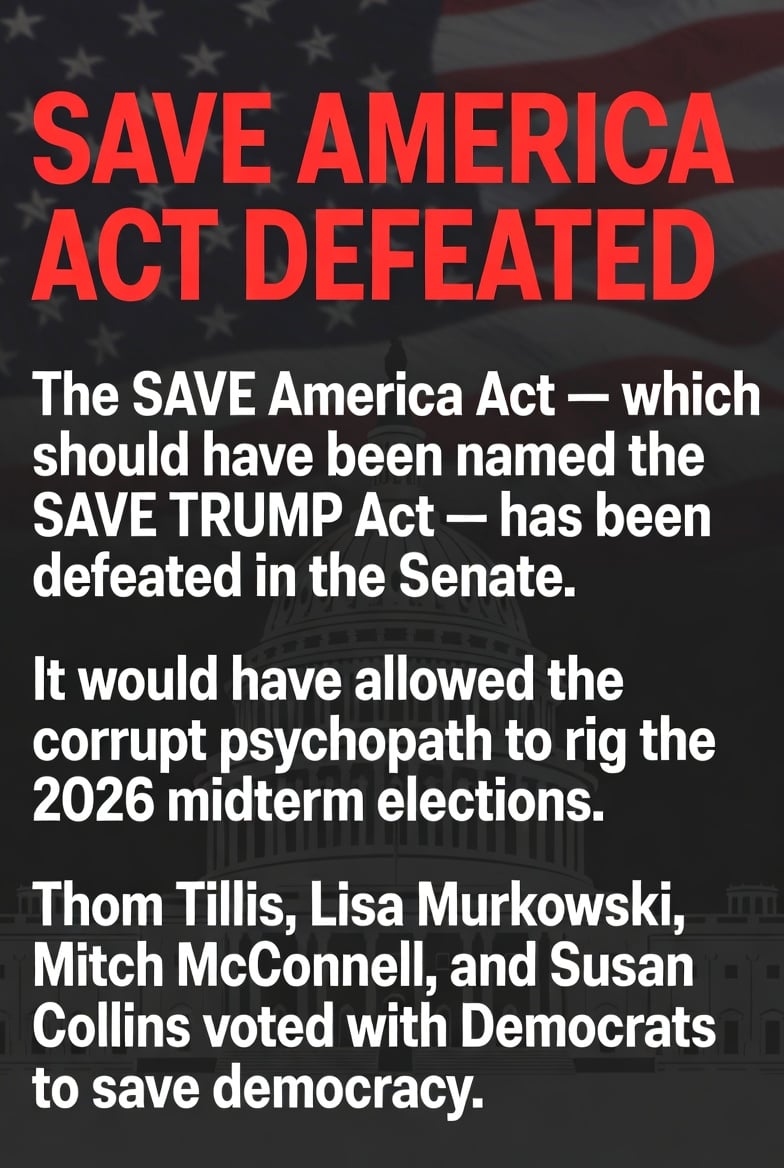
More defections too. In the House. In the Senate. Big wins for Democracy.
The Jared Kushner would-be heist in Albania is being stopped.

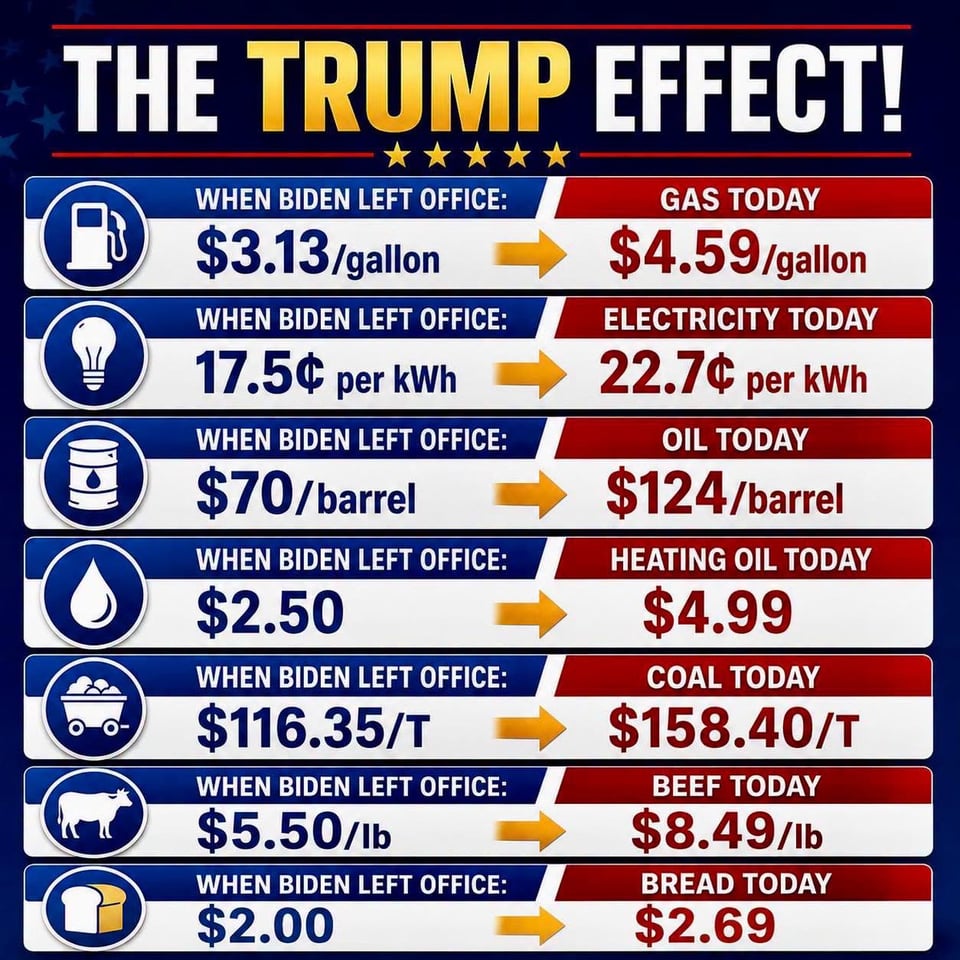
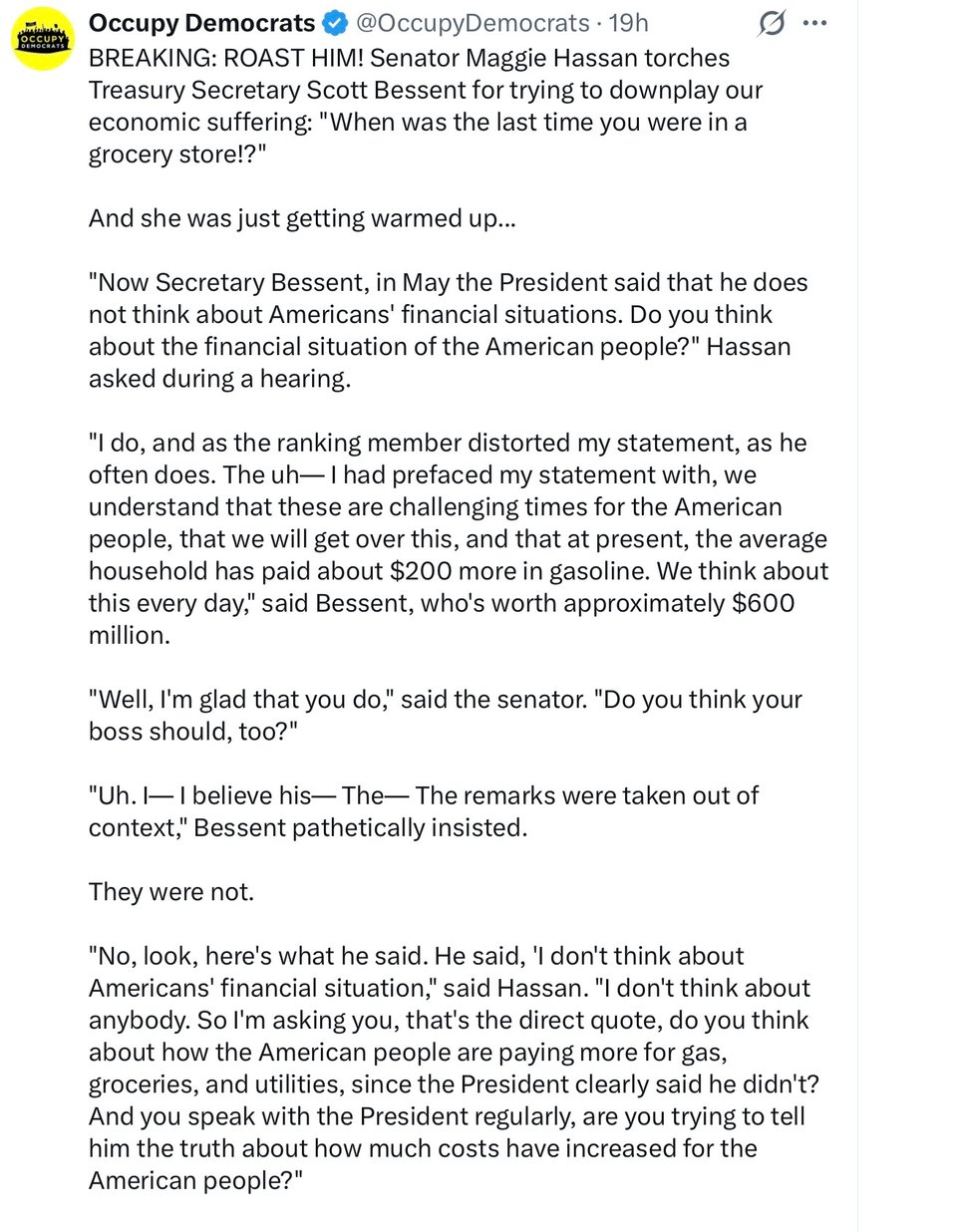
How does Trump's economy seem to you?
Steve Ratner, former head of Obama Auto Task Force. thinks it is bad.
One more thing. Or two. Or three.

Hope you night-owls are watching Kimmel?
Most are.
First Post-Colbert Ratings Snapshot Gives Kimmel a Commanding Lead - LateNighter
First on LateNighter: Late night’s post-Colbert map is still being drawn, but ratings numbers for the first real night of late night’s new normal put Jimmy Kimmel well out in front.

For the first time since May 20—the night before Stephen Colbert signed off from The Late Show—both Jimmy Kimmel Live! and The Tonight Show Starring Jimmy Fallon were back with new episodes Monday, June 1.
That made Monday Nielsen’s first apples-to-apples ratings read on the newly reshuffled 11:35 p.m. landscape, with CBS now airing Comics Unleashed with Byron Allen in Colbert’s old time period.
According to Nielsen live-plus-same-day data, Kimmel dominated the hour with an average 2.185 million total viewers and 295,000 viewers in the 18-49 demographic. That’s more viewers for Jimmy Kimmel Live! across both key ratings measurements than both the Tonight Show and Comics Unleashed combined. (See each show’s numbers at the bottom of this post.)
Compared to the same night one year ago—Monday, June 2, 2025—Kimmel was up 53% in total viewers and up 178% among adults 18-49.
Fallon also saw year-over-year growth, with The Tonight Show up 10% in total viewers and 14% in the demo.
CBS, meanwhile, saw a steep drop-off from its year-ago performance. Comics Unleashed was down 64% in total viewers and down 46% among adults 18-49 compared to The Late Show’s numbers the same night last year, when Colbert won the timeslot.
There are plenty of caveats. One night is not a trend, and live-plus-same-day ratings are only the first snapshot. Viewership numbers for all three shows will increase once live-plus-three-day data is factored in later this week.
And while linear viewing remains the place where the networks make most of their advertising revenue, it no longer captures the totality of late night’s cultural influence, with clips on YouTube, Instagram, and TikTok regularly drawing views in the millions.
Monday’s Jimmy Kimmel Live! featured Olivia Wilde, Adewale Akinnuoye-Agbaje, and a performance by Death Cab for Cutie. Fallon welcomed Tina Fey, Marlon Wayans, and Jazz Chisholm Jr., with a performance from Schmigadoon! CBS’ Comics Unleashed featured comics LouLou Gonzalez, Dwayne Perkins, Samson Crouppen, and Dylan Mandlsohn. (LateNighter)
Trumpy's name is coming down, coming down.🎶🎶
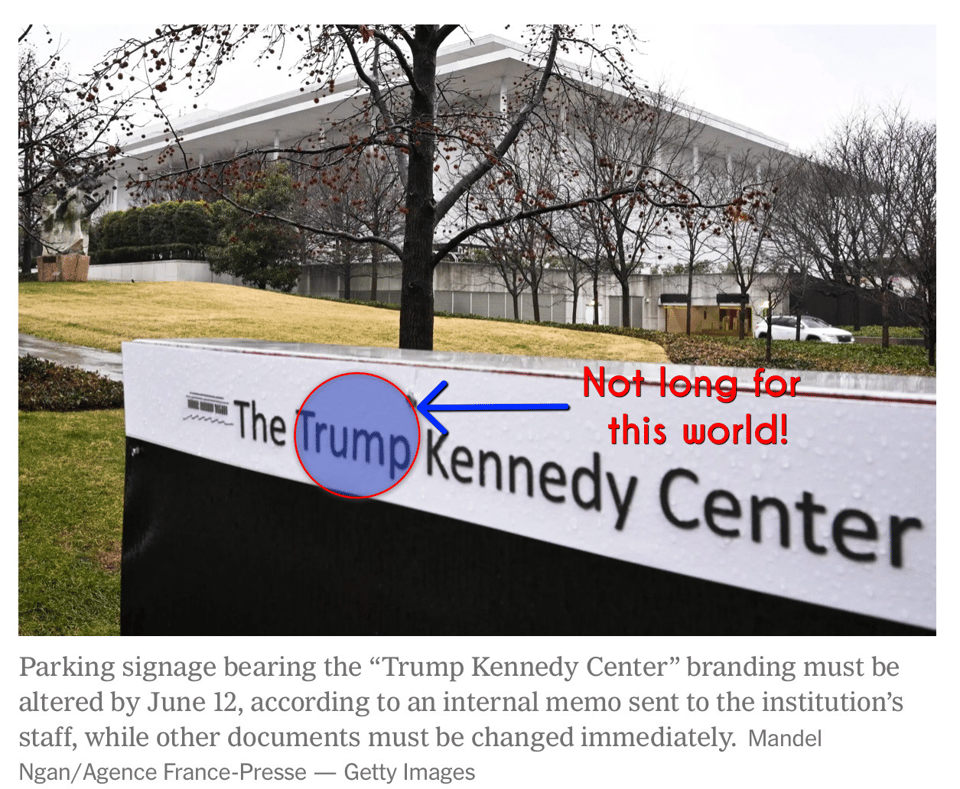
Kennedy Center Tells Staff to Immediately Remove Trump’s Name From Documents.
The center’s general counsel also said that a federal judge’s order meant the president’s name must be taken off indoor and outdoor signage by June 12.
The general counsel’s office at the John F. Kennedy Center for the Performing Arts told employees in a memo on Thursday to “immediately” remove President Trump’s name from the institution’s branding on official forms and other documents. The mandate came days after a federal judge ruled that the board’s decision to add the president’s name to the building had been unlawful.
The memo gave staff at the center detailed instructions on the materials that needed to be updated, including social media accounts, email signatures and voice mail messages. The memo specified that indoor and outdoor signage with the barred name must be altered by June 12.
Center officials indicated last week that they were planning to appeal the judge’s decision, but one has yet to be filed. Mr. Trump was so incensed by the ruling that he threatened to walk away from oversight of the center, where he serves as the chairman.
Representatives for the center did not immediately respond to a request for comment.
“To comply with this order,” the memo said, “you must immediately change email signatures, letterhead and other documents to reflect the name as ‘The John F. Kennedy Center for the Performing Arts,’ or ‘Kennedy Center.’”
U.S. District Judge Christopher Cooper last week ruled in favor of Democratic Rep. Joyce Beatty of Ohio, a member of the Kennedy Center's Board of Trustees, who filed a lawsuit challenging the institution's name change and plans to close for two years for extensive repairs beginning this summer.
Cooper found the board had overstepped its authority and ordered the president's name to be removed from "the institution's title, as represented on the façade of the Center, any other physical or digital signage, and official materials."
The memo to staff Thursday said staff "must immediately change email signatures, letterhead, and other documents to reflect the name as 'The John F. Kennedy Center for the Performing Arts,' or 'Kennedy Center.'"
Changes to interior and exterior signage and any furniture carrying the current name must be switched back by next Friday, according to the memo.
The Kennedy Center didn't immediately respond to requests for comment.
The memo also says center officials still are "considering their options and will provide further guidance shortly" on whether the center will remain open after July 5, when extensive renovations costing $257 million are set to begin.
In his order, Cooper agreed renovations to the arts center are "sorely needed," but he wrote his preliminary injunction does not "categorically" bar the board from closing the Kennedy Center, "should it come to this decision anew after independently balancing its multiple obligations to the Center in a prudent fashion."
"By way of this opinion, the Court does not purport to dictate how the Center should be run, nor does it prescribe any particular plan for the institution — construction, closure, or otherwise — moving forward," he wrote. "It simply holds the Kennedy Center Board to certain minimum requirements imposed by law. Beyond that, the Court will let the parties play on."
In the early weeks of his second term, Mr. Trump replaced several members of the center's Board of Trustees with senior members of his administration and close allies, who then elected him as chair.
In December, the Kennedy Center's board voted to change the performing arts institution's name to The Donald J. Trump and The John F. Kennedy Memorial Center for the Performing Arts. Within hours, the Kennedy Center's website was updated to read "The Trump Kennedy Center" and crews went to work adding Mr. Trump's name to the building's facade. But lawmakers and legal scholars said such a change required congressional action.
Several artists who were set to perform at the institution canceled performances and the executive director of the National Symphony Orchestra, which performs at the Kennedy Center, left for a new job. (New York Times)
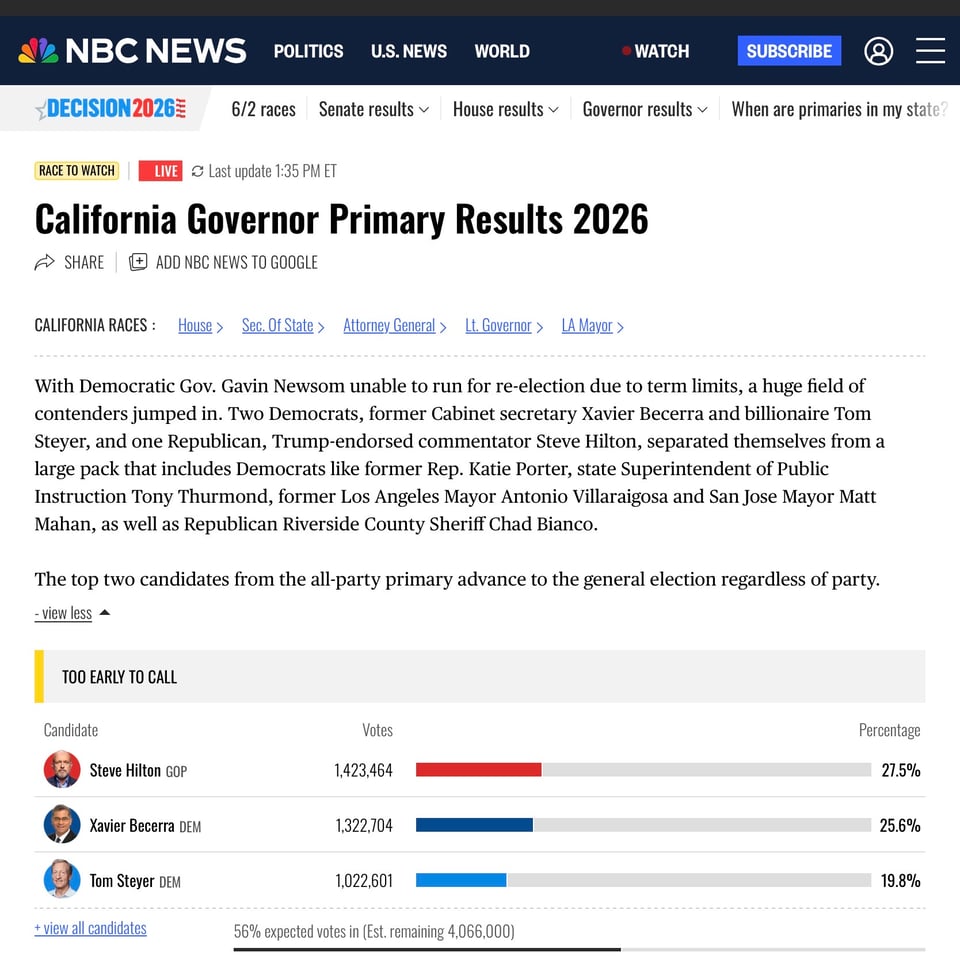
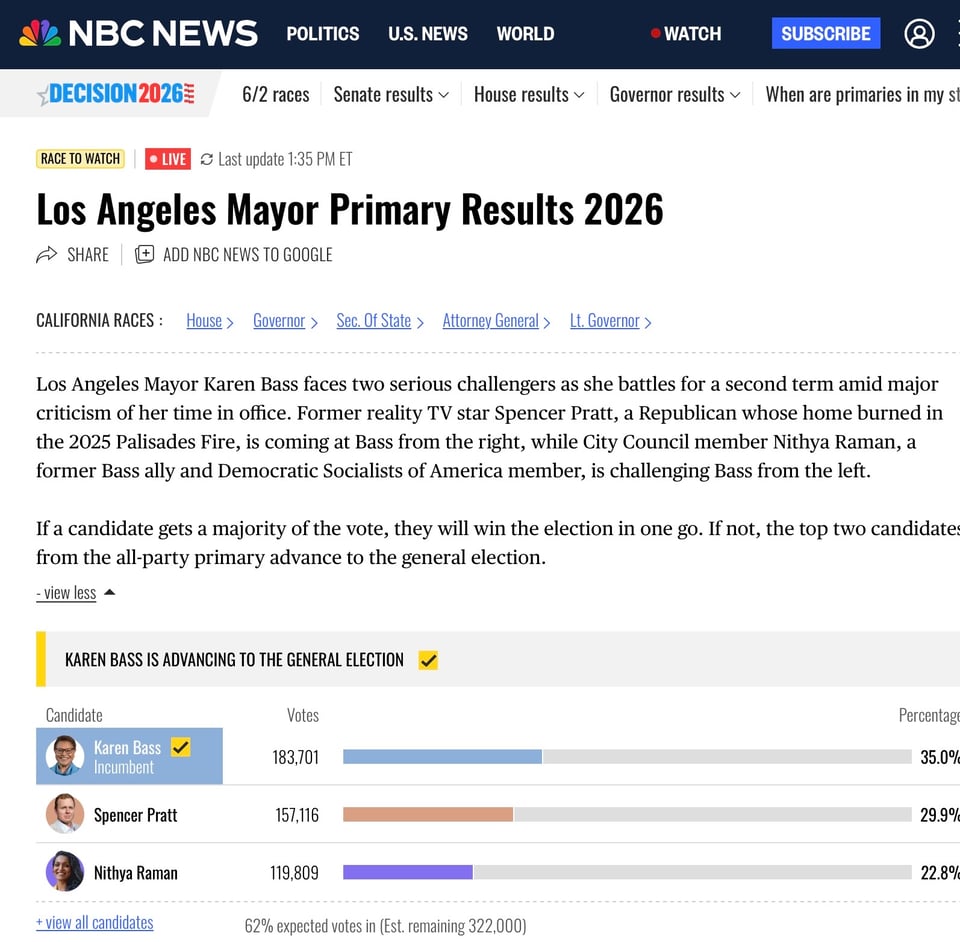
Still counting in California.
It's been a little over 100 years.
Whether you feel that is a long or short time determines how you feel about the current situation.