Friday, January 9,2026. Annette’s Roundup for Democracy.
January 7th - another sad day in American History.
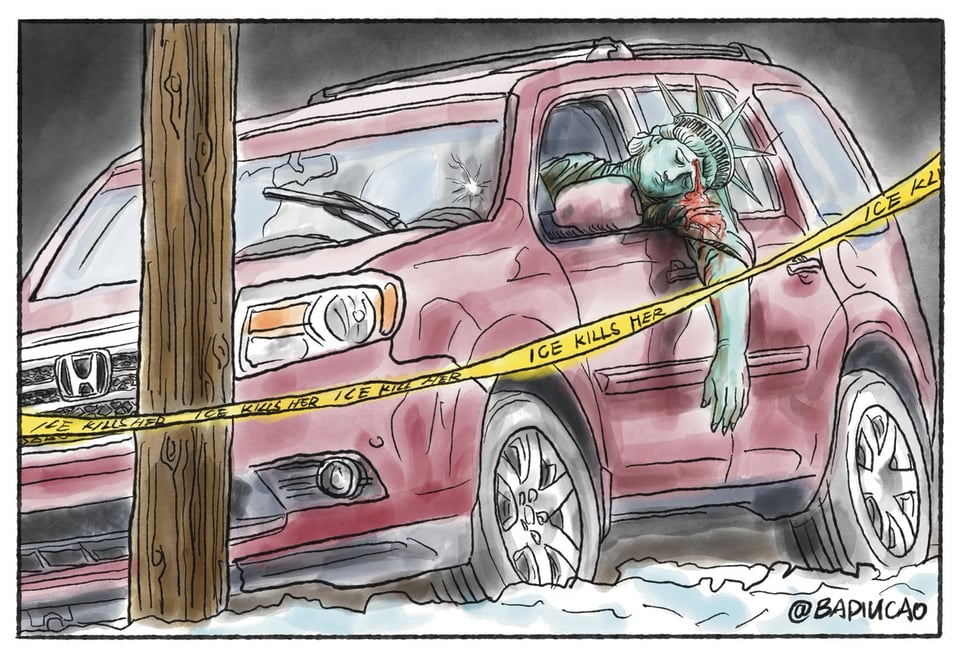
Washington Post Conclusion about ICE Shooting.
ICE agent was not in the vehicle’s path when he fired at driver, video shows.
An analysis of video footage raises questions about claims by President Donald Trump and Homeland Security Secretary Kristi L. Noem about the fatal shooting in Minneapolis.
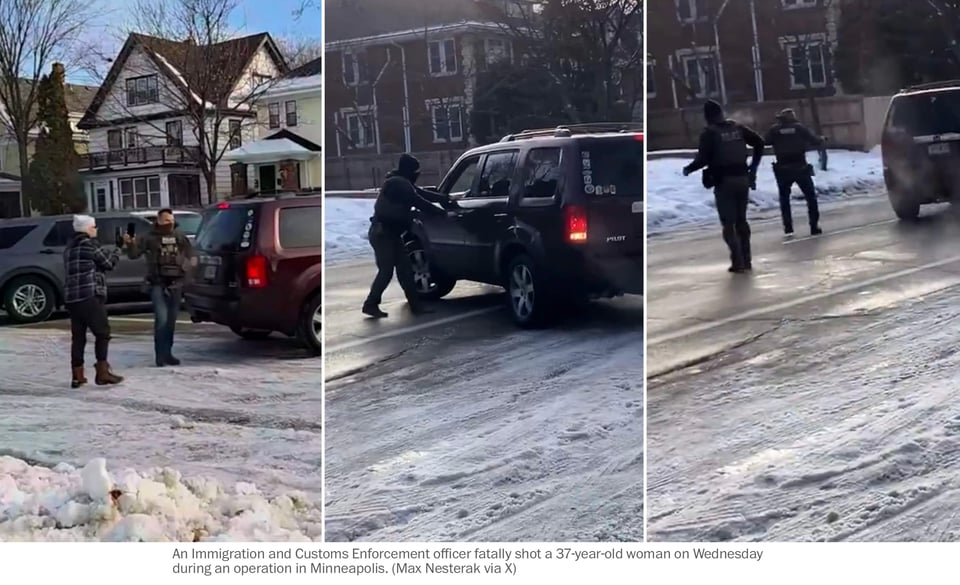
A deadly encounter in Minneapolis on Wednesday between federal Immigration and Customs Enforcement agents and a 37-year-old woman escalated in a matter of seconds. In the aftermath, Homeland Security Secretary Kristi L. Noem said the woman had committed an act of “domestic terrorism,” first disobeying officers’ commands and then weaponizing her SUV by attempting to “run a law enforcement officer over.” President Donald Trump said the woman “violently, willfully and viciously ran over the ICE officer.” A frame-by-frame analysis of video footage, however, raises questions about those accounts. The SUV did move toward the ICE agent as he stood in front of it. But the agent was able to move out of the way and fire at least two of three shots from the side of the vehicle as it veered past him, according to the analysis.
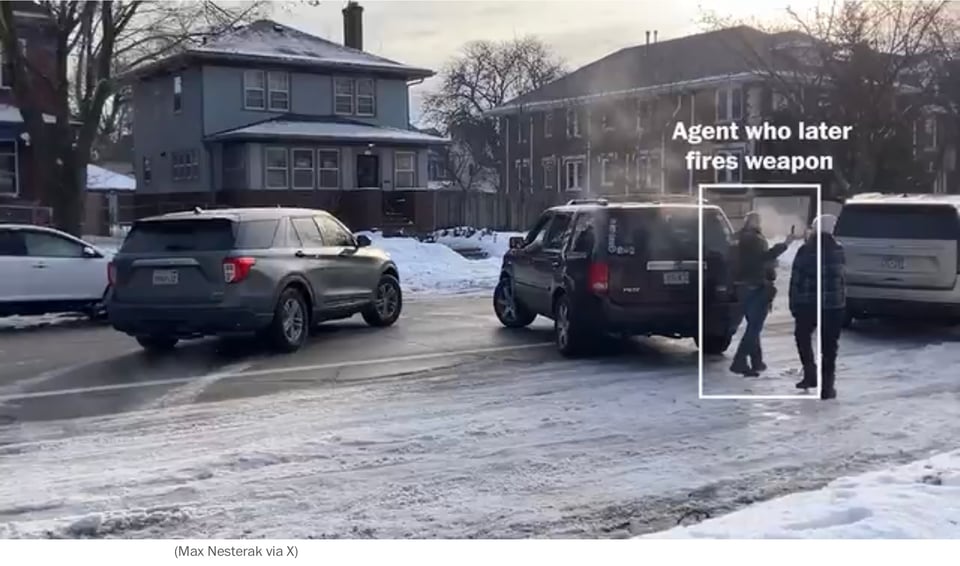
Video taken by a witness shows Renee Nicole Good’s vehicle, a burgundy Honda Pilot SUV, stopped in the middle of a one-way road in a residential area of south Minneapolis on Wednesday morning. That footage and other videos examined by The Washington Post do not show the events leading up to that moment. The agent, who has not been publicly identified, can be seen standing behind Good’s SUV, holding up a phone and pointing it toward a woman who also has her phone out. The two appear to be recording each other. The agent then walks around the passenger side of Good’s vehicle.
A pickup truck pulls up, and two additional agents exit the vehicle and approach Good, the video shows. A voice can be heard saying to “get out” of the car at least two times. One of the agents puts a hand on the opening of the driver’s side window and with his other hand tugs twice quickly on the door handle, but the driver’s door does not open.
That same agent puts his hand farther in the opening of Good’s window, and almost simultaneously, the SUV begins to back up.
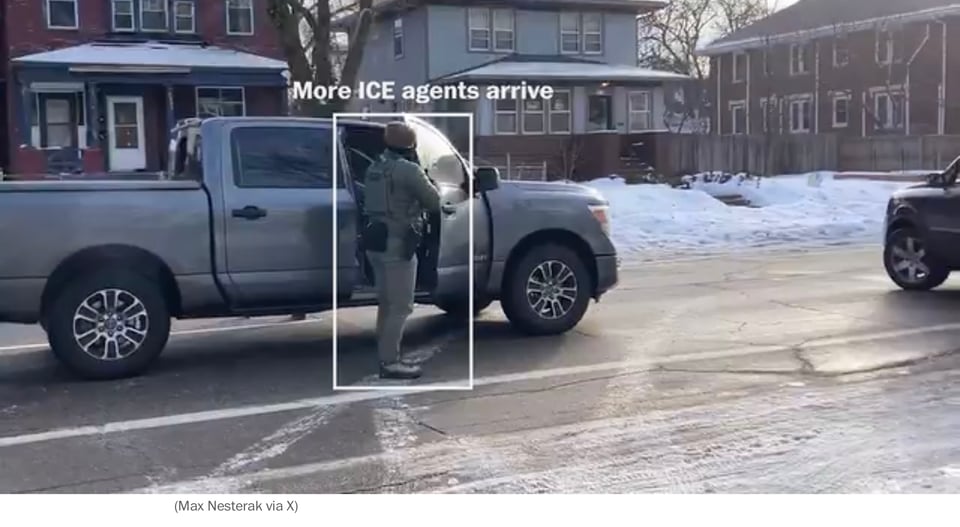
![Shot of Minneapolis shooting
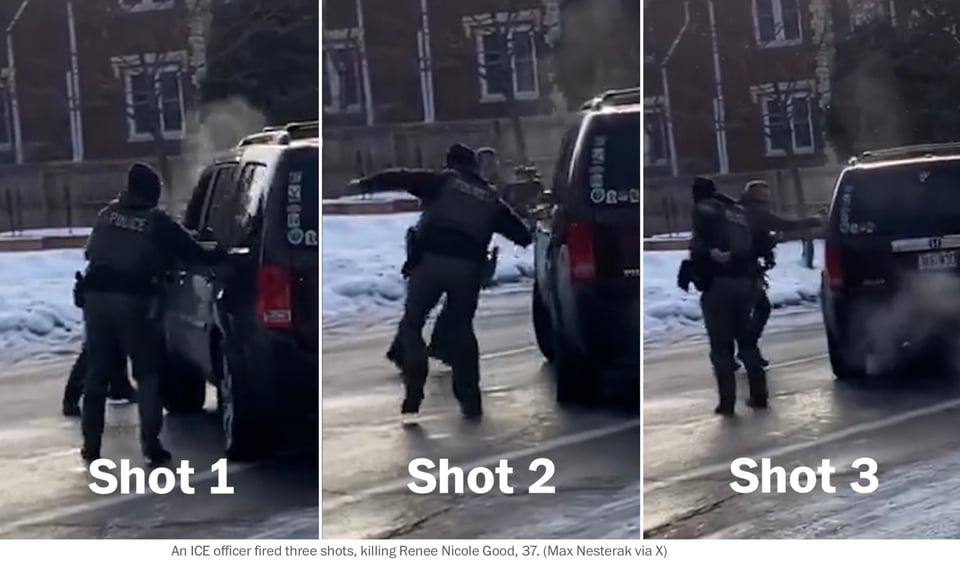
The agent who was first seen behind Good’s SUV reemerges in front of the vehicle, still appearing to hold up a phone. The SUV quickly pulls forward, and then veers to the right, in the correct direction of traffic on the one-way street. As the vehicle moves forward, video shows, the agent moves out of the way and at nearly the same time fires his first shot.
The footage shows that his other two shots were fired from the side of the vehicle. Videos examined by The Post, including one shared on Truth Social by Trump, do not clearly show whether the agent is struck or how close the front of the vehicle comes to striking him. Referring to the officer, Trump wrote in his post that it was “hard to believe he is alive.”
Video shows the agent walking around the scene for more than a minute after the shooting. Good’s SUV travels a short distance before crashing into a car parked on the opposite side of the street.
The FBI and Minnesota’s Bureau of Criminal Apprehension are investigating the shooting. In response to a request for comment, the White House referred to the president’s past social media posts and Noem’s public statements that the officer was struck. Department of Homeland Security spokeswoman Tricia McLaughlin replied in an email echoing the Noem’s assertion from Wednesday: “The individual in question hit the officer with the car.” The full encounter in video, uninterrupted, can be seen here:
[if you clock on this tweet and scroll down to the tweet with the black screen shielded by Twitter, you can watch the full video.]
https://x.com/maxnesterak/status/2008961959731859757?s=20(Washington Post)
From Nicholas Kristof of the New York Times.
This review of the videos of the ICE killing of a US citizen in Minnesota suggest that the victim was simply trying to leave and did not endanger anyone. ICE then refused to allow people to provide medical aid to the dying woman. And then the administration lied about it.…
— Nicholas Kristof (@NickKristof) January 8, 2026
From the New York Times.
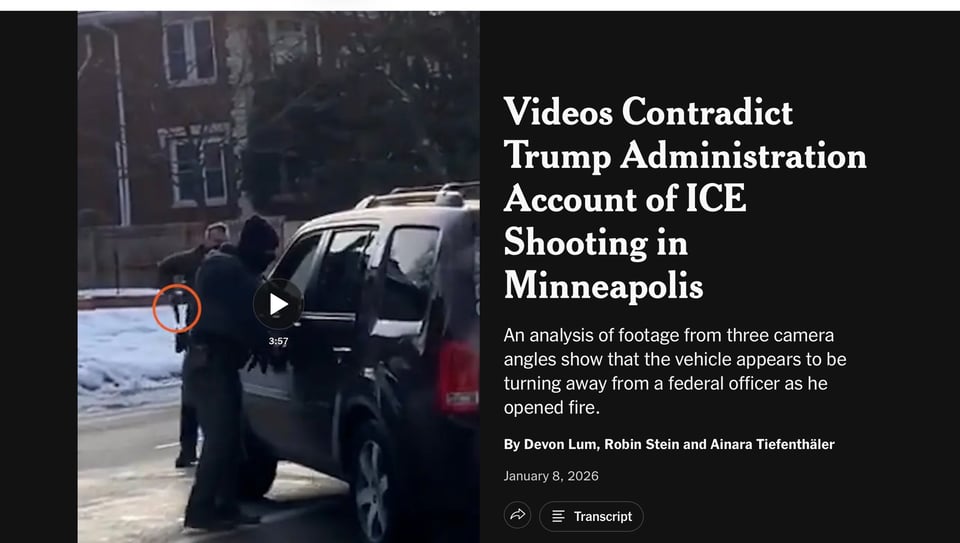
On Wednesday in Minneapolis, a federal agent fatally shot a motorist, 37-year-old Renee Nicole Good. Trump administration officials said these were “defensive shots” fired because the officer was being run over. But our analysis of bystander footage, filmed from different angles, appears to show the agent was not in the path of the victim’s SUV when he fired three shots at close range. Here’s how events unfolded. Moments before the shooting, the victim’s maroon SUV is stopped in the middle of the street. Multiple unmarked federal vehicles are idling nearby. Secretary Noem alleged the motorist “was blocking the officers in.” Bystanders are blowing whistles and yelling at federal agents. Then, federal vehicles start moving toward the maroon SUV with sirens and lights blaring. A federal agent films the scene on his phone. The driver rolls forward slightly, turning left, then stops and waves for others to go ahead. Two agents exit this silver pickup and walk toward the vehicle. Moments later, shots are fired. Let’s look at the scene again more closely. This is the agent who shoots the driver. He walks around the car filming and disappears from view. Other agents pull up and order the driver to exit her vehicle. One of them grabs at the door handle and reaches inside. The SUV reverses, then turns right, apparently attempting to leave. At the same time, the agent filming crosses toward the left of the vehicle and grabs his gun. He opens fire on the motorist and continues shooting as she drives past. The moment the agent fires, he is standing here to the left of the SUV and the wheels are pointing to the right away from the agent. This appears to conflict with allegations that the SUV was ramming or about to ram the officer. President Trump and others said the federal agent was hit by the SUV, often pointing to another video filmed from a different angle. And it’s true that at this moment, in this grainy, low-resolution footage, it does look like the agent is being struck by the SUV. But when we synchronize it with the first clip, we can see the agent is not being run over. In fact, his feet are positioned away from the SUV. The SUV crashes into a white car parked down the road. A bystander runs toward the collision. The federal agents on scene do not appear to rush to provide emergency medical care. Eventually, the agent who shot the motorist approaches the vehicle. Seconds later, he turns back around and tells his colleagues to call 911. Agents blocked several bystanders who attempt to provide medical care, including one who identifies himself as a physician. At the same time, several agents, including the agent who opened fire, get in their vehicles and drive off, apparently altering the active crime scene.
One more thing.
Breakin’ news on Thursday.
DEVELOPING: Local and federal sources tell ABC News that federal agents shot two people in Portland, Oregon, on Thursday afternoon. The FBI is responding.
— ABC News (@ABC) January 8, 2026
The sources say the agents who opened fire are with U.S. Customs and Border Protection. pic.twitter.com/9LrQbU4enE
Violence is contagious.
A critical document on Greenland
🇬🇱 - When the USA bought the West-Indian Islands from Denmark in 1916 the US signed a convention recognising Danish sovereignty over all of Greenland. pic.twitter.com/6GvsRj13Kn
— NXT EU (@NXT4EU) January 7, 2026
Are Backbones coming back in fashion?
Will we ever have a functioning Congress again?
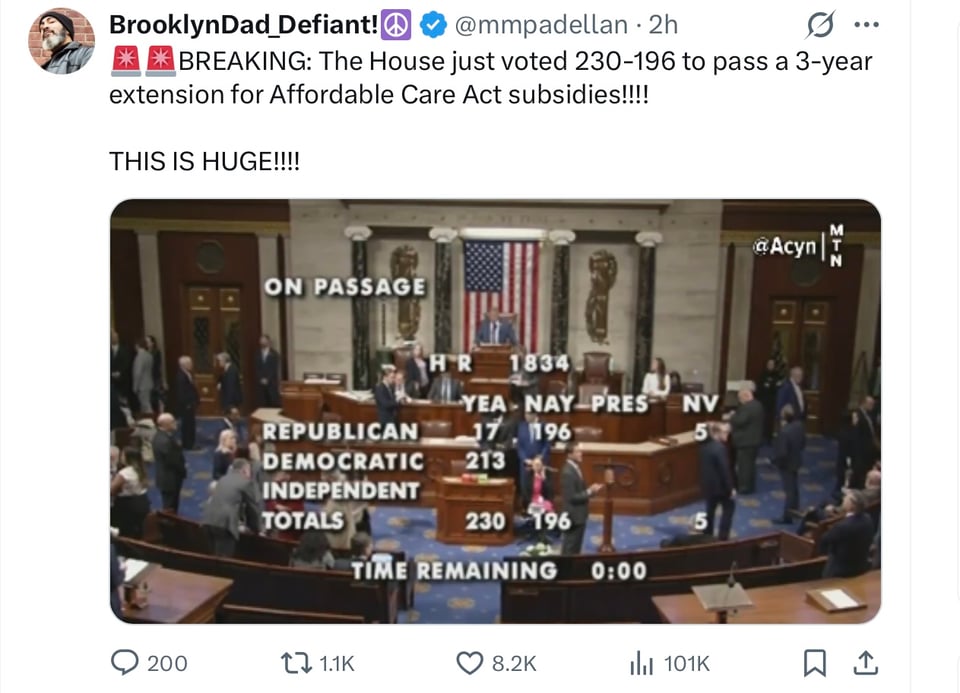
The New York Times says - The passage of the bill was a triumph for Democrats, who drew substantial Republican backing. But it has no path forward, and an election-year compromise is a long shot.
But some, like Senator Susan Collins ( Republican of Maine) feel hopeful - “I am hopeful that we will have a consensus bill from our bipartisan group that the House members will endorse next week,” said Senator Susan Collins, Republican of Maine and one of the leaders of the talks.”
Mike Pence shows more courage than we might expect.
Former Vice President Mike Pence responds to the new White House website blaming Capitol Police over Jan. 6th: "I I think it's very offensive that the White House used taxpayer dollars and a taxpayer website to blame Capitol Hill police for what happened on Jan. 6th." pic.twitter.com/WrkT1F1Qrs
— Kaitlan Collins (@kaitlancollins) January 8, 2026
Where there is a will, there is a way.
Hochul, Mamdani announce free child care for 2-year-olds in New York City.
Like magic. Poof. Free or affordable childcare for 2 year olds is now the law in NYC.
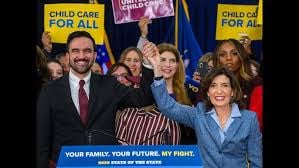
New Yorkers built a movement around the belief that every family should be able to afford a dignified life. Today, as @GovKathyHochul and I mark our commitment to universal childcare, we're proving that a movement of the people can transform how government serves the people.
— Mayor Zohran Kwame Mamdani (@NYCMayor) January 8, 2026

All together now.
What does Fascism look like?
This is what Fascism looks like.
Trump Lays Out a Vision of Power Restrained Only by ‘My Own Morality’
On topic after topic, President Trump made clear that he would be the arbiter of any limits to his authorities, not international law or treaties.
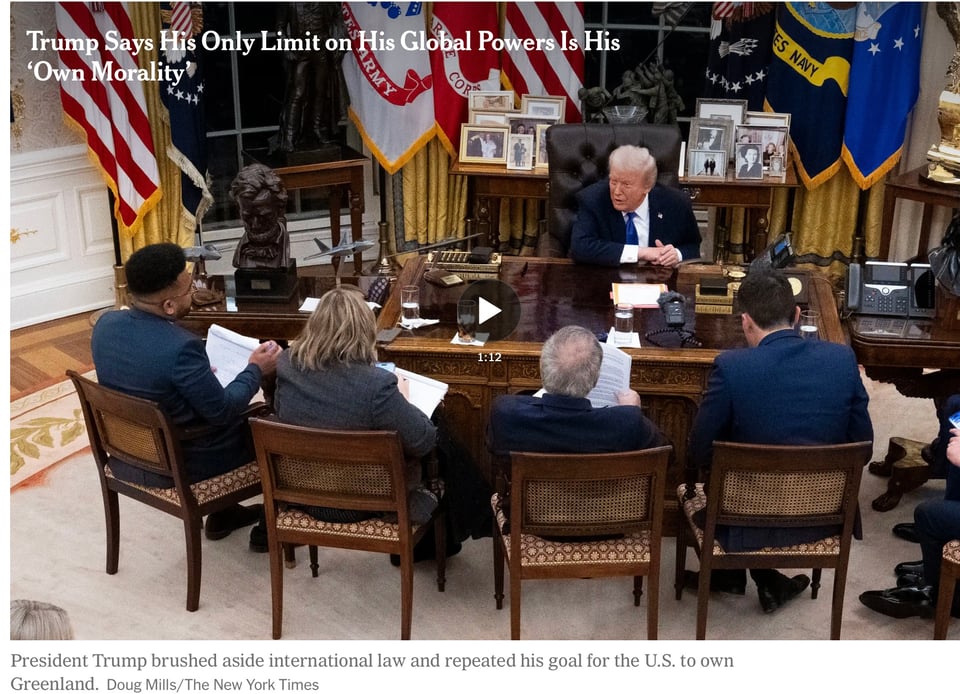
President Trump declared on Wednesday evening that his power as commander in chief is constrained only by his “own morality,” brushing aside international law and other checks on his ability to use military might to strike, invade or coerce nations around the world.
Asked in a wide-ranging interview with The New York Times if there were any limits on his global powers, Mr. Trump said: “Yeah, there is one thing. My own morality. My own mind. It’s the only thing that can stop me.”
“I don’t need international law,” he added. “I’m not looking to hurt people.”
When pressed further about whether his administration needed to abide by international law, Mr. Trump said, “I do.” But he made clear he would be the arbiter when such constraints applied to the United States.
“It depends what your definition of international law is,” he said.
Mr. Trump’s assessment of his own freedom to use any instrument of military, economic or political power to cement American supremacy was the most blunt acknowledgment yet of his worldview. At its core is the concept that national strength, rather than laws, treaties and conventions, should be the deciding factor as powers collide.
He did acknowledge some constraints at home, even as he has pursued a maximalist strategy of punishing institutions he dislikes, exacting retribution against political opponents and deploying the National Guard to cities over the objections of state and local officials.
He made clear that he uses his reputation for unpredictability and a willingness to resort quickly to military action, often in service of coercing other nations. During his interview with The Times, he took a lengthy call from President Gustavo Petro of Colombia, who was clearly concerned after repeated threats that Mr. Trump was thinking of an attack on the country similar to the one on Venezuela.
“Well, we are in danger,” Mr. Petro said in an interview with The Times just before the call. “Because the threat is real. It was made by Trump.”
The call between the two leaders, the contents of which were off the record, was an example of coercive diplomacy in action. And it came just hours after Mr. Trump and Secretary of State Marco Rubio had extracted the United States from dozens of international organizations intended to foster multinational cooperation.
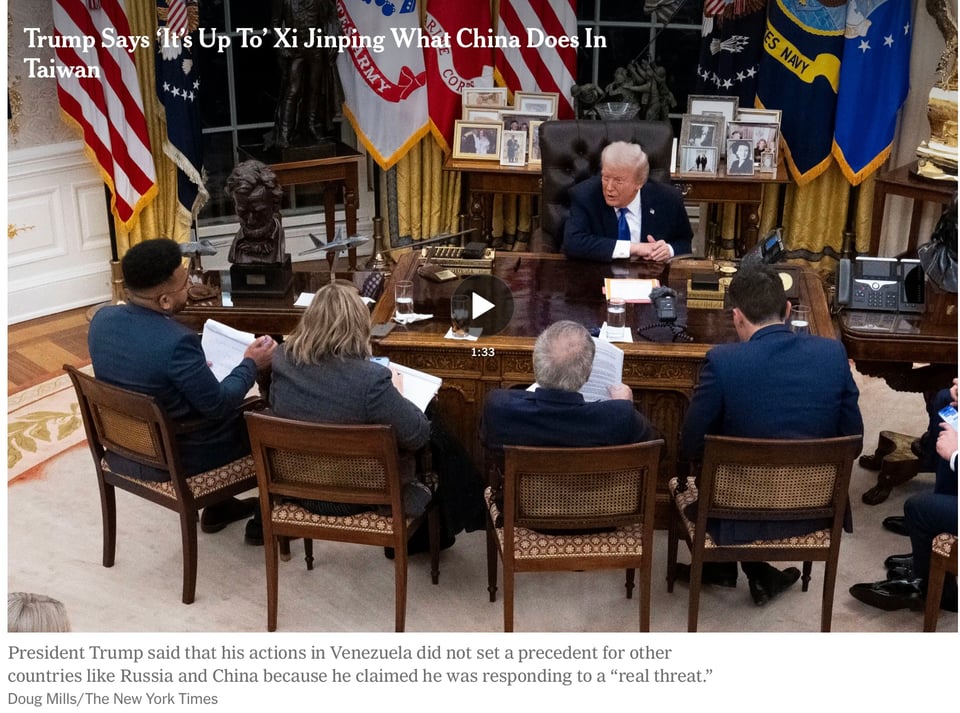
In his conversation with The Times, Mr. Trump sounded more emboldened than ever. He cited the success of his strike on Iran’s nuclear program — he keeps a model of the B-2 bombers used in the mission on his desk; the speed with which he decapitated the Venezuelan government last weekend; and his designs on Greenland, which is controlled by Denmark, a NATO ally.
When asked what was his higher priority, obtaining Greenland or preserving NATO, Mr. Trump declined to answer directly, but acknowledged “it may be a choice.” He made clear that the trans-Atlantic alliance was essentially useless without the United States at its core.
Even as he characterized the norms of the post-World War II order as unnecessary burdens on a superpower, Mr. Trump was dismissive of the idea that the leader of China, Xi Jinping, or President Vladimir V. Putin of Russia could use similar logic to the detriment of the United States. On topic after topic, he made clear that in his mind, U.S. power is the determining factor — and that previous presidents have been too cautious to make use of it for political supremacy or national profit.
The president’s insistence that Greenland must become part of the United States was a prime example of his worldview. It was not enough to exercise the U.S. right, under a 1951 treaty, to reopen long-closed military bases on the huge landmass, which is a strategically important crossroads for U.S., European, Chinese and Russian naval operations.
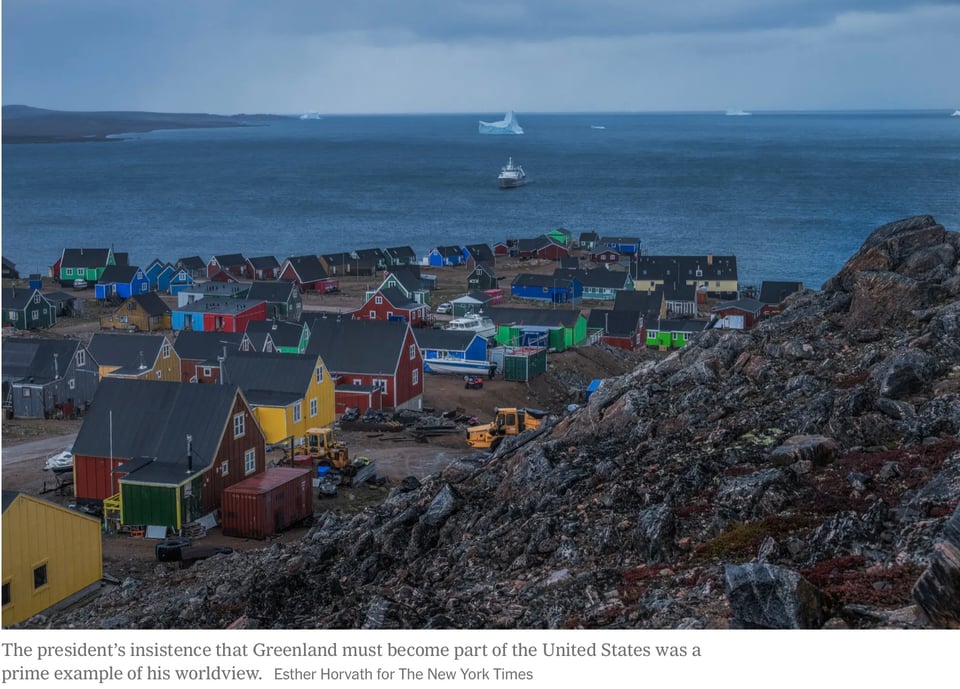
“Ownership is very important,” Mr. Trump said as he discussed, with a real estate mogul’s eye, the landmass of Greenland — three times the size of Texas but with a population of less than 60,000. He seemed to dismiss the value of having Greenland under the control of a close NATO ally.
When asked why he needed to possess the territory, he said: “Because that’s what I feel is psychologically needed for success. I think that ownership gives you a thing that you can’t do, whether you’re talking about a lease or a treaty. Ownership gives you things and elements that you can’t get from just signing a document.”
The conversation made clear that in Mr. Trump’s view, sovereignty and national borders are less important than the singular role the United States plays as the protector of the West.
He argued that only he — and not two predecessors on whom he heaped scorn, Joseph R. Biden Jr. and Barack Obama — had proved capable of persuading NATO nations to spend 5 percent of the gross domestic product on defense. (About 1.5 percent of that is actually for domestic infrastructure — from power grids to cybersecurity — that can support defense. The target does not kick in until 2035, six years after Mr. Trump leaves office.)
“I want them to shape up,” he said. “I think we’ll always get along with Europe, but I want them to shape up. I’m the one that got them to spend more on the, you know, more G.D.P. on NATO. But if you look at NATO, Russia I can tell you is not at all concerned with any other country but us.”
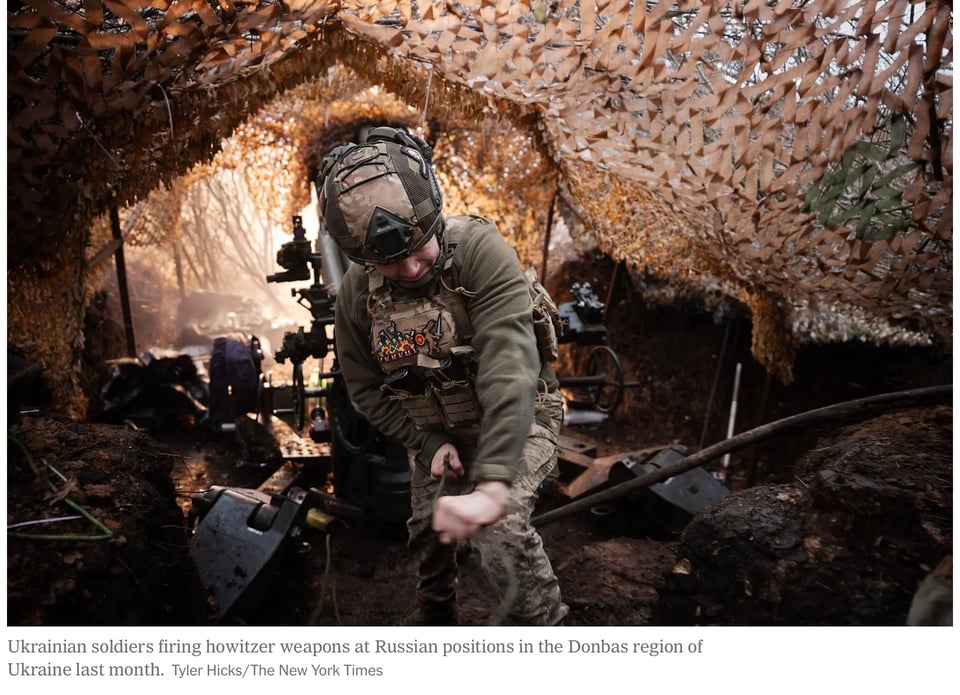
The president added: “I’ve been very loyal to Europe. I’ve done a good job. If it weren’t for me, Russia would have all of Ukraine right now.”
He seemed unconcerned that the last major nuclear arms control agreement with Russia was set to expire in four weeks, leaving the world’s two largest nuclear powers free to expand their arsenals without limit, for the first time in half a century.
“If it expires, it expires,” he said. “We’ll just do a better agreement,” he added, insisting that China, which has the fastest-growing arsenal in the world, should be incorporated in any future agreement.
“You probably want to get a couple of other players involved also,” Mr. Trump said.
The president seemed equally sanguine about whether his decision to send Special Operations forces into Caracas to remove Nicolás Maduro of Venezuela would be exploited by China or Russia. In the days since the action in Venezuela, there have been arguments that the U.S. precedent would help justify a Chinese effort to take Taiwan, or Russia’s attempt to seize Ukraine, which Mr. Putin has described as a historical part of the Russian empire, dating back more than a dozen centuries.
Asked whether he had created a precedent that he may later regret, Mr. Trump argued that his view of the threat posed by Mr. Maduro’s Venezuela was quite different than Mr. Xi’s view of Taiwan.
“This was a real threat,” he said of Venezuela. “You didn’t have people pouring into China,” he argued, repeating his oft-made claim that Mr. Maduro dumped gang members into the United States.
Mr. Trump added: “You didn’t have drugs pouring into China. You didn’t have all of the bad things that we’ve had. You didn’t have the jails of Taiwan opened up and the people pouring into China,” or, he said later, criminals and others “pouring into Russia.”
When a reporter noted that Mr. Xi regarded Taiwan as a separatist threat to China, Mr. Trump said: “That’s up to him, what he’s going to be doing. But, you know, I’ve expressed to him that I would be very unhappy if he did that, and I don’t think he’ll do that. I hope he doesn’t.”
Then, asked whether Mr. Xi might seize on recent events to attack or choke off Taiwan, he suggested that the Chinese leader would not dare to take that step while Mr. Trump was in office. “He may do it after we have a different president, but I don’t think he’s going to do it with me as president,” he said.
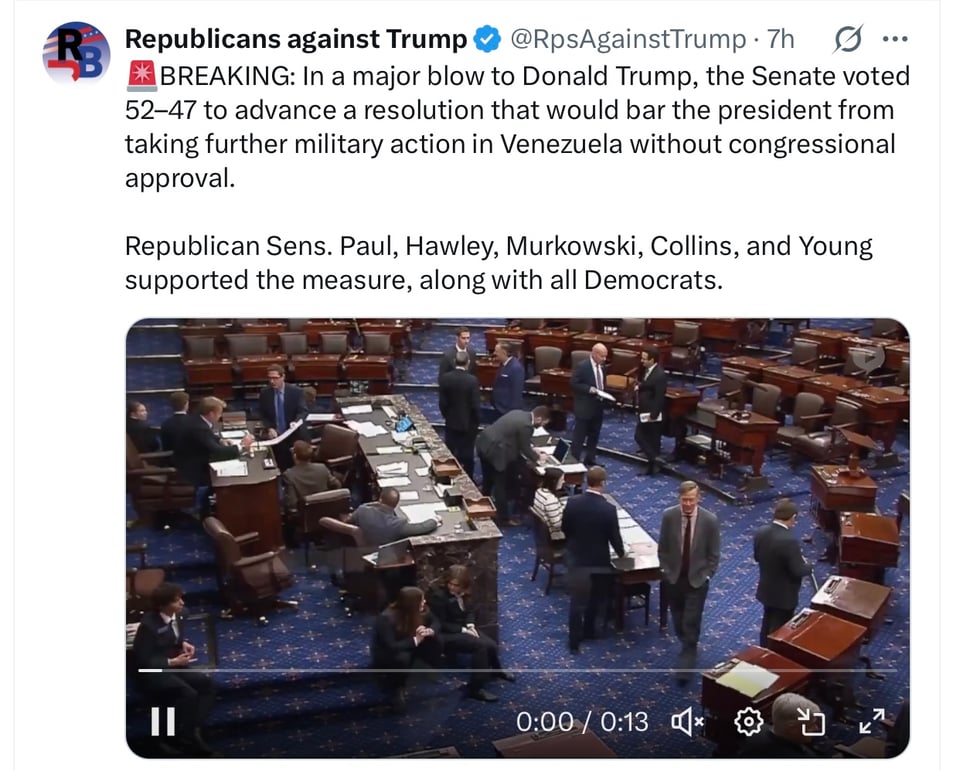
On Thursday, in a rare assertion of congressional authority over the president’s war powers, the Senate agreed to debate a resolution aimed at curbing Mr. Trump’s use of military force in Venezuela. Senator Rand Paul, Republican of Kentucky, said one factor that may have tipped the vote was the president’s comment during Wednesday’s interview that the United States might remain involved in Venezuela for years.
On the domestic front, Mr. Trump suggested that judges only have power to restrict his domestic policy agenda — from the deployment of the National Guard to the imposition of tariffs — “under certain circumstances.”
But he was already considering workarounds. He raised the possibility that if his tariffs issued under emergency authorities were struck down by the Supreme Court, he could repackage them as licensing fees. And Mr. Trump, who said he was elected to restore law and order, reiterated that he was willing to invoke the Insurrection Act and deploy the military inside the United States and federalize some National Guard units if he felt it was important to do so.
So far, he said, “I haven’t really felt the need to do it.” ( Part of the two hour conversation The New York Times had with Trump).

