Friday, January 30, 2026. Annette’s Roundup for Democracy.
The deal on ICE and the budget.
From the New York Times.
Senate Democrats on Thursday struck a deal with President Trump and Republicans that could avert a government shutdown and buy more time to negotiate restrictions on the administration’s immigration crackdown.
The agreement, if it holds, would allow the Senate to move before a Friday midnight deadline to fund a large portion of the government for the remainder of the fiscal year. It would also provide two weeks of funding for the Department of Homeland Security while lawmakers and White House officials negotiate over Democrats’ demands to rein in federal immigration agents.
It still faced obstacles in a Congress where bipartisan consensus is elusive and progress is often slow, but the deal reflected an abrupt political shift that has taken hold at the White House and on Capitol Hill after the fatal shooting last weekend of Alex Pretti, an American citizen, by a federal agent in Minneapolis, the second such killing this month.
———-
The agreement came after Democrats earlier on Thursday followed through on their pledge to oppose the spending package, which includes $64.4 billion for the Department of Homeland Security as well as an array of government agencies, including the Pentagon and health programs. Every Democrat opposed moving forward, as did several Republicans, citing various spending objections.
After Mr. Pretti’s death, Democrats had said they would not vote for any further funding for the Department of Homeland Security unless strict limits were added to curtail immigration officers’ actions. They demanded that the homeland security portion be separated from the rest of the spending package and held up while they try to strike a deal with Mr. Trump and Republicans for new restrictions on the president’s immigration crackdown.
“This is a moment of truth,” Senator Chuck Schumer, Democrat of New York and the minority leader, said on Thursday. “Congress must act to rein in ICE and end the violence.”
———
The administration’s talks with Democrats began after the lawmakers unveiled a set of demands they said they would insist on in exchange for voting for homeland security funding. They included banning immigration officers from wearing masks and requiring them to wear body cameras and visible identification, an end to random immigration sweeps, requirements for judicial warrants for stop and searches and requirements for immigration officers to follow the same use-of-force standards as community law enforcement.
They also want an independent investigation of the two fatal shootings in Minneapolis.
“No more secret police,” Mr. Schumer said. “The Republican majority must step up to the plate. Republicans in Congress cannot allow this violent status quo to continue. They must work with Democrats on legislation — real legislation.”
If the spending agreement holds, it would clear the way for what promises to be a hard-fought negotiation over what restrictions could be imposed on immigration operations.
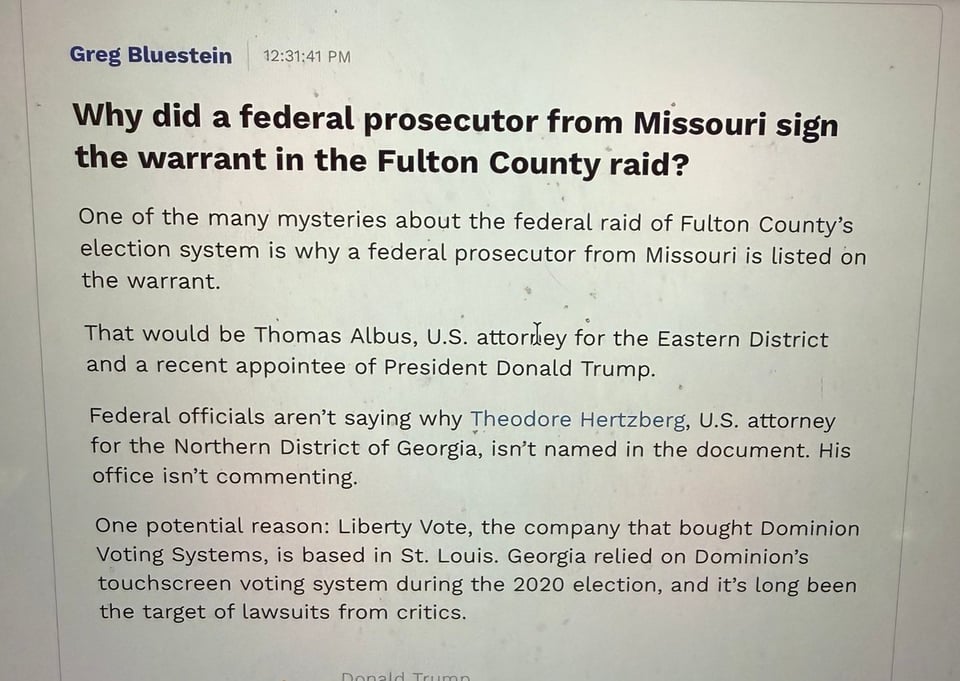
Trump and Kash Patel continue to weaponize the FBI.
From X. FBI Raids Fulton County Elections Office for 2020 Ballots.
On January 28, the FBI executed a federal search warrant at the Fulton County Elections Hub in Union City, Georgia, seizing ballots, tabulator tapes, electronic images, and voter rolls tied to 2020 disputes.
The action followed a Georgia Election Board subpoena and a Justice Department lawsuit, with the warrant citing potential federal election law violations. Fulton officials questioned the legality, claiming the materials belonged to the court clerk, while Democrats called it political revenge and supporters saw it as needed accountability.
Complicating the scene, Director of National Intelligence Tulsi Gabbard was photographed nearby, drawing questions from Democrats.
And the New Governor of Minnesota will be
Tim Walz is not seeking a third term. He will not run for any elective office again after his current term ends in early 2027 — saying he wants to focus on governing and pressing issues rather than campaigning.
One possible Republican nominee, Chris Madel, withdrew from the race. He said he could not align himself with what he viewed as “retribution on the citizens of our state” by his own part. He said the Trump handling of immigration enforcement — made it “nearly impossible for a Republican to win a statewide election in Minnesota.” Let’s make Madel a prophet!
One more thing.
In case you were wondering if there would be relief in Minneapolis.
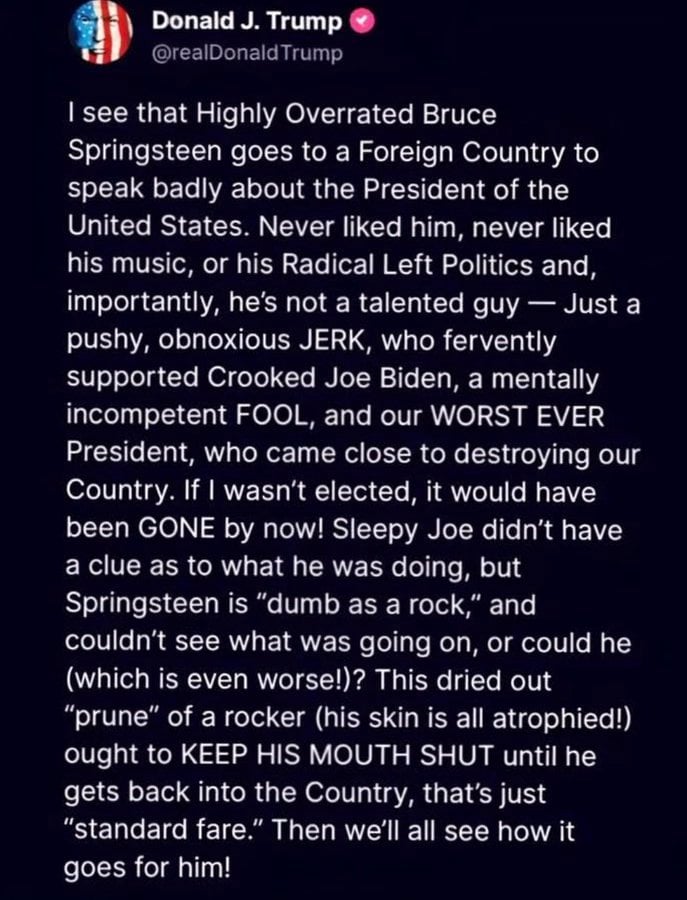
Yes, the Boss got to Trump.
Pathetic man ranted and threatened.
Who is Trump suing now.
As ever, Trump is a frivolous filer, blackmailing folks and organizations into (at least) millions of dollars in settlements. Just another way, Trump mocks the law.

A lawsuit where the loser will be the American taxpayer.👇
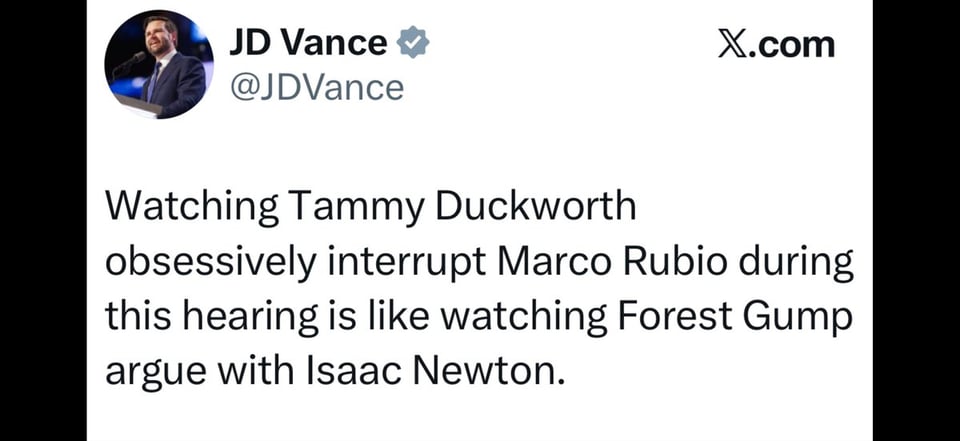
Senator Tammy Duckworth answers lowlife Vance.
First, Vance compared the Iraqi war helicopter pilot who lost her legs in battle to a man with mental disabilities.
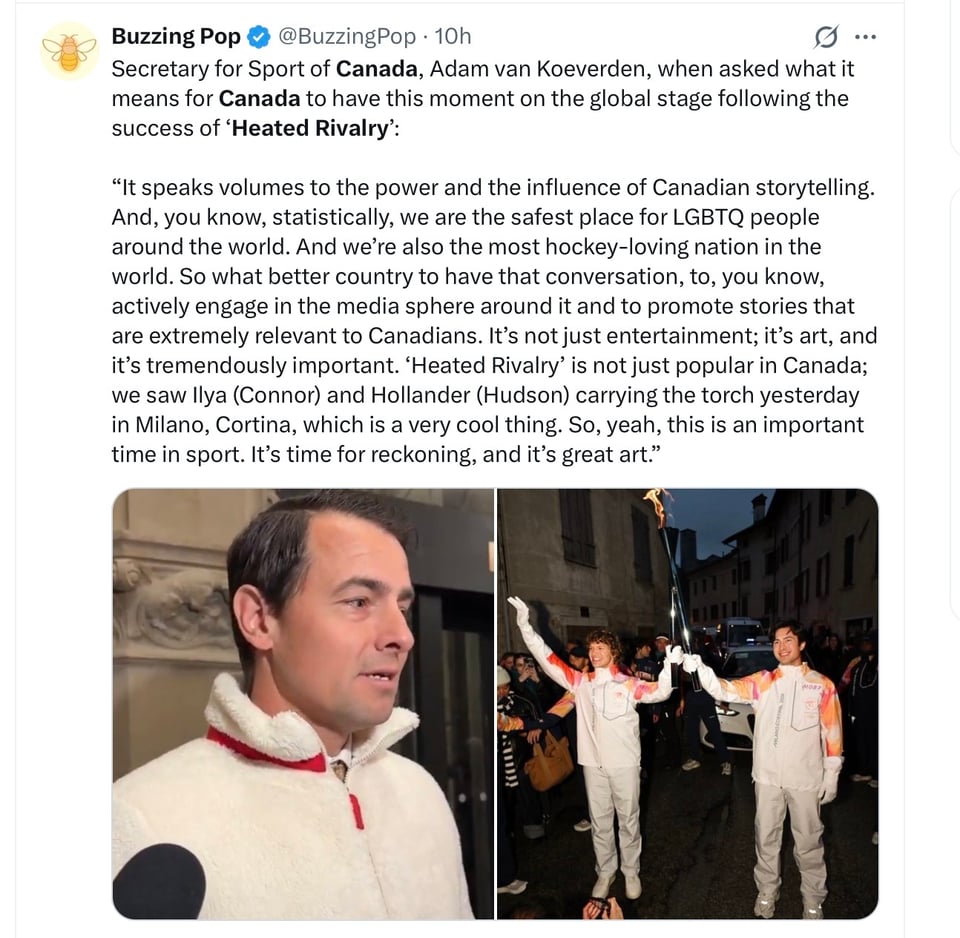
Canada is so proud of its hit show, Heated Rivalry.
Wynton Marsalis, Founder of Jazz at Lincoln Center, to Step Down.
After 40 years with the organization, the trumpeter and impresario will end his role as managing and artistic director in July 2027.

After nearly 40 years as the charismatic founder and recognizable face of Jazz at Lincoln Center, Wynton Marsalis will step down as managing and artistic director next year, the organization announced on Thursday, ending a transformative tenure that raised the profile of jazz nationwide.
“It’s the perfect time to identify the next generation of leadership,” Marsalis, 64, said in an interview. “We want to make sure that we do what we can to nurture what we’ve already built with the understanding that this is an art form and it will continue to grow and the organization will continue to flourish.”
Marsalis’s larger-than-life presence and prominence will not be easy to replicate. He has become a worldwide ambassador for jazz, as comfortable schmoozing with celebrities like Spike Lee and Barack Obama as he is explaining Dizzy Gillespie or Miles Davis to middle schoolers.
“He’s an orchestra leader, he’s a trumpet player, he’s our biggest fund-raiser,” said Gordon J. Davis, the founding chairman of Jazz at Lincoln Center. “Jazz was dead in this country. Wynton raised it up to make it what it should be: a true art of American culture.”
As part of a phased transition plan, Marsalis will step down as artistic director in July 2027 and then serve in an advisory role through the end of his contract in June 2028. Marsalis, who will retain a board position in perpetuity, said he intended to provide “institutional memory and insight, but not oversight.”
Although Marsalis will continue to perform with the Jazz at Lincoln Center Orchestra on occasion, his absence will be palpable. While he has never demanded the spotlight — playing in the back row — his searing and singular horn solos have been a highlight of the ensemble’s concerts.
“Wynton will continue to be an important contributor,” Clarence Otis, the chairman of the board, said. “What we are proud of is the fact that we’ve been able to institutionalize Jazz at Lincoln Center.”
Jazz at Lincoln Center originated in 1987 as a summer jazz concert series and eventually constructed its own permanent and self-described “House of Swing,” which opened in 2004 at the Time Warner Center — now the Deutsche Bank Center — at Columbus Circle. The venue, Frederick P. Rose Hall, includes Rose Theater; the Appel Room, which has a glass wall overlooking Columbus Circle; and Dizzy’s Club.
Jazz at Lincoln Center had its share of growing pains. The organization initially struggled to manage explosive growth after moving into its $131 million home. Jazz at Lincoln Center quickly tripled its budget with the three stages; prior, it did not have even one. Over the next three years, the organization cycled through six executive directors before landing on Adrian Ellis in 2007 and then Greg Scholl in 2012.
The institution stabilized in large part because the board changed the leadership structure, having the executive director report to Marsalis. “I picked almost every song we played at every concert,” he told The New York Times in 2015.
To prepare for Marsalis’s departure, Jazz at Lincoln Center has established two special committees: One will collaborate with him to identify the next generation of artistic leadership, another will lead the search for the next executive director, who would replace Scholl after he leaves in June.
While Marsalis remains the most widely known member of Jazz at Lincoln Center, he named several key contributors to the institution’s growth and success, including Carlos Henriquez, Ted Nash, Victor Goines, Walter Blanding and Rodney Whitaker. Even when musicians have left the orchestra, they remain connected through arranging, composing and performing. “We stay around each other,” Marsalis said.
There is also a fertile crop of young leaders who have grown up with Jazz at Lincoln Center — some of them now in their 40s — “who will nurture the mission and the vision,” Marsalis said. “My job at this time is to get out of the way and follow their leadership.”
Under Marsalis, who started his tenure when he was 26, the organization has expanded its season and increased its education programs, including the Essentially Ellington competition for high school bands from all over the world.
In addition, its “Let Freedom Swing” program serves elementary school students; its annual Jazz Congress convenes jazz artists and industry leaders; and with Blue Engine Records, Jazz at Lincoln Center releases work drawn from its digitized archive of performances.
The leaders of the organization said that, going forward, they hoped to raise $150 million for its endowment; to perform more often in its halls rather than filling them with rentals; and to upgrade its physical infrastructure.
Marsalis said he was proud to have made the “House of Swing” a cultural landmark, one he believes will outlast him.
“We’ve never been healthier — we’re in an unbelievably good position,” he said. “The institution is not Wynton Marsalis at Lincoln Center. It’s Jazz at Lincoln Center.” (New York Times)

