
15 Of 2015: A 10th Anniversary Retrospective (Mortal Man, Undertale, Record Year)
Part 5/5 of a retrospective of my favorite songs from ten years ago, as a tribute to my tenth anniversary writing about music.
Kendrick Lamar - “Mortal Man”
I’ve been thinking about “Mortal Man” a lot lately. It’s always occupied my mind ever since I first heard it, but it’s felt especially relevant ten years later looking at where Kendrick Lamar as an artist is now. Back then, he seemed like hip-hop’s next big hero. Especially with a masterpiece of an album in To Pimp A Butterfly, a celebration of black culture even amongst centuries of political turmoil. The politics of the album especially garnered a lot of attention as police violence against black people became more and more scrutinized. From that aspect, it seemed like Kendrick was the rapper we all needed. Someone who gets it and can educate those who came for the bangers to recognize the plight of the black man in America. Ten years later, Kendrick holds the throne for biggest rapper alive. He dominated 2024 through his ruthless diss tracks toward former biggest rapper alive Drake, dropped an absolute banger of an album in GNX that spawned several huge hits in between 2024 and 2025, and his Super Bowl performance quickly became one of the most iconic and beloved performances in NFL history. Kendrick has definitively won. He became rap’s hero… But is he really?
In “Mortal Man”, Kendrick asks his audience over the soft saxophones and thrumming bass strings, “When shit hit the fan, is you still a fan?”. He pleads for his audience to love him like they would Nelson Mandela, to revere him for his work and to feel like his art was truly worth the blood sweat and tears it took to get there. But inherently, Kendrick knows he can’t be like Nelson. Eventually, he will screw up somewhere. He will fall to the sacrifices that come with worldwide recognition and fame. I remember some discourse over Kendrick provoking Michael Jackson with the lyric, “That [man] gave us ‘Billie Jean’, you say he touched those kids?”. But I think it’s a fair question. Does one’s artistic impact lessen if the person behind them makes mistakes they could never take back? Does Michael Jackson's history with children affect the importance and artistry of “Billie Jean”? It’s not really as easy as separating the art from the artist, nor is it as easy as dismissing any artistic innovator for their failings as a human being. Kendrick himself would eventually go through this with his album Mr. Morale & The Big Steppers. Crumbling under the pressure to continue the commentary and cultural importance promised by albums like To Pimp A Butterfly and DAMN. Diving deep into the history of oppression against the women in his life and family, including from himself. Both in the text (His struggles with sex addiction and infidelity) and subtext (Saying all of this all the while having Kodak Black, who has a history of sexual violence against women, so prominent on throughout album). Even making a song dedicated to recognizing the struggles of trans people and how it’s affected him growing up… all the while using derogatory slurs and deliberate misgendering to tell his story. I wrote about that song at the time, and to be honest, I don’t stand by a lot of it. Much like how Kendrick didn’t stand by some of the more regressive ideas he fell into when processing his uncle’s transition. I’ve become very empathetic to Mr. Morale and its supposed failings. In part because Kendrick has known this whole time that centering himself as a leader was precarious, and that he could always misuse his influence.
“Mortal Man” is pretty messy when you get down to it. A lot of tough questions that seem like Kendrick is flailing for your approval. Evoking Nelson Mandela, pressuring questions about why leaders have been abandoned for the mistakes they make, he admits to holding grudges and being willing to turn on others himself. The song ends not with this question of “When shit hit the fan, is you still a fan”, but with a fabricated conversation between Kendrick and recontextualized quotes from the late Tupac. Which could be seen as Kendrick trying to equate himself as Tupac’s equal, but in reality Kendrick is the one seeing Tupac as a leader. Adopting a lot of Tupac’s own political beliefs and understandings of class consciousness. Hell, the album was originally supposed to abbreviate to TuPAC when it was called Tu Pimp A Caterpillar. It comes off more like Kendrick is pleading for Tupac’s approval, especially as he reads his poem at the very end of the song. When he looks for a response, he only gets silence, and we never find out what Tupac thought of that poem. The whole song being an open question with no clear answer is that made it resonate with me then and now. What will it look like when shit hits the fan for Kendrick? I thought maybe Mr. Morale was that moment, but instead it seemed to only make him stronger. The more therapy Kendrick went through, and the more he kept to himself and his family, the more it fueled him to take action for the genre he holds to dearly and defeat the man whose made a mockery of it the past decade.
But was Kendrick’s fight against Drake really that righteous? Drake may be a worse artist and substantially worse person, but Kendrick played Drake’s own game to defeat him. Take control of the attention economy, release songs that were built for big reactions, memetic quotes and even stretched truths just to keep people thinking he was the one with the upper hand. We never really found out if the other hidden child was real or not. There were quite a few instances of Kendrick making effeminate jokes about Drake, enabling the culture of homophobia and disgrace of non-masculine men within hip-hop. Drake’s serious issue of his creepy behavior towards underage girls and younger women is now an infamous punchline. Which is funny and memorable, but it’s not gonna do anything to get Drake to stop pursuing younger impressionable women, is it? Nor will it bring attention to the other rappers who are just as guilty of pursuing younger and underage women. Kendrick may have called out the industry of hip-hop and the phonies that swarm it, but his solution is to simply be above them rather than try to fix the system from within like his poem on “Mortal Man” implied. Plus, he seems more than happy to continue working with artists who enable that system like Playboi Carti. On one of GNX’s best songs, “man in the garden”, he goes on to declare that he deserves it all. All the accolades and success and power he’s gained within the past year. “Cause my intentions were pure, even when you wasn’t sure”. An uncharacteristically selfish moment as Kendrick gives into greed and pride. And all the while, it just leaves me thinking… what’s going to happen when Kendrick becomes Drake? Someone consumed by his own hype, changed by throne he sits on, abandoning his leadership role and instead playing king. What will happen when all he believes he deserves disappears, whether through his own vices or something else?
When shit hits the fan, will we still be fans?
Toby Fox - “Undertale”
I’ve said on numerous occasions that the title song from Toby Fox’s masterpiece of a game Undertale is my favorite song of all time. Ten years since the game was released, I’m still deeply invested in Toby Fox and his cast of characters, even as Undertale has become a distant memory and Deltarune takes its place. It’s kind of funny looking back at Undertale all these years later. As Toby Fox has improved not just as a game developer, but as a writer and composer, Undertale has started to feel almost primitive. It’s hard to really experience the game for the first time if you weren’t there at the time, because you likely either already know the major story beats or its most impactful moments have become practically memes at this point. Meanwhile, there’s a lot to look forward to with Deltarune. Susie has become one of my all-time favorite protagonists, there’s still a lot of mystery behind the game even as major questions are answered, and the heart that Toby Fox put into Undertale is alive and well in Deltarune’s most poignant moments.
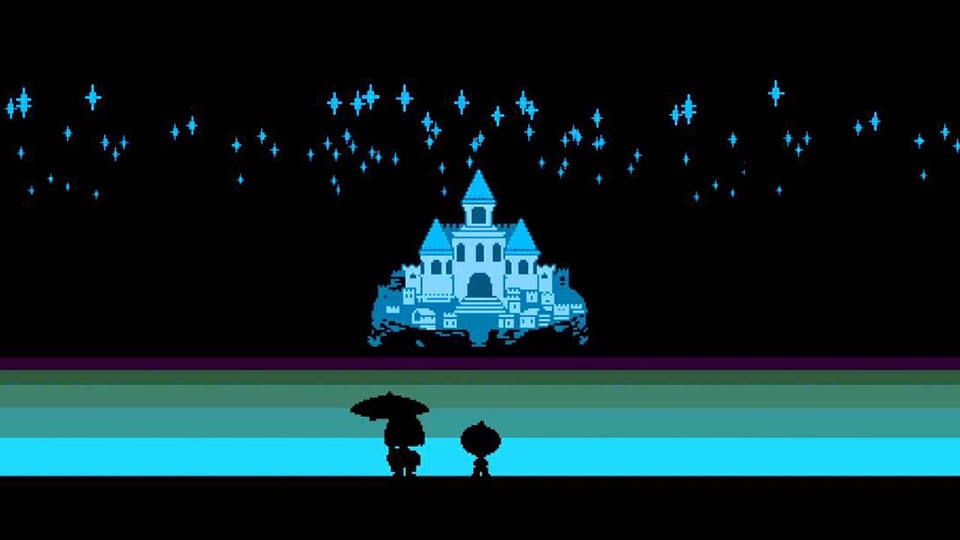
If Deltarune ever makes a song that could even rival “Undertale”, it’s gonna have to be in a moment before the final climax. Because the journey of “Undertale” is just as important as the music. The song opens on a gentle acoustic guitar, playing the recurring melody of “His Theme”, and it remains there the whole time. Even as a piano, drums, and strings slowly enter the room. It’s primarily built off of that melody of “His Theme”, but all the extra flourishes added by the extra instruments seamlessly builds this song into a melancholic and hopeful collage as the song gets bigger and bigger. “Undertale” plays as you look through the New Home, a replica of the house that Toriel lives in at the beginning of the game. As you walk through it, monsters from the Underground start telling you the story of Asriel, Toriel and Asgore’s deceased son. These are the last pieces of the puzzle to understanding why the monsters are trapped in the Underground and why you will be the one to ultimately free them by sacrificing your own life. Which gets unnerving when you know you’re going to have to kill their grieving king in order for you to escape, leaving the monsters you’ve befriended throughout this journey to remain stuck here forever. And as you learn all this, you’re listening to this absolutely incredible piece of music, calling back to previous motifs throughout the game and having you reminisce on everything it took to get here. You’ve met a lot of monsters on the way here. Each with their own hopes and dreams, their reasoning as to why they want to live up on the surface. The relationships these monsters have with each other, and the ways you’ve become a part of their lives through the actions you made with them. You’ve been through a lot to get to this point, and when you look at the mirror that in Toriel’s house brings up the text box, “It’s you!”, the text box that pops up when you look at this mirror is “Despite everything, it’s still you”.
“Despite everything, it’s still you.” is a quote that I’ve lived by for the past ten years. Especially as life gets more and more difficult, realities crash down on me, my mental health changes for better or worse, I learn more parts of myself I’m afraid to confront, as I go through all this turbulence, that quote comes back to me. It’s still me. I’m still here. A lot has happened, a lot has changed, but it’s still me. That’s what “Undertale” represents to me. The song begins and ends with “His Theme”, from the acoustic guitar that begins the song to the chimes that close it. Either way, it’s still “His Theme”. Even as all those instruments built off of it and created a musical journey that always leaves me feeling emotional. It’s an incredible piece of musical storytelling. One that captures the game it accompanies and elevates the experience through song. Capturing so much emotion, movement, and power from a multi-hour game into just six minutes. It reminds me of my own journeys, the life that I’ve lived that’s taken me to where I am now. And yeah, things could be better. My country’s in awful shape, the internet isn’t fun anymore, even my hobbies are difficult to enjoy without the looming threat of Discourse hanging over it. But I’m still here. It’s still me. And I will continue to be me and be there for my friends and communities whether the world gets worse or better. We’ll see if in ten years from now, Toby Fox makes an even better song than “Undertale” once Deltarune has concluded. It’ll take another ten years of memories and friends for that to really settle in though.
Eric Church - “Record Year”
I knew “Record Year” was special from the first moment I heard it. Many have made music about music before, but I wasn’t familiar with them. I was still dipping my toes into the wider world of music beyond the charts and it wasn’t quite the obsessive hobby it’s become for me today. “Record Year” was one of the songs to start that wave though. Eric Church name drops a lot of artists and records he listens to when he’s going through heartbreak, and you can hear the love he has for them in every word. It doesn’t feel like listing off names for the sake of pointing at the screen and going, “I know that one”. The artists and records listed flow into each other, from the The way he describes “Quarter notes and Hank’s halftime” to “Your good and gone keeps me up all night, along with Songs In The Key Of Life”. You can tell he has memories attached to these records, nights where his heart is yearning while the needle spins that memorable heartbreak soundtrack.
It’s something I related to at the time, and even more so now. It’s come up a handful of times now, but I was also dealing with a lot of heartbreak this year, and one of the things that kept me distracted and sane amidst my growing depression was music. Listening to new things, old favorites, songs that might’ve related to my predicament like “I Really Like You”. Eventually albums themselves became part of that heartbreak routine, namely Jamie xx’s In Colour, Twenty One Pilots’ Blurryface and Marianas Trench’s Astoria. You may have noticed all three of those albums were named earlier in this essay. Hell, this entire essay might as well be my “record year”. A collection of songs that meant a lot to me at the time and even now.
I’m so fond of the idea of a “record year” that it’s basically what I’ve been doing for the past ten years. Building an archive of my favorite songs of every year and sharing them with others. Whether I was going through something that year or not, they still soundtracked the year I had and the love I have for them is immeasurable. There have been many times where I considered outright quitting or moving on to something else, but I never did. Because even if I stopped writing today I would still be making lists like this. I would still read lists from other people because I want to know what their record years were like. At the end of the song, Eric Church tells the target of his affection, “If you find your way back, I owe you a beer for my record year”. I think that part is what clinches it as not only one of my favorite songs of all time, but maybe my favorite country song, period. There’s no malice, there’s no hard shell built up from the experience. If anything, Church wants to share it, and finds peace within the music that accompanies his life. A thanks to someone who allowed him the space to find art that resonated with him and accompanied some of the hardest parts of his life. I connect very deeply to that.
To the artists I’ve talked about, positively or negatively, thanks for ten amazing record years.