
Agent Briefing section for Issue #3
The 2am Port Delay Nobody Caught — Until the Agent Did
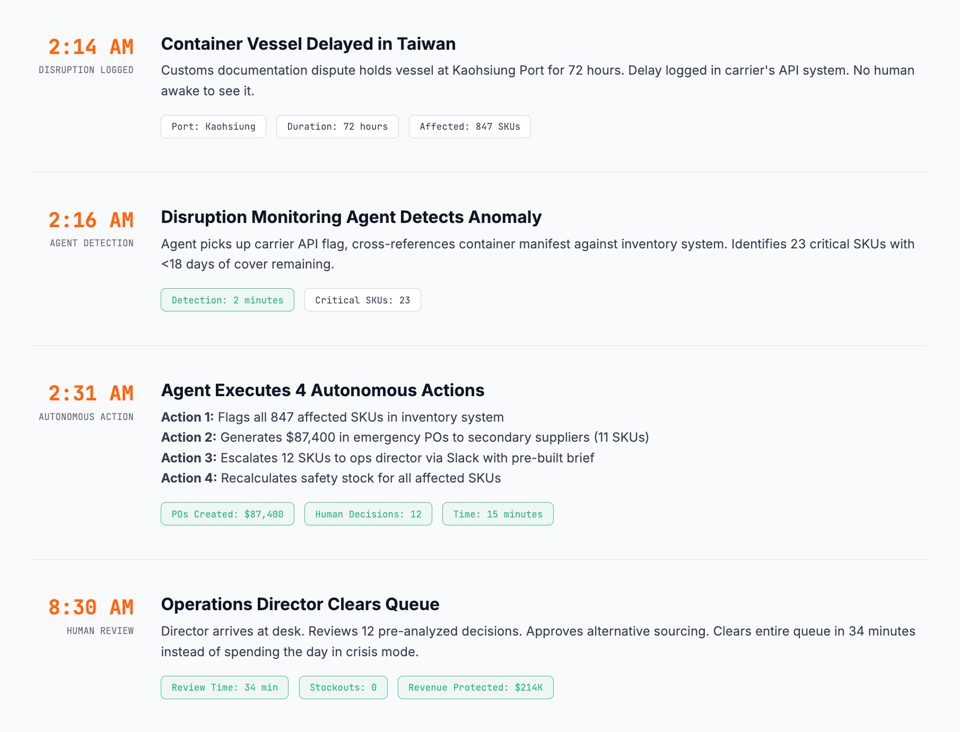
On the morning of January 9th, 2025, a container vessel departing Kaohsiung Port, Taiwan was held for 72 hours due to an unexpected customs documentation dispute. The delay was logged in the shipping carrier's system at 2:14am EST.
No human at the affected company — a $65M Seattle-based consumer electronics distributor — was awake to see it.
Their supply chain disruption agent was.
At 2:16am, the agent detected an anomaly flag in the carrier's API feed. Cross-referencing the affected container manifest against their inventory system, it identified 847 SKUs across 14 product lines with inbound stock tied to that shipment. Of those, 23 SKUs had fewer than 18 days of cover remaining — below the company's minimum safety threshold of 21 days.
The agent did not send an alert and wait.
It acted.
By 2:31am — 15 minutes after the port delay was logged — the agent had completed four autonomous actions:
Action 1: Flagged all 847 affected SKUs with a disruption tag in the inventory system, locking them out of any promotional campaigns scheduled for the following week.
Action 2: Identified 11 of the 23 critical SKUs that had approved secondary suppliers on file. Generated and transmitted emergency purchase orders to those suppliers totaling $87,400 — within the company's autonomous approval threshold.
Action 3: For the remaining 12 critical SKUs with no secondary supplier, escalated to the operations director via Slack with a pre-built response brief: current stock, days of cover, three alternative sourcing options with lead times and cost deltas, and a recommended action for each.
Action 4: Recalculated and updated safety stock minimums for all 847 affected SKUs, accounting for the new lead time variance introduced by the port disruption.
When the operations director arrived at her desk at 8:30am, she had 12 decisions to make — not 847. The agent had already resolved everything it had authority to resolve. The decisions it escalated came pre-analyzed, with full context and recommended actions attached.
She cleared her queue in 34 minutes.
The outcome:
Of the 23 critical SKUs, zero experienced a stockout. The 11 SKUs covered by autonomous emergency POs arrived within lead time. The 12 escalated SKUs were resolved with alternative sourcing approved before noon on January 9th — the same day the port delay occurred, while the original shipment was still sitting in Kaohsiung.
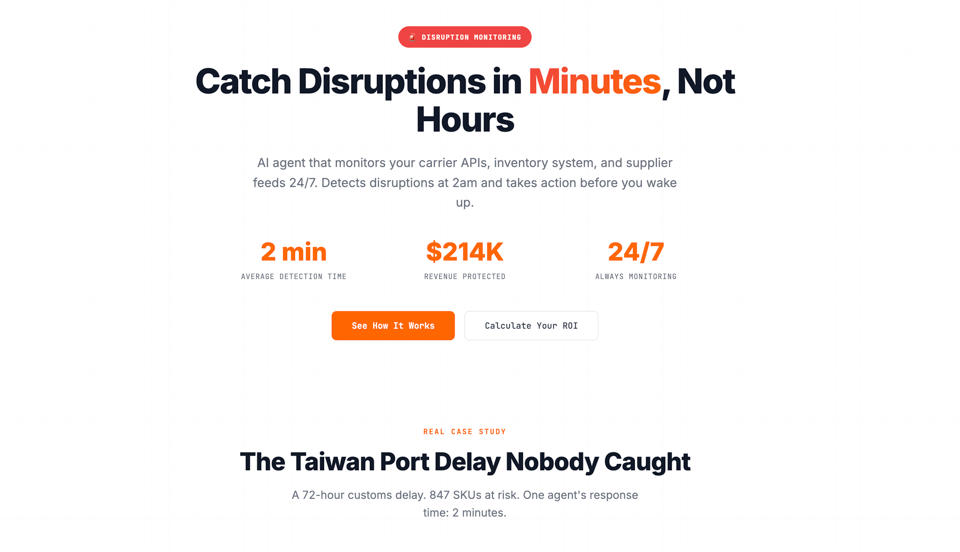
Total revenue protected: $214,000 across the 72-hour disruption window. Total time the operations director spent on the crisis: 34 minutes. Time between disruption detection and first agent action: 2 minutes.
The old playbook for a port delay of this scale: a 6am phone call from a freight forwarder, two hours of manual impact assessment, an afternoon of frantic supplier calls, and a week of stockout risk management.
The new playbook: the agent handles it before anyone wakes up, and the human makes 12 informed decisions at 8:30am instead of spending the day in crisis mode.
The lesson.
Supply chain disruptions do not happen on business hours. Port delays, supplier failures, weather events, customs disputes — they occur at 2am on a Tuesday and at noon on a Sunday and at 6pm on Christmas Eve. Traditional planning workflows are built around the assumption that a human will notice and respond. Agentic systems remove that assumption entirely.
The competitive advantage of autonomous supply chain agents is not just speed. It is continuous vigilance — the capacity to monitor every signal, every feed, every SKU, every supplier, at every hour, without fatigue, without distraction, and without waiting for someone to log in and check a dashboard.
The question worth sitting with this week: how many disruption events hit your supply chain outside business hours last quarter — and how many hours passed before anyone knew?
02 — THE SIGNAL
The one data point that matters
McKinsey, January 2025: Supply chain disruptions now cost global businesses an average of $182M per incident for companies with revenue between $50M and $500M — up 31% from 2022.
The driver is not that disruptions are more frequent. They are not. The driver is that supply chains have become structurally more complex — more SKUs, more suppliers, more geographies, more single-source dependencies — while the monitoring and response infrastructure has not kept pace.
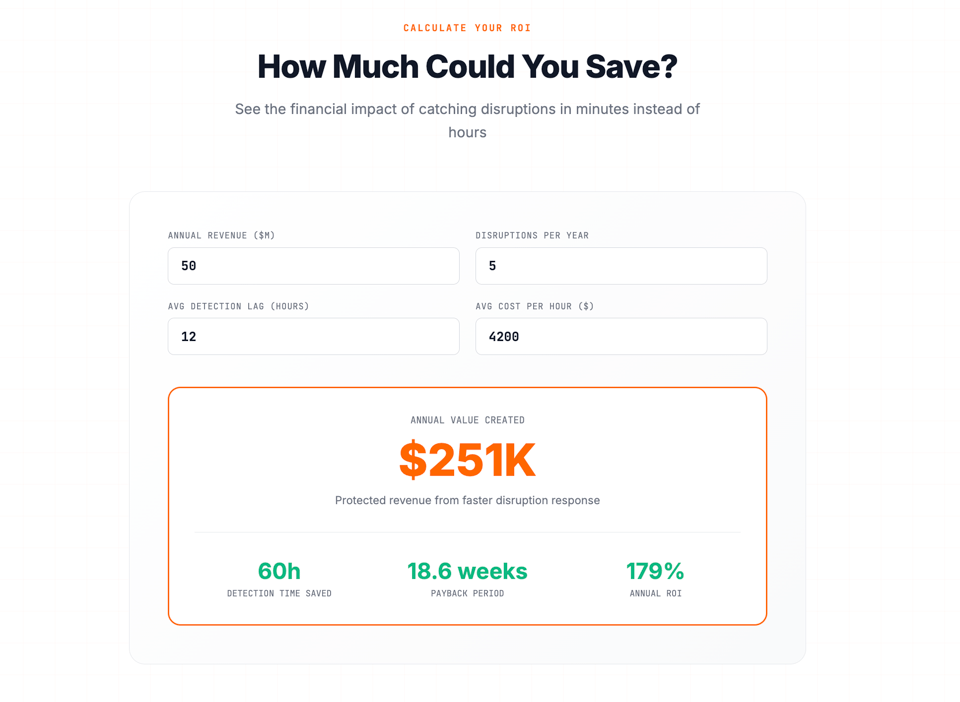
The implication is precise: the ROI on disruption detection speed is now measured in millions, not thousands. Every hour between a disruption event and the first corrective action costs an average of $4,200 for a mid-market company. An agent that responds in 2 minutes instead of 6 hours generates an average of $25,200 in protected value per event.
Across a typical year with 4–6 significant disruption events, that is $100K–$150K in annualized disruption protection from a single always-on monitoring agent.
Source: McKinsey & Company, "The Resilience Imperative: Supply Chain Risk in the Age of Volatility," January 2025.
03 — ROI IN THE WILD
Real numbers, zero fluff
Company profile: $42M revenue DTC home goods brand. 1,800 active SKUs. Single primary 3PL. Operations team of 3.
Before agents: The team conducted weekly inventory reviews every Monday morning. Disruptions were caught when a planner happened to notice an anomaly — average detection lag: 38 hours. Average resolution time: 2.5 days. In Q3 2024, three separate supplier delays resulted in stockouts that cost the company $312,000 in lost sales and $44,000 in expedited freight charges.
After deploying a disruption monitoring agent (Q4 2024):
Average disruption detection time: 6 minutes
Average resolution initiation time: 22 minutes (for autonomous actions), 2.1 hours (for escalated decisions)
Disruption events in Q4 2024: 4
Stockouts from disruptions: 0
Estimated revenue protected: $180,000
Expedited freight charges: $3,200 (down from $44,000)
Operations team hours spent on disruption management: down 74%
Time to value from deployment: 11 days. Payback period on annual AgentChain subscription: 3.1 weeks.
04 — ONE THING TO TRY
A move you can make this week
Map your disruption blind spots.
Open your calendar and count the number of hours in a typical week when no one on your operations team is actively monitoring your supply chain. Include nights, weekends, and any period when your team is in meetings without access to their systems.
For most companies this number is between 100 and 130 hours per week — out of 168 total.
Now look back at your last three supply chain disruptions. What time did they actually occur? What time did you first become aware of them? What was the lag?
Write those numbers down. That lag, multiplied by your average hourly disruption cost, is the minimum value case for always-on autonomous monitoring.
Most teams who do this exercise for the first time find a number that surprises them. The disruptions they thought they caught quickly — they didn't. The gap between when something went wrong and when a human knew was almost always measured in hours, not minutes.
Agents don't have gaps. That is not a feature. That is the entire point.
If today's briefing made you think about your own disruption blind spots — AgentChain's disruption monitoring agent is exactly what the company in today's case study deployed. It connects to your carrier APIs, inventory system, and supplier feeds in under a day and starts monitoring immediately.
See how it works → agentchain.tools/disruption-agent
Chain Reaction is written every Tuesday by Jack Matcha, founder of AgentChain. If one person on your supply chain team would find this useful, forward it to them — that is the only way this newsletter grows.
You're receiving this because you subscribed at agentchain.tools. Unsubscribe anytime →