AI News Social — Paying Interest on Borrowed Thought
Paying Interest on Borrowed Thought
Sometime in February 2025, a phrase that had been moving quietly through workshops and op-eds achieved escape velocity.
Sometime in February 2025, a phrase that had been moving quietly through workshops and op-eds achieved escape velocity. Cognitive debt — borrowed from software engineering's "technical debt," itself borrowed from finance — became the dominant frame for a worry that had been articulated more clumsily before: that students and workers using generative AI were not merely learning differently but accumulating a deficit they would eventually have to repay. By autumn, an MDPI paper on social work education titled itself, without irony, Paying the Cognitive Debt: An Experiential Learning Framework for Integrating AI in Social Work Education. The metaphor had finished its journey from worry to organizing principle.
This week's arc tracks that phrase, and the broader argument it carries, across four quarters: from the panic of early 2025, triggered by a single Microsoft–Carnegie Mellon paper, through the cognitive-offloading literature of the spring, into the remediation industry of the summer, and arriving at the integration frameworks now being drafted by deans and provosts. The shape is familiar to anyone who has watched a moral panic become a curriculum reform. What is less familiar — what this piece will argue — is that the language of debt did real work along the way. It converted a contested question about what thinking is, and what schools are for, into an accounting problem with a managerial solution. The studies thinned out. The frameworks thickened. The thing the phrase was supposed to be naming — call it intellectual development, or judgment, or the capacity to be wrong in instructive ways — became progressively harder to see beneath the spreadsheet that was now being laid over it.
The discourse has a precise origin. In February 2025, a study by Microsoft Research and Carnegie Mellon circulated under headlines that compressed its findings to a slogan: AI use correlates with reduced critical thinking. Within a week, Rolling Out was reporting that "excessive reliance on AI tools may be silently eroding workers' ability to think critically," R&D World was framing the same finding around an "antidote," and PC-Tablet was offering strategies for "mindful AI usage." The headline that landed hardest — Is AI Making You Dumber? Shocking Findings on Critical Thinking and Cognitive Skills! — pre-existed the study's nuance and outlived it.
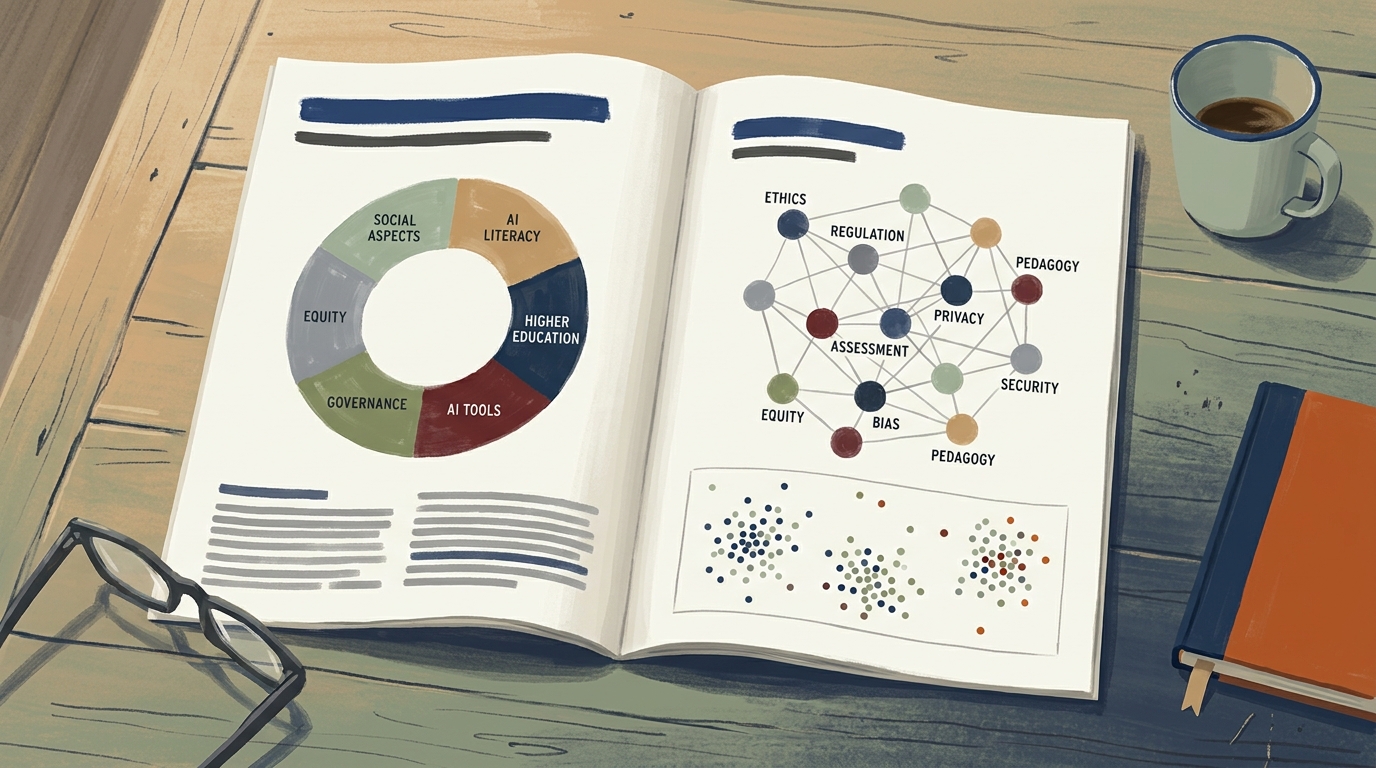
This week in four categories
- Social Aspects of AI — 1361 articles · essay, report, podcast, top articles
- AI Literacy — 1333 articles · essay, report, podcast, top articles
- AI Tools — 1217 articles · essay, report, podcast, top articles
- Higher Education — 2224 articles · essay, report, podcast, top articles
Also this week
- Four audience briefings for Higher Education — general, educators, researchers, leadership: https://ainews.social/#cat-he
- TertulIA — the long-form weekly conversation podcast: https://ainews.social/#tertulia
- Three thinker columns (McLuhan, Toffler, Asimov): https://ainews.social/#thinkers
- Analytical strip (contradictions, stances, frames, themes) and full analysis page: https://ainews.social/#analyses
How this edition was made
6135 candidate sources were evaluated against a nine-criterion inclusion rubric; those that met threshold were read through four reader-serving probes — what is actually being said, what is being sold or obscured, who benefits, what it means for society / literacy / the tools / the institution — and synthesized into this week's editorial material.
Full methodology · This week's analyses · Previous editions
AI News Social is a weekly bilingual publication about artificial intelligence across four distinct lenses — society, literacy, tools, and higher education. Each edition leads with The Longer View column and the TertulIA conversation podcast, accompanied by four category reports, four audience briefings, and a full analytical surface. Orchestrated by Dr. Diego Bonilla at Sacramento State. You're receiving this because you subscribed at ainews.social — unsubscribe anytime using the link below.